

Archive position — measured, not model output
0 likes on Devpost
2,263 of the 7,850 archived projects have more likes, and 5,587 share exactly 0 — so this project's #5,186 place in the like-ranked listing is a tie-break inside that group, not a ranking.
Projects (log scale)
Likes on Devpost. ▲ marks this project's group.
Show the figures
| Likes | Projects | Share of archive |
|---|---|---|
| 0 | 5,587 | 71.2% |
| 1 | 1,758 | 22.4% |
| 2 | 284 | 3.6% |
| 3–4 | 132 | 1.7% |
| 5–9 | 75 | 1.0% |
| 10+ | 14 | 0.2% |
 User Stories BotA demo video on every pull request
Get a demo video on every new feature
GitHub App that watches your pull requests and records a narrated, captioned demo.
Save time on demo prep and make informed decisions faster with a video walkthrough of every new feature.
Executive Summary
What the company appears to be
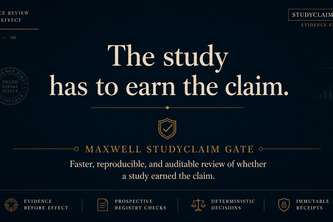
Maxwell StudyClaim Gate is a self-reported tool that evaluates scientific claims against medical studies using two independent axes: (1) whether the claim is supported by the study’s content and (2) whether the study's reported primary outcome aligns with its prospectively registered history. It uses GPT-5.6 for reading and extracting information, and deterministic Python code to make decisions, aiming to catch outcome switches in registry data that are invisible in standard claim-checking.
What changed
The project is described as a prototype built for the OpenAI 2026 hackathon. It includes a working two-axis system with 107 tests passing from a clean clone, and it demonstrates a real-world case of outcome switching in a published trial (NCT01401283). The author states that the tool enforces architectural invariants to ensure decisions are not made unilaterally by the model.
The single most important open question
Is the system’s architecture robust enough to scale beyond a single replayed case, or does it rely on manual curation and verification for broader application?
What The Product Actually Is
The description states that Maxwell StudyClaim Gate is a two-axis verification tool for scientific claims. It evaluates:
- Axis 1: Whether the claim is supported by the study’s content (e.g., endpoint, design-appropriate language, population, timeframe, comparator, outcome status, result direction).
- Axis 2: Whether the study's reported primary outcome matches its registered history, including registry version diffs.
It uses GPT-5.6 for reading and extracting unstructured text, and Codex-generated Python code to enforce deterministic rules and make decisions. The system is designed to separate model-based reading from decision-making, with a tamper-evident SHA-256 receipt binding each decision.
Evidence The author describes the tool as built with OpenAI Codex and GPT-5.6, and states that it includes 107 tests passing from a clean clone.
Inference The system is structured to avoid model-based unilateral assessments by using deterministic logic for rule enforcement.
Positioning & Claim Evolution
The author positions Maxwell StudyClaim Gate as a tool to speed up, improve reproducibility, and increase auditability of scientific claim verification, particularly in medical research. It is described as addressing a gap in current practices where outcome switches in registry data are not caught by standard checks.
It claims to solve a specific failure mode: registry primary/secondary outcome switching that occurs after publication but before the final registry version is updated, which can be invisible when comparing only against the latest registry version.
The tool is positioned as a verification layer, not a replacement for human judgment. It does not allege intent or make claims about the validity of the study itself — it simply states facts and routes unresolved concerns to methodologist review.
Evidence The author cites specific studies (Chan et al., Holst et al., Boutron et al.) to support the prevalence of outcome discrepancies, and references a real case (NCT01401283) where registry outcome roles were switched.
Inference The tool is built around a specific, non-obvious failure mode in scientific publishing — not a general-purpose claim-checker or fact-checking engine.
Target Customer & ICP
The description states that the tool is aimed at medical editors, research-integrity teams, scientific communicators, and regulatory and compliance reviewers who manually verify scientific claims today.
It is described as targeting users who need to verify that a claim earned its evidence, especially in cases where outcome switching may have occurred.
Evidence The author explicitly names these user groups and describes their current manual, slow, and inconsistent verification process.
Inference The tool is not intended for general public use or for automated scientific publishing workflows — it is a specialized verification tool for experts in research integrity.
Business Model & Pricing Evidence
Not evidenced.
The description does not contain any information about pricing, monetization, or business model. It is unclear whether the tool is intended to be sold, licensed, or offered as an open-source prototype.
Technical & Delivery Signals
- The system uses GPT-5.6 for reading and extracting unstructured text.
- Codex-generated Python code handles deterministic decision-making, including schema building, rule functions, registry version diffing, aggregation, and receipt binding.
- It enforces a two-axis separation to avoid conflating claim vs. study with study vs. registry.
- The system includes a tamper-evident SHA-256 receipt, where any change in bound facts invalidates verification.
- It has 107 tests passing from a clean clone, and the architecture is designed around four invariants:
- No-source-no-clearance
- Veto-only
- Two-axis independence
- Release-gating
Evidence The author describes the technical stack, logic, and testing framework.
Inference The tool is built with a deliberate separation of model-based reading and deterministic decision-making, which supports its stated goal of auditability and reproducibility.
Traction & Maturity Signals
Not evidenced.
There is no mention of revenue, customers, usage metrics, or adoption. The project is described as a hackathon submission and prototype, not a product in active use.
Competitive Context
Not evidenced.
The description does not mention any competitors or existing tools in the space of scientific claim verification or registry outcome tracking.
Open Questions & Risks
- Prototype vs. scalable tool: The system is described as a hackathon prototype with 107 tests, but there is no evidence it has been scaled beyond a single replayed case.
- Dependency on curated data: The evaluation corpus was built using specific, verified identifiers and constraints — this raises questions about how easily the system can be applied to arbitrary studies.
- Limited scope of registry coverage: The tool is described as focusing on a specific failure mode (outcome switching) and not addressing broader claim-checking issues.
- No commercial or user feedback: There is no evidence of real-world usage, feedback, or iteration beyond the prototype.
Questions the description leaves open
- What are the limitations of applying this system to arbitrary studies beyond the single replayed case?
- How does the tool handle edge cases where registry data is incomplete or inconsistent?
- Is there a plan to expand beyond the current focus on outcome switching to broader claim-checking?
- What is the expected path from prototype to production use, and what are the key technical hurdles?
- Are there any known issues with model confidence bleeding into assessments despite the architecture design?
Overall Assessment
Not evidenced.
There is no information on funding, valuation, or investment interest. The project is described as a hackathon submission with no indication of commercial traction or strategic interest from investors or partners.
User Stories BotA demo video on every pull request
Get a demo video on every new feature
GitHub App that watches your pull requests and records a narrated, captioned demo.
Save time on demo prep and make informed decisions faster with a video walkthrough of every new feature.
Source
Submitted to the OpenAI 2026 hackathon on Devpost. Project home on Devpost. Back to the full gallery on Devpost.
This competitive analysis was produced by top-founders.com (opens in a new tab)
Generated by a language model from this project's public Devpost page — its tagline, the author's own write-up and any built-with tags listed there — as captured in August 2026. Short quotations are the author's words. It is an opinion on the idea as a business, not on the people behind it, and it reflects the description as published then. If the project has moved on, request a correction below. The analysis is not independent research and contains no verified traction, revenue or customer data.
An independent guide by KFG International LLC — not affiliated with, endorsed by, or connected to Devpost or OpenAI.