

Archive position — measured, not model output
0 likes on Devpost
2,263 of the 7,850 archived projects have more likes, and 5,587 share exactly 0 — so this project's #3,223 place in the like-ranked listing is a tie-break inside that group, not a ranking.
Projects (log scale)
Likes on Devpost. ▲ marks this project's group.
Show the figures
| Likes | Projects | Share of archive |
|---|---|---|
| 0 | 5,587 | 71.2% |
| 1 | 1,758 | 22.4% |
| 2 | 284 | 3.6% |
| 3–4 | 132 | 1.7% |
| 5–9 | 75 | 1.0% |
| 10+ | 14 | 0.2% |
 User Stories BotA demo video on every pull request
Get a demo video on every new feature
GitHub App that watches your pull requests and records a narrated, captioned demo.
Save time on demo prep and make informed decisions faster with a video walkthrough of every new feature.
Executive Summary
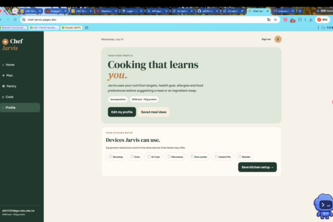
What the company appears to be: Chef Jarvis is a web-based AI cooking companion built as a personal project by one developer (Chia Yu Liang). The product claims to generate personalized meal plans and cooking workflows based on user profiles including body data, nutrition targets, allergies, dislikes, and kitchen equipment. It uses AI to suggest recipes, substitutions, and guide users through cooking with parallel timers and spoken instructions.
What changed: The project was submitted as a hackathon entry (OpenAI 2026) and describes itself as a full-stack deployed web application with authentication, database, edge functions, and integration with external APIs like Google Gemini and USDA FoodData Central. It includes features such as Chef Mode for guided cooking, smart grocery lists, and nutrition tracking.
Single most important open question: Is there any evidence of user adoption, revenue, or traction beyond the author's own description? The project is described as a personal project with no external validation or customer data.
What The Product Actually Is
The description states that Chef Jarvis is:
- A web-based AI cooking companion
- Built as a personal project by one developer (Chia Yu Liang)
- A full-stack deployed application with:
- Static web client (Cloudflare Pages, vanilla JS)
- Supabase for auth and database
- Edge Functions (Deno) for AI processing
- Integration with Google Gemini and USDA FoodData Central
- Features include:
- Personal food profile onboarding
- AI meal plan generation using Gemini
- Personalized healthy swaps based on user goals
- Smart grocery checklist
- USDA-verified nutrition data
- Chef Mode with step-by-step guided cooking, spoken instructions, and parallel timers
- Equipment adaptations for available kitchen tools
The product is described as a "deliberately dependency-light static client" with AI work pushed to the edge.
Evidence: Self-reported by the author. No independent verification or external data provided.
Positioning & Claim Evolution
The description states that Chef Jarvis:
- Flips traditional recipe apps by starting with the person, not the dish
- Claims to turn one sentence like "high-protein Kung Pao chicken for two" into a complete cooking workflow
- Positions itself as a personalized AI cooking companion
- Emphasizes hands-free guided cooking with parallel timers and spoken instructions
- Focuses on personalization through user profiles including body data, macro targets, allergies, dietary needs, dislikes, and kitchen equipment
The author describes the product as evolving from a simple idea into a full-stack application with security features and graceful degradation strategies.
Evidence: Self-reported claims about positioning and evolution. No external validation or market positioning data provided.
Target Customer & ICP
The description states that Chef Jarvis targets:
- Users who want personalized meal planning based on their body data, nutrition goals, allergies, dislikes, and kitchen equipment
- People looking for hands-free guided cooking with parallel timers
- Individuals interested in nutrition tracking and grocery list generation
It is implied that the target user is someone who cooks regularly and values personalization and convenience.
Evidence: Self-reported positioning. No specific customer segments or personas defined beyond general use cases.
Business Model & Pricing Evidence
The description does not provide any information about:
- Revenue model
- Pricing structure
- Monetization strategy
- Customer acquisition costs
- Any commercial arrangements
It only describes the technical implementation and features of the product.
Evidence: Not evidenced. No business model or pricing data provided.
Technical & Delivery Signals
The description states that Chef Jarvis was built with:
- Cloudflare Pages (static web client, vanilla JS)
- Supabase for auth and database
- Edge Functions (Deno) for AI work
- Integration with Google Gemini and USDA FoodData Central
- Security model including JWT-verified edge functions, server-side secrets only, and Row Level Security (RLS)
- Personalization math using Mifflin–St Jeor equation for BMR calculation
- Defensive parsing of LLM outputs to handle markdown fences, truncation, or schema drift
- Graceful degradation strategies including fallback models and non-AI plans
- UI rendering with XSS protection via escaping helpers
The author notes challenges around:
- LLM output handling
- Safe rendering of untrusted content
- Concurrent timer implementation
- Platform migration from Netlify to Cloudflare
Evidence: Self-reported technical details. No external validation or performance metrics.
Traction & Maturity Signals
The description does not provide any evidence of:
- User adoption or customer base
- Revenue or monetization
- Customer feedback or usage data
- Product maturity beyond the hackathon submission
- Any traction indicators such as downloads, signups, or engagement metrics
It only describes the project as a personal effort and a hackathon submission.
Evidence: Not evidenced. No traction or maturity data provided.
Competitive Context
The description does not provide any information about:
- Competitors in the market
- Market size or competitive landscape
- Differentiation from existing solutions
- Industry positioning or market trends
It only describes the author's own product and its features.
Evidence: Not evidenced. No competitive context provided.
Open Questions & Risks
Inferences based on self-reported information:
- The project is described as a personal effort by one developer, which suggests limited scalability or team capacity
- No evidence of revenue, customers, or traction beyond the author's own account
- The product is presented as a hackathon submission, implying it may not be fully mature for commercial use
- Heavy reliance on AI with fallback mechanisms indicates potential instability in core functionality
- Lack of any business model or pricing information raises questions about monetization strategy
Inference: The project appears to be a prototype or personal endeavor rather than a commercial product with traction.
Questions the description leaves open
- What is the actual user base or adoption rate beyond the author's own use?
- Are there any plans for monetization or revenue generation?
- How does the team plan to scale beyond one developer?
- What are the technical limitations of the current AI integration and how are they being addressed?
- Is there any feedback from users or early adopters?
- What is the roadmap for product development beyond the current features?
- Are there any partnerships or integrations planned with nutrition or grocery platforms?
Note: These questions are based on the self-reported description and do not reflect verified data.
Overall Assessment
The description states that Chef Jarvis is a personal project built by one developer as part of a hackathon submission. There is no evidence of:
- Revenue
- Customers
- Traction
- Commercial viability
- Business model or pricing structure
The product is described as a full-stack web application with security features and AI integration, but lacks any indication of market validation or commercial success.
Assessment: The project appears to be a prototype or personal endeavor without demonstrated traction or commercial potential. Further due diligence would require evidence of user adoption, revenue, or customer engagement beyond the author's own account.
Confidence Level: Low — based entirely on self-reported information with no external validation or data points.
User Stories BotA demo video on every pull request
Get a demo video on every new feature
GitHub App that watches your pull requests and records a narrated, captioned demo.
Save time on demo prep and make informed decisions faster with a video walkthrough of every new feature.
Source
Submitted to the OpenAI 2026 hackathon on Devpost. Project home on Devpost. Back to the full gallery on Devpost.
This competitive analysis was produced by top-founders.com (opens in a new tab)
Generated by a language model from this project's public Devpost page — its tagline, the author's own write-up and any built-with tags listed there — as captured in August 2026. Short quotations are the author's words. It is an opinion on the idea as a business, not on the people behind it, and it reflects the description as published then. If the project has moved on, request a correction below. The analysis is not independent research and contains no verified traction, revenue or customer data.
An independent guide by KFG International LLC — not affiliated with, endorsed by, or connected to Devpost or OpenAI.