

Archive position — measured, not model output
0 likes on Devpost
2,263 of the 7,850 archived projects have more likes, and 5,587 share exactly 0 — so this project's #3,225 place in the like-ranked listing is a tie-break inside that group, not a ranking.
Projects (log scale)
Likes on Devpost. ▲ marks this project's group.
Show the figures
| Likes | Projects | Share of archive |
|---|---|---|
| 0 | 5,587 | 71.2% |
| 1 | 1,758 | 22.4% |
| 2 | 284 | 3.6% |
| 3–4 | 132 | 1.7% |
| 5–9 | 75 | 1.0% |
| 10+ | 14 | 0.2% |
 User Stories BotA demo video on every pull request
Get a demo video on every new feature
GitHub App that watches your pull requests and records a narrated, captioned demo.
Save time on demo prep and make informed decisions faster with a video walkthrough of every new feature.
Executive Summary
What the company appears to be
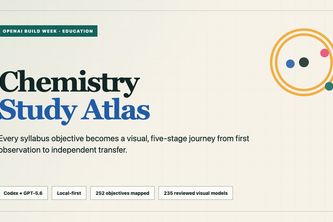
Chemistry Study Atlas is a self-developed, local-first educational tool for secondary-school chemistry. The author describes it as an objective-by-objective visual learning journey that maps a complete syllabus into 252 content statements, with 235 reviewed visual models. It uses React, TypeScript, and browser-local storage, and does not require cloud storage or accounts.
What changed
During the OpenAI hackathon Build Week, the author added 220 new reviewed models to an existing prototype, bringing the total to 235. The app now includes a five-stage learning journey (learn, explain, reason, question, transfer) and supports local progress tracking, weak-point recovery, and JSON backup.
The single most important open question
Is there evidence of real-world usage or feedback from students or teachers beyond the author’s own testing and review process?
Note
This analysis is based entirely on the self-reported description provided by the author. No independent verification, revenue data, customer base, or traction metrics are available.
What The Product Actually Is
The description states that Chemistry Study Atlas is a visual-first educational tool for secondary-school chemistry. It maps a complete syllabus into:
- 12 topics
- 49 subtopics
- 252 content statements
Of these, 235 have been reviewed and include objective-specific visual models, while the remaining 17 are marked as queued.
Each objective follows a five-stage learning journey:
- Learn through a semantic visual model
- Follow a worked explanation
- Complete guided reasoning
- Answer an unseen independent question
- Finish with a transfer check
It also includes:
- A practical-evidence lab
- Local progress and drafts
- Weak-point review
- Mission resume
- JSON backup
The app is built using:
- React, TypeScript, Vite, Zod, Vitest, Playwright
- Browser local storage (no cloud or account required)
Inference The product is a deterministic, offline-first learning environment designed for individual use. It does not appear to include any real-time collaboration or shared progress features.
Positioning & Claim Evolution
The author positions Chemistry Study Atlas as:
- A visual-first chemistry study aid
- An alternative to traditional text-heavy syllabi
- A tool that avoids ungrounded AI explanations in favor of verified visuals and structured learning
Key claims from the description:
- It maps a full secondary-school chemistry syllabus into objective-by-objective visual models.
- The experience is private, dependable, and not reliant on unpredictable chatbots.
- Visual models are reviewed for scientific accuracy and include explicit limitations.
Inference The positioning evolved from a personal project (to help a 14-year-old) to a structured educational tool with a clear pedagogical framework. The use of AI tools like GPT-5.6 and Codex was used to support development, not as part of the runtime experience.
Target Customer & ICP
The description states that the tool is intended for:
- Secondary-school students (specifically 14-year-olds)
- Students needing more than text-based syllabi
- Learners who want to understand why something happens, not just what happens
It also mentions:
- The app supports weak-point recovery
- It includes a practical-evidence lab
- It is designed for independent learning
Inference The ICP appears to be self-directed secondary-school students (ages 12–18) who are looking for structured, visual, and scientifically accurate chemistry study materials. No evidence of teacher or institutional adoption is provided.
Business Model & Pricing Evidence
The description does not state:
- Any pricing model
- Revenue streams
- Monetization strategy
- Subscription plans or paid features
It does state that the app:
- Uses local storage only
- Does not require an account or cloud storage
- Is unofficial and independent
Inference There is no evidence of a commercial business model. The tool appears to be a personal or prototype project with no stated monetization.
Technical & Delivery Signals
The app is built using:
- React, TypeScript, Vite, Zod, Vitest, Playwright
- Browser local storage (no backend or cloud)
- Typed visual contracts for scientific diagrams
- Unit and browser tests (including responsive and accessibility checks)
Key technical features:
- Deterministic learner experience
- No generic fallback visuals
- Visual models include defined claims, reading steps, accessible text, and explicit model limitations
- Review agents found issues like incorrect bond topology or misleading titration colour
Inference The tool is built with engineering rigor, especially around visual accuracy. It uses AI tools for development but not as part of the learner experience.
Traction & Maturity Signals
The description states:
- 252 curriculum statements mapped
- 235 reviewed objective-specific visual models
- 220 new models added during Build Week
- 287 unit and content checks
- 98 desktop and 98 phone browser regressions
- 34 browser-test suites
It also notes:
- The project existed as a prototype before the hackathon
- It was extended during Build Week with significant additions
Inference There is no evidence of real-world usage or adoption beyond the author’s own testing and review process. No customer feedback, usage data, or retention metrics are provided.
Competitive Context
The description does not mention:
- Competitors
- Market positioning relative to other chemistry tools
- Existing platforms for secondary-school chemistry education
Inference The competitive context is unknown. The tool appears to be a standalone prototype with no known market presence or comparison to existing products.
Open Questions & Risks
Key risks and open questions:
- No real-world usage or feedback — the app has not been tested by students or teachers beyond the author’s own process.
- Single-person development team — only one developer (Jason Long) is listed.
- No monetization strategy — no evidence of a business model or revenue plan.
- Unverified scientific accuracy — while models are reviewed, there is no independent validation or third-party verification.
- Limited scalability — the app is local-first and not designed for shared or institutional use.
Inference The tool is in an early prototype phase with no evidence of traction or commercial viability.
Questions the description leaves open
- What feedback have you received from students or teachers who used this tool?
- How do you plan to validate the scientific accuracy of visual models beyond your own review process?
- Have you considered how this would scale for multiple users or institutions?
- Are there any plans to monetize or commercialize the product?
- What is the long-term vision for content updates and curriculum alignment?
Overall Assessment
Not evidenced.
There is no evidence of:
- Revenue
- Customers
- Traction
- Market validation
- Commercial strategy
The tool is described as a personal prototype with no known commercial or institutional adoption.
Inference At this stage, the project appears to be an early-stage educational experiment, not a viable investment or partnership opportunity. It lacks any demonstrated market need, user base, or monetization path.
User Stories BotA demo video on every pull request
Get a demo video on every new feature
GitHub App that watches your pull requests and records a narrated, captioned demo.
Save time on demo prep and make informed decisions faster with a video walkthrough of every new feature.
Source
Submitted to the OpenAI 2026 hackathon on Devpost. Project home on Devpost. Back to the full gallery on Devpost.
This competitive analysis was produced by top-founders.com (opens in a new tab)
Generated by a language model from this project's public Devpost page — its tagline, the author's own write-up and any built-with tags listed there — as captured in August 2026. Short quotations are the author's words. It is an opinion on the idea as a business, not on the people behind it, and it reflects the description as published then. If the project has moved on, request a correction below. The analysis is not independent research and contains no verified traction, revenue or customer data.
An independent guide by KFG International LLC — not affiliated with, endorsed by, or connected to Devpost or OpenAI.