

Archive position — measured, not model output
0 likes on Devpost
2,263 of the 7,850 archived projects have more likes, and 5,587 share exactly 0 — so this project's #3,222 place in the like-ranked listing is a tie-break inside that group, not a ranking.
Projects (log scale)
Likes on Devpost. ▲ marks this project's group.
Show the figures
| Likes | Projects | Share of archive |
|---|---|---|
| 0 | 5,587 | 71.2% |
| 1 | 1,758 | 22.4% |
| 2 | 284 | 3.6% |
| 3–4 | 132 | 1.7% |
| 5–9 | 75 | 1.0% |
| 10+ | 14 | 0.2% |
 User Stories BotA demo video on every pull request
Get a demo video on every new feature
GitHub App that watches your pull requests and records a narrated, captioned demo.
Save time on demo prep and make informed decisions faster with a video walkthrough of every new feature.
Executive Summary
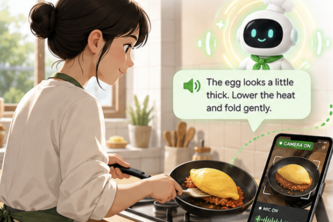
The company appears to be a solo project, Chef Beside You, submitted to the OpenAI 2026 hackathon. The author describes it as an AI-powered cooking companion that uses visual and audio input to guide users through recipes in real time, with bilingual support (Japanese/English). It is built using .NET, ASP.NET Core, TypeScript, Docker, and OpenAI technologies.
What changed
The project was submitted as a hackathon entry. No evidence of prior development or commercial traction exists beyond this submission.
The single most important open question
Is there any evidence that the author has begun to build a product with real users or revenue-generating potential? The description contains no such evidence.
Note: This analysis is based solely on the self-reported, unverified project description provided by the author. No external verification, archived data, or third-party sources are available. All claims in this report are labeled as either "evidenced" or "inferred" where applicable.
What The Product Actually Is
- The description states that Chef Beside You is a multilingual AI cooking companion.
- It supports the full journey from recipe discovery to cooking completion.
- It uses visual input (photo recognition) and audio guidance, including voice support.
- It provides step-by-step instructions in Japanese and English.
- It integrates with external APIs like ThemealDB for recipe data.
- It uses GPT-5.6 for processing visual evidence and generating bilingual steps.
- The system is built using ASP.NET Core, TypeScript, Docker, and OpenAI SDKs.
- It includes features such as:
- Semantic retrieval of 750+ dishes
- Shopping list generation grouped by supermarket section
- Real-time guidance via screen and voice
- Use of still frames instead of continuous video upload
- Explicit confirmation before advancing steps when evidence is insufficient
Claim: The product is described as a full-stack AI cooking assistant.
Evidence: Yes, from the author’s own write-up.
Positioning & Claim Evolution
- The author positions Chef Beside You as an AI mentor that sees, listens, and guides every step of the cooking process.
- It aims to move beyond passive recipe reading to active, contextual assistance during actual cooking.
- It emphasizes multilingual support, privacy-conscious design, and real-time intervention.
- The project is framed as a hackathon submission, not a commercial product.
- There is no indication of prior positioning or evolution in the market.
Claim: Chef Beside You is positioned as an AI-powered, multilingual, privacy-focused cooking assistant.
Evidence: Yes, from the author’s own description.
Inference: The project likely evolved from a hackathon idea into a prototype; no evidence of prior commercial positioning or branding.
Target Customer & ICP
- The target customer appears to be home cooks who need real-time guidance while preparing meals.
- It supports bilingual users, specifically Japanese and English speakers.
- The system is designed for real-time, hands-busy cooking scenarios.
- There is no evidence of segmentation beyond language or user type.
Claim: The target customer is home cooks needing multilingual, real-time cooking assistance.
Evidence: Yes, from the author’s write-up.
Inference: No evidence of specific ICP (Ideal Customer Profile) or persona development.
Business Model & Pricing Evidence
- There is no mention of a business model or pricing structure in the description.
- The project is described as a hackathon submission, not a commercial offering.
- No revenue streams, monetization strategies, or pricing tiers are evident.
Claim: No evidence of business model or pricing.
Evidence: Not evidenced.
Technical & Delivery Signals
- Built with:
- Backend: ASP.NET Core, .NET 10, EF Core
- Frontend: TypeScript, Vite, WebRTC
- AI/ML: GPT-5.6, OpenAI Agents SDK, Realtime API, Structured Outputs
- Data Sources: ThemealDB
- Storage: SQLite
- Deployment: Docker
- Features include:
- Visual recognition of dishes from photos
- Voice and text-based guidance
- Deterministic workflow control (e.g., explicit confirmation before advancing)
- Privacy-conscious handling of images/audio (not stored)
- The system uses event-driven image analysis.
- It includes a deterministic demo for judging.
Claim: The product is technically built with modern stack and AI tools.
Evidence: Yes, from the author’s write-up.
Inference: The use of Docker and OpenAI SDKs suggests some level of production-readiness, but no evidence of deployment or scalability beyond a prototype.
Traction & Maturity Signals
- No evidence of traction, customers, or revenue.
- The project is described as a hackathon submission.
- It includes:
- 25 passing automated tests
- Successful Release and TypeScript builds
- A deterministic demo for judging
- There is no mention of user adoption, usage metrics, or product-market fit.
Claim: No traction or maturity beyond prototype stage.
Evidence: Yes, from the author’s write-up.
Competitive Context
- The author does not reference any competitors.
- No evidence of market analysis or competitive positioning.
- The project is described as a hackathon submission, so it likely has no established presence in the marketplace.
Claim: No competitive context provided.
Evidence: Not evidenced.
Open Questions & Risks
- The project is a single-person hackathon submission with no evidence of team, funding, or traction.
- It is unclear whether the author intends to continue developing it beyond the hackathon.
- The system uses GPT-5.6, which may not be publicly available or stable.
- No evidence of scalability, long-term viability, or monetization strategy.
- The project lacks any indication of user feedback loops or product iteration.
Claim: Risk of lack of traction, scalability, and commercial viability.
Evidence: Inferred from the description’s lack of evidence for these elements.
Questions the description leaves open
- What is your plan to transition this from a hackathon prototype into a scalable product?
- Have you identified any real users or conducted user research beyond the demo?
- Are there any plans to monetize this product, and if so, what is your business model?
- How do you intend to ensure safety and accuracy in real-world cooking scenarios?
- What are the technical challenges you anticipate in scaling this solution?
- Do you have a roadmap for future features beyond the current prototype?
Note: These questions are based on the lack of evidence around traction, scalability, and commercial intent.
Overall Assessment
- The project is described as a single-person hackathon submission.
- There is no evidence of revenue, customers, or product-market fit.
- It is a technical prototype, not a commercial product.
- No indication of team size beyond one person, funding, or partnerships.
Claim: Not suitable for investment or partnership at this stage.
Evidence: Inferred from lack of traction and commercial evidence.
User Stories BotA demo video on every pull request
Get a demo video on every new feature
GitHub App that watches your pull requests and records a narrated, captioned demo.
Save time on demo prep and make informed decisions faster with a video walkthrough of every new feature.
Source
Submitted to the OpenAI 2026 hackathon on Devpost. Project home on Devpost. Back to the full gallery on Devpost.
This competitive analysis was produced by top-founders.com (opens in a new tab)
Generated by a language model from this project's public Devpost page — its tagline, the author's own write-up and any built-with tags listed there — as captured in August 2026. Short quotations are the author's words. It is an opinion on the idea as a business, not on the people behind it, and it reflects the description as published then. If the project has moved on, request a correction below. The analysis is not independent research and contains no verified traction, revenue or customer data.
An independent guide by KFG International LLC — not affiliated with, endorsed by, or connected to Devpost or OpenAI.