

Archive position — measured, not model output
0 likes on Devpost
2,263 of the 7,850 archived projects have more likes, and 5,587 share exactly 0 — so this project's #7,148 place in the like-ranked listing is a tie-break inside that group, not a ranking.
Projects (log scale)
Likes on Devpost. ▲ marks this project's group.
Show the figures
| Likes | Projects | Share of archive |
|---|---|---|
| 0 | 5,587 | 71.2% |
| 1 | 1,758 | 22.4% |
| 2 | 284 | 3.6% |
| 3–4 | 132 | 1.7% |
| 5–9 | 75 | 1.0% |
| 10+ | 14 | 0.2% |
 User Stories BotA demo video on every pull request
Get a demo video on every new feature
GitHub App that watches your pull requests and records a narrated, captioned demo.
Save time on demo prep and make informed decisions faster with a video walkthrough of every new feature.
Executive Summary
What the company appears to be
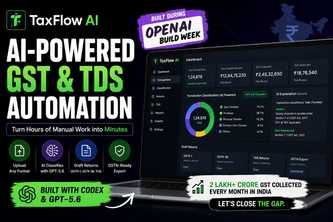
TaxFlow AI is an AI-powered tax compliance platform built during OpenAI Build Week to simplify GST and TDS management for Indian businesses. The description states it is a browser-based, zero-config, intelligent compliance companion that ingests raw financial files (PDFs, Excel, CSV), processes them using deterministic statutory rules, and auto-drafts government-compatible offline upload payloads.
What changed
The project was developed as part of a hackathon submission. It is self-reported as a functional prototype with technical capabilities for processing unstructured financial data and applying Indian tax laws in a local-first architecture.
Single most important open question — the commercial due-diligence read
Is there any evidence that this product has been adopted or used by real businesses, or that it has moved beyond a proof-of-concept stage?
What The Product Actually Is
The description states that TaxFlow AI is an AI-powered tax compliance platform designed to automate GST and TDS management for Indian MSMEs. It functions as:
- A browser-based tool (local-first architecture)
- An ingestion engine capable of parsing multi-format documents:
- PDFs using
pdfjs-dist - Excel/CSV files via
SheetJS
- PDFs using
- A tax math engine applying statutory Indian GST/TDS rules
- A draft return generator, producing JSON or CSV exports compatible with GSTN portal
It is described as a zero-config, intelligent compliance companion for business owners and Chartered Accountants (CAs).
The description states: “TaxFlow AI acts as a zero-config, intelligent compliance companion for business owners and Chartered Accountants (CAs).”
Positioning & Claim Evolution
The project positions itself as a solution to the compliance burden faced by Indian MSMEs, particularly those dealing with unstructured financial data from UPI payments, scanned OCR invoices, and multi-sheet bank ledgers.
It claims to bridge a gap between existing tools that require structured input and real-world business operations which are often unstructured.
The description states: “We built TaxFlow AI to bridge this gap — an autonomous, browser-based regulatory agent that ingests raw financial files of any format…”
The positioning evolves from a technical hackathon prototype into a potential B2B SaaS or tooling product, though no evidence of commercial traction is provided.
The description states: “TaxFlow AI is built during OpenAI Build Week to simplify GST and TDS management for Indian businesses.”
Target Customer & ICP
The project targets:
- Indian MSMEs (Micro, Small, and Medium Enterprises)
- Business owners and Chartered Accountants (CAs) who manage tax compliance manually
- Users operating on unstructured transaction narratives, missing GSTINs, and high-volume peer-to-peer (P2P) transfers
The description states: “India's vast economy, over 63 million Micro, Small, and Medium Enterprises (MSMEs) form the financial backbone of the nation.”
No evidence is provided about specific customer segments beyond this general category.
Business Model & Pricing Evidence
There is no evidence in the description regarding:
- Revenue model
- Pricing structure
- Monetization strategy
- Customer acquisition plans
The description states: “No revenue, customer or traction data is available beyond what they state.”
Technical & Delivery Signals
The project is built using modern web technologies:
- Frontend: React 19 + TypeScript 6 + Vite 8
- Styling: Modular Vanilla CSS with custom variables and glassmorphism design tokens
- PDF Parsing: Mozilla pdfjs-dist text stream parser
- Excel/CSV Engine: SheetJS with multi-row cell reconstructor
- UI Components: Header.tsx, IngestionParserView.tsx, TransactionReviewView.tsx, etc.
- Performance Features:
- 100-row pagination to avoid UI freezing
- Sub-second ingestion for large files
The description states: “TaxFlow AI is built using a modern, lightweight web tech stack focused on local-first processing and sub-second performance.”
Traction & Maturity Signals
There is no evidence of:
- Revenue or ARR
- Customers or user base
- Product-market fit
- Adoption metrics
- Product usage data
The description states: “No revenue, customer or traction data is available beyond what they state.”
Competitive Context
The project does not reference any specific competitors. It is described as solving a gap in the market for handling unstructured financial data and applying Indian tax rules.
The description states: “Existing tax tools either over-tax non-commercial personal money transfers or fail when confronted with compressed PDF binary streams and multi-column bank ledgers.”
No evidence of existing solutions or competitive landscape is provided.
Open Questions & Risks
- No commercial traction: The product is presented as a hackathon submission with no evidence of real-world usage.
- Local-first architecture may limit scalability: Processing in-browser could be inefficient for large-scale enterprise use.
- Deterministic rules vs. AI: While the description emphasizes rule-based logic over LLMs, this may not scale well to evolving tax regulations.
- Unverified claims: All features and capabilities are self-reported without independent validation.
The description states: “Everything above is the authors' own account. It is not independently verified…”
Questions the description leaves open
- Has the product been tested with real MSMEs or CAs?
- What is the expected path to monetization?
- Are there any partnerships or integrations planned with GSTN or tax authorities?
- How does the team plan to scale beyond a browser-based prototype?
- What are the legal and compliance risks of operating in the Indian tax space?
- Is there any interest from potential users or customers yet?
Overall Assessment
Not evidenced.
There is no evidence that this project has achieved product-market fit, customer traction, or commercial viability beyond a hackathon prototype.
The description states: “No revenue, customer or traction data is available beyond what they state.”
The team size is small (3 members), and the product is described as a technical proof-of-concept. Without evidence of adoption, monetization, or scalability, this project does not appear to be ready for investment or partnership at this stage.
User Stories BotA demo video on every pull request
Get a demo video on every new feature
GitHub App that watches your pull requests and records a narrated, captioned demo.
Save time on demo prep and make informed decisions faster with a video walkthrough of every new feature.
Source
Submitted to the OpenAI 2026 hackathon on Devpost. Project home on Devpost. Back to the full gallery on Devpost.
This competitive analysis was produced by top-founders.com (opens in a new tab)
Generated by a language model from this project's public Devpost page — its tagline, the author's own write-up and any built-with tags listed there — as captured in August 2026. Short quotations are the author's words. It is an opinion on the idea as a business, not on the people behind it, and it reflects the description as published then. If the project has moved on, request a correction below. The analysis is not independent research and contains no verified traction, revenue or customer data.
An independent guide by KFG International LLC — not affiliated with, endorsed by, or connected to Devpost or OpenAI.