

Archive position — measured, not model output
1 like on Devpost
505 of the 7,850 archived projects have more likes, and 1,758 share exactly 1 — so this project's #1,258 place in the like-ranked listing is a tie-break inside that group, not a ranking.
Projects (log scale)
Likes on Devpost. ▲ marks this project's group.
Show the figures
| Likes | Projects | Share of archive |
|---|---|---|
| 0 | 5,587 | 71.2% |
| 1 | 1,758 | 22.4% |
| 2 | 284 | 3.6% |
| 3–4 | 132 | 1.7% |
| 5–9 | 75 | 1.0% |
| 10+ | 14 | 0.2% |
 User Stories BotA demo video on every pull request
Get a demo video on every new feature
GitHub App that watches your pull requests and records a narrated, captioned demo.
Save time on demo prep and make informed decisions faster with a video walkthrough of every new feature.
Executive Summary
What the company appears to be
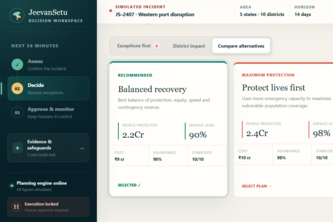
JeevanSetu AI (LifeBridge AI) is a self-reported AI-powered crisis decision workspace designed for teams managing essential supply disruptions. It structures uncertain information into a three-stage workflow: Assess, Decide, and Approve/ Monitor. The system uses GPT-5.6 for constrained information extraction and deterministic code for calculations, with strict validation and human oversight at every step.
What changed
The author states this is a prototype built during an OpenAI hackathon. It is described as a decision-support tool that avoids black-box AI recommendations by exposing assumptions, comparing alternatives, and maintaining human accountability in crisis response.
Single most important open question
Is there evidence of real-world use or traction beyond the author’s own development and testing? The description contains no data on customers, revenue, adoption, or operational deployment.
What The Product Actually Is
The description states that JeevanSetu AI is a human-governed crisis decision-support workspace for simulated essential-supply disruptions. It operates through three stages:
- Assess: Users enter disruption notices (with optional screenshots). GPT-5.6 extracts structured incident data, validated via strict checks.
- Decide: A deterministic engine compares multiple recovery strategies based on criteria like cost, speed, resource utilisation and vulnerability.
- Approve and Monitor: Human decision-makers approve or modify actions; the system records decisions and allows export of simulated briefs.
The tool is described as a decision-support prototype, not an autonomous system. The author notes that AI handles information extraction but deterministic code performs calculations and planning.
Evidence
- The product uses GPT-5.6 for constrained information extraction.
- Deterministic TypeScript modules perform risk, allocation and feasibility calculations.
- Strict validation (via Zod) ensures AI outputs are checked before acceptance.
- Human approval is a core workflow boundary, not just a confirmation step.
Inference The system is designed to avoid AI autocracy in high-stakes environments by separating reasoning from execution.
Positioning & Claim Evolution
The author positions JeevanSetu AI as a decision-support tool, not an autonomous crisis manager. It is framed as a bridge between fragmented signals and responsible action during disruptions.
Key claims:
- “Can AI help teams respond faster without taking accountability away from humans?”
- “AI structures uncertainty. Deterministic code performs the calculations. Humans remain accountable.”
- “The most important accomplishment is not that the application produces a recommendation. It is that it makes the reasoning visible and challengeable.”
Evidence
- The tagline: “AI-powered crisis decision workspace that helps teams assess disruptions, compare response plans, approve actions, and monitor execution with human oversight.”
- The author’s own write-up emphasizes transparency, assumption exposure, and human control.
- The system is described as a prototype, not a production-grade solution.
Inference The positioning reflects an intent to build a tool that supports rather than replaces human judgment in crisis management. This is a shift from purely AI-driven solutions.
Target Customer & ICP
The description states the product targets teams managing essential supply disruptions, such as during natural disasters or logistics failures.
It is designed for crisis response teams who must:
- Assess fragmented information;
- Compare multiple recovery plans;
- Make accountable decisions under time pressure.
Evidence
- The inspiration comes from supply-chain planning and control-tower design.
- The tool addresses “essential supplies stop moving” and “time becomes the scarcest resource.”
- It is built for “teams” rather than individual users.
Inference The ICP likely includes logistics, emergency response, or public sector teams managing critical infrastructure or supply chains during disruptions.
Business Model & Pricing Evidence
Not evidenced.
The description does not mention any pricing model, monetisation strategy, or business model. It is described as a prototype built for a hackathon.
Technical & Delivery Signals
The author reports building the system using:
- GPT-5.6 and OpenAI API
- Codex (as an engineering collaborator)
- Next.js, React, TypeScript
- Zod for validation
- Vitest and Playwright for testing
- Vercel for deployment
Evidence
- The system is built with modern web stack.
- Uses deterministic modules for calculations.
- Includes synthetic fallback when AI intake fails.
- Codex was used throughout the engineering lifecycle.
Inference The tool is a full-stack prototype, likely intended to be deployed in production but currently remains a proof-of-concept.
Traction & Maturity Signals
Not evidenced.
There is no mention of:
- Customers
- Revenue
- Usage metrics
- Product adoption
- Deployment beyond the author’s own environment
The system is described as a publicly accessible prototype, not a commercial product in use.
Competitive Context
Not evidenced.
No competitors or market positioning are mentioned. The description does not reference existing tools for crisis response, decision support or supply chain management.
Open Questions & Risks
- Prototype-only status: The system is described as a hackathon prototype with no evidence of real-world deployment.
- No traction or customers: No data on adoption, usage or revenue.
- Single-person team: The team size is listed as 1, suggesting limited development capacity.
- Unverified claims: All descriptions are self-reported and unverified.
- Lack of commercial viability signals: No pricing, monetisation or business model described.
Questions the description leaves open
- Has the prototype been tested in any real-world crisis scenarios?
- What is the current status of data integrations? Are there plans to connect with real supply chain systems?
- How does the system handle adversarial inputs or edge-case disruptions?
- What are the plans for scaling beyond a single-user, single-use model?
- Is there any intention to commercialise this product, and if so, what is the business model?
Overall Assessment
Not evidenced.
There is no evidence of:
- Revenue or financials
- Customer base or adoption
- Product-market fit
- Commercial traction
The description is entirely self-reported and unverified. It describes a prototype built for a hackathon, not a product in the market.
Confidence level Low. The project shows potential but lacks any evidence of commercial viability or real-world use.
User Stories BotA demo video on every pull request
Get a demo video on every new feature
GitHub App that watches your pull requests and records a narrated, captioned demo.
Save time on demo prep and make informed decisions faster with a video walkthrough of every new feature.
Source
Submitted to the OpenAI 2026 hackathon on Devpost. Project home on Devpost. Back to the full gallery on Devpost.
This competitive analysis was produced by top-founders.com (opens in a new tab)
Generated by a language model from this project's public Devpost page — its tagline, the author's own write-up and any built-with tags listed there — as captured in August 2026. Short quotations are the author's words. It is an opinion on the idea as a business, not on the people behind it, and it reflects the description as published then. If the project has moved on, request a correction below. The analysis is not independent research and contains no verified traction, revenue or customer data.
An independent guide by KFG International LLC — not affiliated with, endorsed by, or connected to Devpost or OpenAI.