

Archive position — measured, not model output
0 likes on Devpost
2,263 of the 7,850 archived projects have more likes, and 5,587 share exactly 0 — so this project's #3,221 place in the like-ranked listing is a tie-break inside that group, not a ranking.
Projects (log scale)
Likes on Devpost. ▲ marks this project's group.
Show the figures
| Likes | Projects | Share of archive |
|---|---|---|
| 0 | 5,587 | 71.2% |
| 1 | 1,758 | 22.4% |
| 2 | 284 | 3.6% |
| 3–4 | 132 | 1.7% |
| 5–9 | 75 | 1.0% |
| 10+ | 14 | 0.2% |
 User Stories BotA demo video on every pull request
Get a demo video on every new feature
GitHub App that watches your pull requests and records a narrated, captioned demo.
Save time on demo prep and make informed decisions faster with a video walkthrough of every new feature.
Executive Summary
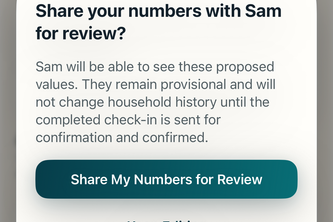
Check-In is a self-reported personal finance app for couples, built by a single developer over a few days using AI tools like GPT 5.6 Sol and Swift. The author states it aims to make financial conversations fun and productive by enabling users to visualize consolidated assets and debts without the anxiety of tracking transactions. It is described as a native iOS app that leverages Apple data sharing and does not require backend infrastructure.
The project has no evidenced traction, revenue, or customer base. It is presented as a proof-of-concept with no external validation. The author claims to have built it without prior Swift experience, using AI for development. There is no evidence of pricing, business model, or market positioning beyond the self-reported description.
The single most important open question
Is there any evidence that Check-In has been used by anyone other than its creator, or that it has achieved any level of adoption or user feedback?
What The Product Actually Is
The description states that Check-In is an app in the "Apps for Life" category. It allows individuals or couples to engage in financial conversations without the stress of tracking budgets and transactions.
It enables users to build a future financial picture, see consolidated assets and debts, and identify focus areas for decision-making (e.g., buying a house).
The author claims it uses Apple native data sharing and does not require backend infrastructure. It was built using Swift and AI tools like GPT 5.6 Sol.
Inference The app appears to be a personal finance dashboard or visualization tool, likely focused on couples’ financial coordination rather than transactional tracking.
Positioning & Claim Evolution
The author states that Check-In is designed to make money conversations "fun and productive" for couples. It positions itself as a solution to the anxiety of budget tracking by offering a consolidated view of assets and debts.
It also claims to help users “see the fruits of their labor” and identify focus areas, suggesting it is not just about tracking but about planning and decision-making.
Inference The positioning evolved from a personal tool (the author’s own use case) into a product for couples, with an emphasis on emotional ease in financial communication.
Target Customer & ICP
The description states that Check-In is for individuals or couples who want to have easy financial conversations without the stress of tracking budgets and transactions.
It is implied that the target user is someone who has financial goals but struggles with transactional tracking, particularly in a partnered context.
Inference The ICP appears to be financially conscious couples or individuals who are looking for a simplified way to manage shared finances and make decisions together.
Business Model & Pricing Evidence
There is no evidence of pricing, monetization, or business model in the description. The author does not state whether Check-In will be free, paid, subscription-based, or ad-supported.
Not evidenced
Technical & Delivery Signals
The app was built using Swift and AI tools like GPT 5.6 Sol. It uses Apple native data sharing and does not require backend infrastructure.
The author states that they had never written Swift before but still built a fully functional app in a few days.
It is described as being ready for the App Store, though it has not yet been released or validated by users.
Inference The technical approach suggests a lightweight, native iOS solution with minimal backend dependencies. AI was used to assist in development and planning.
Traction & Maturity Signals
There is no evidence of any traction, user base, or adoption beyond the author’s own use. The app has not been released or validated by others.
The author states that they are preparing it for App Store release but does not provide any data on downloads, usage, or feedback.
Not evidenced
Competitive Context
There is no evidence of competitors or market analysis in the description. The author does not reference existing tools or platforms for couples' financial management.
Not evidenced
Open Questions & Risks
- Single-person development: The app was built by one person with no prior Swift experience, raising questions about scalability and long-term maintenance.
- No user feedback or validation: There is no evidence of real-world usage or user testing beyond the author’s own use.
- Unverified claims: All descriptions are self-reported and unverified. No third-party data, revenue, or customer information is provided.
- AI dependency: Heavy reliance on AI for development raises questions about long-term control, reproducibility, and potential obsolescence of AI tools.
Questions the description leaves open
- What specific financial data does Check-In access from Apple, and how is it secured?
- Have you tested the app with any other users beyond yourself?
- Are there any plans to monetize or scale the product beyond personal use?
- How do you plan to handle privacy and data compliance issues in a financial app?
- What are your long-term goals for Check-In, and how do they align with market demand?
Overall Assessment
There is no evidence of traction, revenue, or customer adoption. The project is described as a personal tool built by one person using AI and Swift, with no external validation.
Not evidenced
The author states that the app is ready for App Store release but provides no data on user engagement, feedback, or market fit.
This is a self-reported concept with no commercial due-diligence evidence to support investment or partnership interest. The lack of any measurable outcome or user base makes it difficult to assess viability or scalability.
Confidence: Low — based entirely on the author’s own account, which is unverified and lacks any supporting data.
User Stories BotA demo video on every pull request
Get a demo video on every new feature
GitHub App that watches your pull requests and records a narrated, captioned demo.
Save time on demo prep and make informed decisions faster with a video walkthrough of every new feature.
Source
Submitted to the OpenAI 2026 hackathon on Devpost. Project home on Devpost. Back to the full gallery on Devpost.
This competitive analysis was produced by top-founders.com (opens in a new tab)
Generated by a language model from this project's public Devpost page — its tagline, the author's own write-up and any built-with tags listed there — as captured in August 2026. Short quotations are the author's words. It is an opinion on the idea as a business, not on the people behind it, and it reflects the description as published then. If the project has moved on, request a correction below. The analysis is not independent research and contains no verified traction, revenue or customer data.
An independent guide by KFG International LLC — not affiliated with, endorsed by, or connected to Devpost or OpenAI.