

Archive position — measured, not model output
0 likes on Devpost
2,263 of the 7,850 archived projects have more likes, and 5,587 share exactly 0 — so this project's #3,216 place in the like-ranked listing is a tie-break inside that group, not a ranking.
Projects (log scale)
Likes on Devpost. ▲ marks this project's group.
Show the figures
| Likes | Projects | Share of archive |
|---|---|---|
| 0 | 5,587 | 71.2% |
| 1 | 1,758 | 22.4% |
| 2 | 284 | 3.6% |
| 3–4 | 132 | 1.7% |
| 5–9 | 75 | 1.0% |
| 10+ | 14 | 0.2% |
 User Stories BotA demo video on every pull request
Get a demo video on every new feature
GitHub App that watches your pull requests and records a narrated, captioned demo.
Save time on demo prep and make informed decisions faster with a video walkthrough of every new feature.
Executive Summary
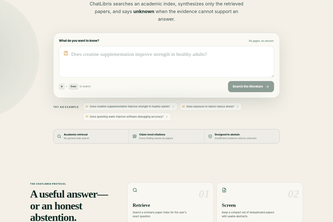
What the company appears to be: ChatLibris is a self-reported academic research assistant that searches indexed academic literature, synthesizes retrieved papers, and returns either a cited answer or an explicit "Unknown" when evidence is insufficient. It was built as a hackathon project by one person (DrHCodes Milojevic) with no user accounts, database, conversation history, or full-text parsing capabilities.
What changed: The author states they focused on building a system that prevents fabricated citations and enforces abstention from answering when evidence is lacking — distinguishing between technical failures and scientific uncertainty. This approach was designed to be "trustworthy AI" by building trust into the architecture rather than adding disclaimers afterward.
The single most important open question: Does ChatLibris have any commercial traction, revenue, or customer adoption beyond its hackathon prototype? The description makes no claims about monetization, users, or market validation — only that it was built under time constraints and is intended to evolve toward more advanced features.
What The Product Actually Is
The description states that ChatLibris:
- Searches an academic index
- Synthesizes only the retrieved papers
- Says "unknown" when evidence cannot support an answer
- Prevents fabricated citations by generating source identifiers itself and checking model outputs
- Distinguishes between different types of failure (e.g., no sufficient literature, synthesis failure)
- Restricts retrieval to indexed academic literature (not necessarily peer-reviewed)
- Was built for a hackathon with limited scope
It is described as a system that "prevents the system from answering when the evidence was insufficient" and enforces structured output.
Inference: Based on the author's own account, this is not a production-ready product but a proof-of-concept prototype. It lacks user accounts, persistent storage, conversation history, or PDF upload capabilities.
Positioning & Claim Evolution
The description states:
- ChatLibris is positioned as an assistant that "knows when it should not answer"
- It distinguishes between technical failure and scientific uncertainty
- The goal is to make academic evidence easier to access without stripping away uncertainty, limitations, or disagreement
- It was built with the understanding that “trustworthy AI cannot be created by adding a disclaimer after generation”
- Future versions may include stronger peer-review filtering, systematic-review prioritization, study-design classification, and full-text analysis
Inference: The positioning evolved from a hackathon prototype to a vision of a trustworthy research assistant that respects scientific uncertainty. However, the current version is not described as having any commercial or user-facing features beyond basic question-answering.
Target Customer & ICP
The description does not state:
- Who the target customer is
- Whether there is an identified ICP (Ideal Customer Profile)
- If there are any existing users or personas defined
Not evidenced: No information about who uses ChatLibris, what their needs are, or how they would interact with it beyond the author’s own use case.
Business Model & Pricing Evidence
The description does not state:
- How ChatLibris intends to make money
- Whether there is a pricing model
- If any monetization strategy has been developed or tested
Not evidenced: No evidence of business model, pricing, or revenue streams. The project is described as a hackathon submission with no indication of commercial intent.
Technical & Delivery Signals
The description states:
- Built using OpenAI Codex and Vercel
- Uses server-side rules to enforce abstention
- Generates source identifiers internally to prevent fake citations
- Distinguishes between multiple failure modes (search, synthesis, timeout)
- Was built under time pressure with aggressive scope cuts
- Did not include user accounts, databases, conversation history, PDF uploads, vector databases, or full-text parsing
Inference: The technical architecture is minimal and hackathon-focused. It does not appear to be production-ready or scalable.
Traction & Maturity Signals
The description states:
- This was a hackathon project (OpenAI 2026)
- No user accounts, database, conversation history, or persistent storage
- No revenue, customers, or adoption data
- The author explicitly says they cut scope aggressively for the hackathon
Not evidenced: No evidence of traction, headcount, customer base, or usage metrics. The project is described as a prototype with no commercial deployment.
Competitive Context
The description does not state:
- Who the competitors are
- What existing products or services exist in this space
- How ChatLibris differentiates from them
Not evidenced: No competitive analysis or market positioning beyond self-reported claims about trust and uncertainty.
Open Questions & Risks
Key risks and open questions based on the description:
- The project is a hackathon prototype with no commercial traction, revenue, or users
- It lacks core features like user accounts, persistent storage, conversation history, or full-text analysis
- There is no evidence of any business model or monetization strategy
- The author states that most of the intended functionality was not built due to time constraints
- No third-party validation or independent verification of claims
Inference: The project appears to be a proof-of-concept with no clear path to market traction or commercial viability.
Questions the description leaves open
- What is your plan for monetization and customer acquisition beyond the hackathon?
- Have you validated demand from potential users in academic or research settings?
- How do you intend to scale beyond a single-user prototype?
- What are the technical limitations of the current architecture that would prevent production use?
- Are there any partnerships or institutional relationships that support this project’s future development?
Overall Assessment
The description states that ChatLibris is a hackathon submission with no revenue, customers, or commercial traction.
Assessment: Not evidenced as a viable investment or partnership opportunity at this stage. The project is described as a prototype built under time constraints and lacks any evidence of product-market fit, scalability, or commercial readiness.
User Stories BotA demo video on every pull request
Get a demo video on every new feature
GitHub App that watches your pull requests and records a narrated, captioned demo.
Save time on demo prep and make informed decisions faster with a video walkthrough of every new feature.
Source
Submitted to the OpenAI 2026 hackathon on Devpost. Project home on Devpost. Back to the full gallery on Devpost.
This competitive analysis was produced by top-founders.com (opens in a new tab)
Generated by a language model from this project's public Devpost page — its tagline, the author's own write-up and any built-with tags listed there — as captured in August 2026. Short quotations are the author's words. It is an opinion on the idea as a business, not on the people behind it, and it reflects the description as published then. If the project has moved on, request a correction below. The analysis is not independent research and contains no verified traction, revenue or customer data.
An independent guide by KFG International LLC — not affiliated with, endorsed by, or connected to Devpost or OpenAI.