

Archive position — measured, not model output
0 likes on Devpost
2,263 of the 7,850 archived projects have more likes, and 5,587 share exactly 0 — so this project's #3,217 place in the like-ranked listing is a tie-break inside that group, not a ranking.
Projects (log scale)
Likes on Devpost. ▲ marks this project's group.
Show the figures
| Likes | Projects | Share of archive |
|---|---|---|
| 0 | 5,587 | 71.2% |
| 1 | 1,758 | 22.4% |
| 2 | 284 | 3.6% |
| 3–4 | 132 | 1.7% |
| 5–9 | 75 | 1.0% |
| 10+ | 14 | 0.2% |
 User Stories BotA demo video on every pull request
Get a demo video on every new feature
GitHub App that watches your pull requests and records a narrated, captioned demo.
Save time on demo prep and make informed decisions faster with a video walkthrough of every new feature.
Executive Summary
What the company appears to be: ChatNotion is a self-reported Chrome extension that integrates with ChatGPT to structure AI-generated answers into navigable knowledge trees. The author describes it as a tool for students, researchers, and curious minds to explore fields systematically and build expertise faster.
What changed: The project description indicates an evolution from a simple chat organizer into a "local-first learning workspace" connecting exploration, contextual follow-up conversations, note-taking, and knowledge retention directly inside ChatGPT. It was built through iterative conversation-to-code workflows with Codex and GPT-5.6.
Single most important open question: Is there evidence of user adoption or feedback beyond the author's own development process?
Note: This analysis is based entirely on self-reported information provided by the author. No external verification, revenue data, customer names, or traction metrics are available. All claims in this report are labeled as "the description states..." and should be treated as unverified assertions.
What The Product Actually Is
The description states that ChatNotion is a Manifest V3 Chrome extension built with plain JavaScript, CSS, and browser-native APIs. It does not use frameworks, bundlers, backends, or external data services.
It runs across three connected areas:
- A content script renders the ChatNotion panel inside an isolated Shadow DOM.
- A background service worker manages durable storage, history, cross-tab synchronization, import/export, and scheduled backups.
- A backup page handles explicit browser permissions for saving automatic backups to a local folder.
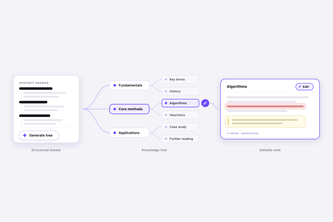
The extension transforms ChatGPT answers into expandable knowledge trees where:
- Each unexplored node represents a possible next question.
- Explored nodes can become editable knowledge pages.
- Users can annotate, highlight, and continue building on what they understand.
Data is stored locally using chrome.storage.local, IndexedDB, and extension-owned pages with restrictive Content Security Policy. No developer-operated server or tracking is used.
Inference: The product appears to be a browser-based tool designed for personal knowledge management within ChatGPT, not a commercial SaaS offering.
Positioning & Claim Evolution
The description states that ChatNotion aims to bring the "complete learning loop" into one place: ask, structure, explore, branch, annotate, and continue building on what you understand.
It positions itself as:
- A tool for turning open-ended conversations into structured, evolving knowledge.
- An alternative to traditional chat organizers by providing a map of what to explore next.
- A solution for users who manually reconstruct relationships between ideas in ChatGPT.
The author notes that the product evolved from a simple organizer into a more complex workspace. The original inspiration was rooted in dissatisfaction with how ChatGPT handles learning — particularly its lack of explicit structure and mapping of idea connections.
Inference: Positioning has shifted from a basic organizational tool to a full-fledged personal knowledge system integrated within ChatGPT, emphasizing local-first architecture and privacy.
Target Customer & ICP
The description states that ChatNotion is built for:
- Students
- Researchers
- Curious minds
These are described as users who want to explore any field systematically and build expertise faster.
Inference: The target audience likely includes individuals engaged in self-directed learning or academic research, with a focus on personal productivity rather than enterprise use cases. No evidence of B2B targeting or specific industry verticals is provided.
Business Model & Pricing Evidence
There is no mention of pricing, monetization strategy, or business model in the description.
Not evidenced: No revenue streams, subscription tiers, or commercial arrangements are described.
Technical & Delivery Signals
The extension:
- Is built with plain JavaScript, CSS, and browser-native APIs.
- Uses no framework, bundler, backend, or external data service.
- Runs on Manifest V3 Chrome extension architecture.
- Stores data using chrome.storage.local, IndexedDB, and extension-owned pages.
- Implements versioned data models, migrations, cross-tab synchronization, Undo/Redo history, and automatic backups.
- Includes 162 automated tests covering various aspects of functionality.
The author mentions using Codex and GPT-5.6 during development, but not for product delivery or runtime operations.
Inference: The technical stack suggests a lightweight, local-first approach with strong emphasis on user control and privacy. No evidence of cloud infrastructure or third-party integrations is present.
Traction & Maturity Signals
The description states:
- ChatNotion is currently under review for the Chrome Web Store.
- Judges can install the packaged build using Chrome’s Load unpacked option.
- The project was submitted to the OpenAI 2026 hackathon on Devpost.
- It includes 162 automated tests, indicating a mature development process.
However, there is no evidence of:
- User adoption
- Customer feedback
- Revenue or ARR
- Market traction beyond its submission to a hackathon
Not evidenced: No signs of real-world usage or market validation are evident.
Competitive Context
The description does not reference competitors or similar tools. It mentions ChatGPT’s built-in Projects feature but frames ChatNotion as an enhancement that provides deeper structural mapping and interactivity.
Not evidenced: No competitive landscape, market positioning, or differentiation from existing tools is described.
Open Questions & Risks
- No revenue or monetization model — the product appears to be a prototype or personal project.
- Limited scope — designed only for ChatGPT and Chrome, with no indication of multi-platform support.
- Single founder team — one person built the entire extension.
- No external validation — no customers, reviews, or third-party endorsements.
- Dependence on ChatGPT interface stability — changes in ChatGPT’s UI could break functionality.
- Privacy-focused architecture may limit scalability — local-first design implies no centralized data handling or analytics.
Inference: The lack of commercial traction and a clear path to monetization raises questions about viability as a scalable business. Dependence on a single developer and limited platform scope are key concerns.
Questions the description leaves open
- What is the intended long-term vision for ChatNotion beyond its current Chrome extension?
- How does the team plan to scale beyond a single-person development effort?
- Are there plans to support other AI platforms or models beyond ChatGPT?
- Has the product been tested with real users outside of the development process?
- What are the key challenges in maintaining compatibility with evolving ChatGPT interfaces?
- How does the team intend to monetize this tool if at all?
Overall Assessment
The description states that ChatNotion is a self-reported prototype built for the OpenAI 2026 hackathon. It is not evidenced to have generated revenue, attracted users, or demonstrated commercial viability.
Assessment: Not suitable for investment or partnership at this stage due to lack of traction, unclear monetization strategy, and absence of external validation. The product shows technical sophistication but lacks evidence of market demand or sustainable business model.
User Stories BotA demo video on every pull request
Get a demo video on every new feature
GitHub App that watches your pull requests and records a narrated, captioned demo.
Save time on demo prep and make informed decisions faster with a video walkthrough of every new feature.
Source
Submitted to the OpenAI 2026 hackathon on Devpost. Project home on Devpost. Back to the full gallery on Devpost.
This competitive analysis was produced by top-founders.com (opens in a new tab)
Generated by a language model from this project's public Devpost page — its tagline, the author's own write-up and any built-with tags listed there — as captured in August 2026. Short quotations are the author's words. It is an opinion on the idea as a business, not on the people behind it, and it reflects the description as published then. If the project has moved on, request a correction below. The analysis is not independent research and contains no verified traction, revenue or customer data.
An independent guide by KFG International LLC — not affiliated with, endorsed by, or connected to Devpost or OpenAI.