

Archive position — measured, not model output
0 likes on Devpost
2,263 of the 7,850 archived projects have more likes, and 5,587 share exactly 0 — so this project's #5,180 place in the like-ranked listing is a tie-break inside that group, not a ranking.
Projects (log scale)
Likes on Devpost. ▲ marks this project's group.
Show the figures
| Likes | Projects | Share of archive |
|---|---|---|
| 0 | 5,587 | 71.2% |
| 1 | 1,758 | 22.4% |
| 2 | 284 | 3.6% |
| 3–4 | 132 | 1.7% |
| 5–9 | 75 | 1.0% |
| 10+ | 14 | 0.2% |
 User Stories BotA demo video on every pull request
Get a demo video on every new feature
GitHub App that watches your pull requests and records a narrated, captioned demo.
Save time on demo prep and make informed decisions faster with a video walkthrough of every new feature.
Executive Summary
What the company appears to be
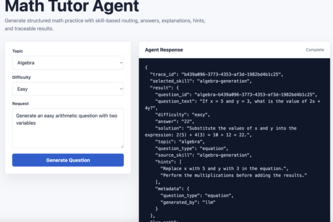
MathTutorAgent is a self-reported, personal project by one developer (Chirag Vithalani) that builds an AI-powered web-based math tutor using agentic AI and LLMs. The author describes it as a modular system with skills-based agent architecture, persistence, validation, and a user interface.
What changed
This is a hackathon submission, not a product in production or commercial use. It is described as a proof-of-concept built over a short time frame using Python, FastAPI, SQLite, and LLMs (OpenAI, Gemini, Ollama).
The single most important open question
Is there any evidence of actual user adoption, revenue, or traction beyond the author’s own development work?
Note: This analysis is based solely on the self-reported description provided by the author. No external verification, funding history, customer data, or commercial metrics are available.
What The Product Actually Is
The description states:
- MathTutorAgent generates age-appropriate math questions.
- It validates quality, classifies difficulty, detects duplicates.
- It stores learning history through a web-based AI tutor.
- It uses Python, FastAPI, SQLite, and LLMs (OpenAI, Gemini, Ollama).
- The system includes a skill-based agent architecture and orchestration layer.
Inference: Based on the author’s own account, this is an experimental educational tool built for personal or academic use, not yet commercialized.
Claim: The product is described as a modular agentic tutoring platform.
Evidence: Author's write-up.
Positioning & Claim Evolution
The description states:
- The project was inspired by the desire to make math learning more personalized, engaging, and adaptive using Agentic AI and LLMs.
- It aims to be an AI-powered personal tutor for math.
Inference: The positioning is that of a personalized, AI-driven educational tool. The author’s intent is to build a scalable agentic system for math tutoring.
Claim: The product is positioned as an AI-powered personal math tutor.
Evidence: Author's write-up and tagline.
Target Customer & ICP
The description states:
- The inspiration came from being a parent wanting to improve math learning.
- It generates age-appropriate questions and stores learning history.
Inference: The target audience appears to be parents or educators looking for adaptive, personalized math learning tools. However, no explicit customer segmentation or ICP is described.
Claim: The product targets parents or educators seeking personalized math learning.
Evidence: Author's write-up.
Business Model & Pricing Evidence
The description states:
- No mention of pricing, monetization, or business model.
- It is described as a personal project built for hackathon use.
Inference: There is no evidence of any commercial business model or pricing strategy in the provided text.
Claim: No business model or pricing information is provided.
Evidence: Author's write-up and project metadata.
Technical & Delivery Signals
The description states:
- Built with Python, FastAPI, SQLite, LLMs (OpenAI, Gemini, Ollama).
- Uses a skill-based agent architecture and orchestration layer.
- Includes testing, tracing, persistence, validation, and a web interface.
- Challenges included reliable skill routing, maintaining quality, preventing duplicates.
Inference: The technical stack suggests a prototype or MVP built for experimentation. It includes some observability features but lacks evidence of production-grade infrastructure or scalability.
Claim: The system uses FastAPI, SQLite, and multiple LLMs with agent orchestration.
Evidence: Author's write-up.
Traction & Maturity Signals
The description states:
- This is a hackathon submission (OpenAI 2026).
- It was built by one person (Chirag Vithalani).
- No mention of users, customers, or adoption.
- The author notes future plans for enhancements.
Inference: There is no evidence of traction, revenue, or customer base. This is a personal project with no commercial deployment.
Claim: No traction or maturity signals are evident.
Evidence: Author's write-up and metadata.
Competitive Context
The description states:
- No mention of competitors or market positioning.
- The author does not reference existing platforms in the edtech or AI tutoring space.
Inference: There is no evidence of awareness or analysis of competitive landscape.
Claim: No competitive context is provided.
Evidence: Author's write-up.
Open Questions & Risks
The description states:
- It is a one-person project.
- It was built for a hackathon.
- Challenges include maintaining quality, preventing duplicates, and supporting multiple LLM providers.
Inference:
- Risk of limited scalability or reliability due to single-person development.
- Lack of commercial traction raises questions about product-market fit.
- No evidence of production-grade systems or long-term viability.
Claim: Risks include lack of team, no traction, and unproven scalability.
Evidence: Author's write-up.
Questions the description leaves open
- What is the actual user base or adoption rate for this tool?
- How does it plan to scale beyond a single developer’s effort?
- Is there any intention to monetize or commercialize this product?
- What are the current limitations in terms of accuracy, quality control, and duplicate detection?
- Are there plans to integrate with existing educational platforms or LMS systems?
Note: These questions are based on the lack of evidence for traction, scalability, or business model.
Overall Assessment
The description states:
- This is a hackathon project built by one person.
- No revenue, customers, or commercial use are evident.
- It is described as a proof-of-concept with future enhancements planned.
Inference:
This is not a product ready for investment or partnership. It is an experimental prototype without evidence of market traction or business viability.
Claim: Not suitable for investment or partnership at this stage.
Evidence: Author's write-up and metadata.
User Stories BotA demo video on every pull request
Get a demo video on every new feature
GitHub App that watches your pull requests and records a narrated, captioned demo.
Save time on demo prep and make informed decisions faster with a video walkthrough of every new feature.
Source
Submitted to the OpenAI 2026 hackathon on Devpost. Project home on Devpost. Back to the full gallery on Devpost.
This competitive analysis was produced by top-founders.com (opens in a new tab)
Generated by a language model from this project's public Devpost page — its tagline, the author's own write-up and any built-with tags listed there — as captured in August 2026. Short quotations are the author's words. It is an opinion on the idea as a business, not on the people behind it, and it reflects the description as published then. If the project has moved on, request a correction below. The analysis is not independent research and contains no verified traction, revenue or customer data.
An independent guide by KFG International LLC — not affiliated with, endorsed by, or connected to Devpost or OpenAI.