

Archive position — measured, not model output
0 likes on Devpost
2,263 of the 7,850 archived projects have more likes, and 5,587 share exactly 0 — so this project's #5,182 place in the like-ranked listing is a tie-break inside that group, not a ranking.
Projects (log scale)
Likes on Devpost. ▲ marks this project's group.
Show the figures
| Likes | Projects | Share of archive |
|---|---|---|
| 0 | 5,587 | 71.2% |
| 1 | 1,758 | 22.4% |
| 2 | 284 | 3.6% |
| 3–4 | 132 | 1.7% |
| 5–9 | 75 | 1.0% |
| 10+ | 14 | 0.2% |
 User Stories BotA demo video on every pull request
Get a demo video on every new feature
GitHub App that watches your pull requests and records a narrated, captioned demo.
Save time on demo prep and make informed decisions faster with a video walkthrough of every new feature.
Executive Summary
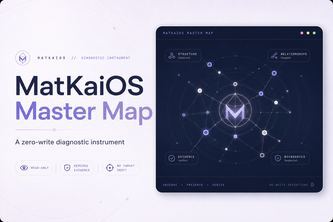
What the company appears to be: MatKaiOS Master Map is a self-reported diagnostic tool for inspecting the structure of a local-first operating and coordination platform for governed AI agents called MatKaiOS. It is described as an external, zero-write, evidence-based system that maps MatKaiOS without executing or modifying it.
What changed: The author states that this project emerged from long-term experimentation with AI agents and their governance within a local development environment. A previous version (v1) was replaced by v2, which is described as an external diagnostic tool built around principles such as physical separation between the tool and target system, zero-write verification, and bounded capture of Git snapshots.
Single most important open question: Is there any evidence that MatKaiOS has been adopted or used beyond the author's own development environment?
What The Product Actually Is
The description states that MatKaiOS Master Map is an external, zero-write, evidence-based diagnostic system for inspecting the structure of MatKaiOS. It is described as a tool that builds a verifiable view of the system from a controlled Git snapshot and the evidence found inside the repository.
It includes five primary foundations:
- External Zero-Write Foundation
- Facts & Evidence Foundation
- Source Authority Foundation
- Structural Anatomy Foundation
- Static Module Resolution Foundation
The author describes it as not being all of MatKaiOS, but rather a diagnostic instrument developed to understand, verify, and make better decisions about the evolution of MatKaiOS.
Positioning & Claim Evolution
The description states that MatKaiOS Master Map was created to help observe and understand the system without modifying the system it is trying to explain. It evolved from an internal tool (v1) that became increasingly difficult to maintain as a reproducible and trustworthy representation of the current system.
The author notes that the goal is not to pretend that powerful agents are harmless, but rather to make capability, risk, authority, and responsibility visible so the human can make an informed decision. The project evolved from using natural language instructions to structured formats like Markdown and JSON, eventually leading to a runtime where identity, sessions, tools, providers, policies, memory, evidence, autonomy, and security boundaries are real parts of the system.
Target Customer & ICP
Not evidenced. The description does not specify target customers or ideal customer profiles beyond the author's own use case.
Business Model & Pricing Evidence
Not evidenced. There is no mention of pricing, revenue models, or commercial arrangements in the provided description.
Technical & Delivery Signals
The project was built using:
- ai-agents
- codex
- developer-tools
- git
- github
- github-actions
- javascript
- json
- markdown
- node.js
- npm
- ollama
- openai
- sqlite
- static-analysis
It uses OpenAI Codex for inspection, implementation, refactoring, testing, and static analysis. The author mentions using GPT-5.6 Sol for studying architecture and characterizing limitations.
The system follows principles such as:
- physical separation between the tool, target, store, and vault;
- bounded capture of Git targets;
- zero-write and no-drift verification;
- facts linked to evidence;
- deny-by-default policies;
- provenance and producer identity;
- deterministic manifests and receipts;
- derived structural anatomy without retaining raw source-code bytes;
- static reference resolution;
- explicit terminal states;
- fail-closed behavior;
- precise documentation of boundaries and non-claims.
Traction & Maturity Signals
Not evidenced. The description does not contain any data on revenue, customers, adoption rates, or usage metrics. It describes the project as a long-term effort built through experimentation and iterations, but provides no evidence of traction or market validation.
Competitive Context
Not evidenced. There is no mention of competitors or competitive landscape in the provided description.
Open Questions & Risks
- The entire description is self-reported and unverified.
- No evidence of revenue, customers, or adoption beyond the author's own development environment.
- The project appears to be a personal experiment rather than a commercial product.
- The author states that the system being inspected (MatKaiOS) was not created in one week for this event, suggesting it is a long-term project with no clear commercialization path.
- The description mentions challenges such as maintaining AI-agent work sessions without losing intent or control of scope, indicating potential instability or complexity issues.
Questions the description leaves open
- What specific problems does MatKaiOS solve for users beyond the author's own development environment?
- How is the system currently being used or tested outside of the author's personal development setup?
- Are there any existing users, partners, or customers who have provided feedback on the platform?
- What are the plans for monetization or commercialization of MatKaiOS or Master Map?
- Can you provide evidence of the system's performance or reliability in real-world scenarios?
- How does the project plan to scale beyond a single developer's environment?
Overall Assessment
Not evidenced. The description provides no information about financials, market opportunity, or strategic fit that would inform an investment or partnership decision. The project appears to be a personal experiment with no demonstrated traction or commercial viability.
User Stories BotA demo video on every pull request
Get a demo video on every new feature
GitHub App that watches your pull requests and records a narrated, captioned demo.
Save time on demo prep and make informed decisions faster with a video walkthrough of every new feature.
Source
Submitted to the OpenAI 2026 hackathon on Devpost. Project home on Devpost. Back to the full gallery on Devpost.
This competitive analysis was produced by top-founders.com (opens in a new tab)
Generated by a language model from this project's public Devpost page — its tagline, the author's own write-up and any built-with tags listed there — as captured in August 2026. Short quotations are the author's words. It is an opinion on the idea as a business, not on the people behind it, and it reflects the description as published then. If the project has moved on, request a correction below. The analysis is not independent research and contains no verified traction, revenue or customer data.
An independent guide by KFG International LLC — not affiliated with, endorsed by, or connected to Devpost or OpenAI.