

Archive position — measured, not model output
0 likes on Devpost
2,263 of the 7,850 archived projects have more likes, and 5,587 share exactly 0 — so this project's #5,181 place in the like-ranked listing is a tie-break inside that group, not a ranking.
Projects (log scale)
Likes on Devpost. ▲ marks this project's group.
Show the figures
| Likes | Projects | Share of archive |
|---|---|---|
| 0 | 5,587 | 71.2% |
| 1 | 1,758 | 22.4% |
| 2 | 284 | 3.6% |
| 3–4 | 132 | 1.7% |
| 5–9 | 75 | 1.0% |
| 10+ | 14 | 0.2% |
 User Stories BotA demo video on every pull request
Get a demo video on every new feature
GitHub App that watches your pull requests and records a narrated, captioned demo.
Save time on demo prep and make informed decisions faster with a video walkthrough of every new feature.
Executive Summary
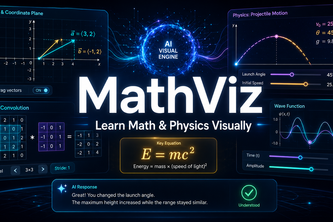
The company appears to be a solo developer project named MathViz, an AI-powered visual learning platform for math and physics education. The author states it generates interactive lessons from natural-language questions using AI, SVG visuals, and browser-based interactivity.
What changed: The project was submitted to the OpenAI 2026 hackathon, indicating a development milestone or prototype release.
The single most important open question: Is there any evidence of user adoption, revenue, or traction beyond the author's own account?
This analysis is based entirely on self-reported information from the project description and author's write-up. No third-party verification or independent data is available. The description contains no claims about revenue, customers, funding, or market traction.
What The Product Actually Is
The description states that MathViz:
- Turns natural-language math or physics questions into interactive visual lessons
- Generates animated SVG scenes with guided explanations and equation-to-visual mappings
- Includes browser narration, live follow-up interactions, and separate practice challenges
- Uses React, TypeScript, Vite frontend and FastAPI backend
- Integrates OpenAI-compatible model providers for lesson generation
- Renders lessons in an interactive SVG-based visual runtime
The author describes it as creating "a complete learning loop" involving seeing concepts, hearing explanations, connecting to equations, manipulating visuals, practicing, and receiving feedback.
Evidence: Self-reported by the author. No independent verification or demonstration provided.
Positioning & Claim Evolution
The author states that MathViz:
- Is not just an AI chatbot or static animation generator
- Creates a "complete learning loop"
- Supports OpenAI-compatible providers to avoid vendor lock-in
- Aims to become an "agentic learning platform" where learners can ask questions and get interactive paths to understanding
The positioning appears to be evolving from a hackathon prototype toward a broader educational platform, with claims of:
- Interactivity beyond static content
- Educational completeness (seeing, hearing, connecting, manipulating, practicing)
- Agentic interface design
- Multi-model support
Evidence: Self-reported claims by the author. No external validation or market positioning data.
Target Customer & ICP
The description states that MathViz is designed for:
- Learners exploring math and physics concepts
- Students who want to see formulas happen, interact with them, and test understanding in one place
The author's inspiration was to make concepts feel connected for students who are taught through separate equations, diagrams, and explanations.
Evidence: Self-reported by the author. No specific customer segments or personas identified.
Business Model & Pricing Evidence
No evidence of business model or pricing structure is provided in the description.
Evidence: Not evidenced.
Technical & Delivery Signals
The author states that MathViz:
- Uses React, TypeScript, Vite frontend and FastAPI backend
- Integrates OpenAI-compatible model providers
- Renders lessons in an interactive SVG-based visual runtime
- Includes features like multi-scene lessons with timed steps, draggable objects, equation mapping using KaTeX, browser text-to-speech narration, learner memory, encrypted model profiles, and validation/repair flows for imperfect model JSON
- Was built with Codex and GPT-5.6 assistance
The author notes challenges in making AI-generated scenes reliable and improving visual layout intelligence.
Evidence: Self-reported by the author. No independent technical review or delivery data provided.
Traction & Maturity Signals
No evidence of traction, customers, revenue, or adoption is provided in the description.
The project was submitted to a hackathon (OpenAI 2026), which suggests development maturity but not market traction.
Evidence: Not evidenced.
Competitive Context
No information about competitors or competitive positioning is provided in the description.
Evidence: Not evidenced.
Open Questions & Risks
- The project is described as a solo developer effort (team size: 1)
- No evidence of revenue, customers, or traction
- The author notes significant technical challenges in making AI-generated scenes reliable
- The platform appears to be in early development stage (hackathon submission)
- No information about scalability, monetization, or long-term sustainability
Evidence: Self-reported by the author. No external validation or risk assessment data.
Questions the description leaves open
- What is your specific target user persona and how did you identify them?
- How do you plan to validate that the AI-generated content meets educational standards?
- What are your plans for scaling beyond a single developer?
- Have you conducted any user testing or feedback sessions with students or educators?
- What is the expected timeline for moving from prototype to market-ready product?
- How will you handle potential legal issues around AI-generated educational content?
- What are your plans for monetization and revenue model?
- How do you plan to ensure consistent quality across different AI model providers?
Inference: These questions arise from the lack of evidence regarding user validation, scalability, and business model.
Overall Assessment
Not evidenced.
The description provides no information about:
- Revenue or financial performance
- Customer base or adoption metrics
- Funding status or investor interest
- Market traction or competitive positioning
- Business model viability
This is a self-reported solo developer project submitted to a hackathon. There is no evidence of commercial traction, market validation, or business maturity.
Evidence: Not evidenced.
User Stories BotA demo video on every pull request
Get a demo video on every new feature
GitHub App that watches your pull requests and records a narrated, captioned demo.
Save time on demo prep and make informed decisions faster with a video walkthrough of every new feature.
Source
Submitted to the OpenAI 2026 hackathon on Devpost. Project home on Devpost. Back to the full gallery on Devpost.
This competitive analysis was produced by top-founders.com (opens in a new tab)
Generated by a language model from this project's public Devpost page — its tagline, the author's own write-up and any built-with tags listed there — as captured in August 2026. Short quotations are the author's words. It is an opinion on the idea as a business, not on the people behind it, and it reflects the description as published then. If the project has moved on, request a correction below. The analysis is not independent research and contains no verified traction, revenue or customer data.
An independent guide by KFG International LLC — not affiliated with, endorsed by, or connected to Devpost or OpenAI.