

Archive position — measured, not model output
1 like on Devpost
505 of the 7,850 archived projects have more likes, and 1,758 share exactly 1 — so this project's #1,256 place in the like-ranked listing is a tie-break inside that group, not a ranking.
Projects (log scale)
Likes on Devpost. ▲ marks this project's group.
Show the figures
| Likes | Projects | Share of archive |
|---|---|---|
| 0 | 5,587 | 71.2% |
| 1 | 1,758 | 22.4% |
| 2 | 284 | 3.6% |
| 3–4 | 132 | 1.7% |
| 5–9 | 75 | 1.0% |
| 10+ | 14 | 0.2% |
 User Stories BotA demo video on every pull request
Get a demo video on every new feature
GitHub App that watches your pull requests and records a narrated, captioned demo.
Save time on demo prep and make informed decisions faster with a video walkthrough of every new feature.
Executive Summary
What the company appears to be
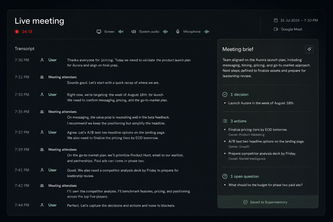
JARVIS is a self-reported local-first, meeting-aware personal assistant built as a real-time pipeline for capturing, analyzing, and acting on meeting context. It claims to store decisions in durable long-term memory (Supermemory), perform background research, and deliver voice-ready answers—without requiring users to remember or re-engage with past meetings.
What changed
The project description reflects an early-stage prototype submitted to a hackathon. It is not evidenced to have launched commercially or gained traction. The author states it was built in a short timeframe (likely a hackathon) and includes no evidence of revenue, customers, or adoption beyond its own claims.
Single most important open question
Is there any evidence that JARVIS has been used by users beyond the development team, or that it has moved past prototype status?
What The Product Actually Is
The description states that JARVIS is a local-first, meeting-aware personal assistant. It captures user-authorized screen, system-audio, and microphone input during meetings. It distinguishes between the user’s voice and attendees, creates timestamped transcripts, identifies participants, decisions, action items, owners, deadlines, key moments, and unresolved questions.
It stores this context in Supermemory Local, which acts as a durable long-term memory layer. When users ask follow-up questions later, JARVIS recalls from Supermemory before responding, maintaining conversation continuity.
JARVIS also supports background research agents that gather evidence, evaluate claims, and store sourced recommendations back into Supermemory. It uses technologies like Groq Whisper for transcription, GPT-OSS models for analysis, ElevenLabs for speech generation, and integrates with tools such as Kokoro and macOS speech APIs for fallbacks.
The frontend is built using React and Vite, while the backend uses FastAPI and WebSockets to coordinate real-time processing and streaming responses. The system also captures metadata such as date, time, timezone, platform, and duration.
Inference JARVIS appears to be a prototype or proof-of-concept, not a commercial product, based on its hackathon submission and lack of evidence for deployment or usage beyond the development team.
Positioning & Claim Evolution
The author positions JARVIS as a personal AI butler that understands what is happening in meetings, remembers it across sessions, and proactively helps users move from conversation to action. It aims to go beyond transcription or summarization by connecting meeting outcomes to future work.
It claims to be:
- Meeting-aware
- Local-first (privacy-focused)
- Context-aware with long-term memory
- Proactive in follow-up tasks and research
- Voice-enabled with streaming speech synthesis
Inference This positioning is a self-reported vision, not validated by market data or user feedback. The claim of being a “true personal AI butler” is aspirational, not yet demonstrated.
Target Customer & ICP
The description does not explicitly name target customers or personas. However, it implies that JARVIS targets individuals who:
- Attend frequent meetings
- Need to track decisions and follow-ups
- Want to reduce cognitive load from remembering context
- Value privacy (due to local-first architecture)
- May benefit from AI-driven research assistance
Inference The ICP is likely knowledge workers, professionals, or executives who rely heavily on meetings and need structured recall and actionability. No specific customer segments are named.
Business Model & Pricing Evidence
There is no evidence of pricing, monetization strategy, or business model in the description. The project is presented as a hackathon submission with no indication of commercial intent or revenue streams.
Inference No business model is evidenced; this remains an unproven concept.
Technical & Delivery Signals
The system is built using:
- Frontend: React + Vite
- Backend: FastAPI + WebSockets
- Speech-to-text: Groq Whisper
- Language models: GPT-OSS, NVIDIA NIM, Groq
- Voice synthesis: ElevenLabs, Kokoro, macOS
- Memory layer: Supermemory Local
It supports:
- Real-time capture and processing
- Streaming responses
- Structured outputs with fallbacks
- Metadata capture (date, time, platform)
- Fallback mechanisms for reliability
Inference The technical stack suggests a well-thought-out prototype, but there is no evidence of production deployment or scalability beyond the development team.
Traction & Maturity Signals
There is no evidence of:
- Revenue
- Customers
- Users
- Adoption metrics
- Product-market fit
- Commercial launch
The project was submitted to a hackathon, indicating it is in an early stage of development.
Inference No traction or maturity signals are evidenced. The product is described as a prototype, not a live offering.
Competitive Context
The description does not mention competitors or market positioning relative to existing tools like Notion, Slack, Zoom, or AI meeting assistants such as Otter.ai, Loom, or Microsoft Teams’ AI features.
Inference No competitive analysis is provided. The project’s uniqueness or differentiation from existing solutions is self-reported and unverified.
Open Questions & Risks
- Unproven commercial viability: No evidence of revenue, customers, or adoption.
- Prototype-only status: Submitted to a hackathon; no indication of product maturity.
- Privacy assumptions: The local-first approach may be appealing but is not validated in practice.
- Dependency on external tools: Heavy reliance on third-party APIs (ElevenLabs, Groq, etc.) introduces risk if those services change or become unavailable.
- No user feedback loop: No mention of user testing or iteration beyond the hackathon.
Inference The project is at a very early stage and lacks any evidence of real-world usage or commercial traction.
Questions the description leaves open
- Has JARVIS been tested with actual users outside the development team?
- What are the technical limitations of the current prototype, especially around scalability or reliability?
- Are there plans to monetize this product, and if so, how?
- How does JARVIS handle edge cases like multi-language meetings or noisy environments?
- Is Supermemory Local a proprietary or open-source component? Can it be integrated with other systems?
- What are the key assumptions about user behavior that underpin the product vision?
Overall Assessment
Not evidenced — there is no evidence of revenue, customers, traction, or commercial viability to support an investment or partnership decision.
The project is described as a self-reported hackathon prototype, not a functioning product. The author’s claims about functionality and future potential are aspirational but unvalidated.
Confidence level Low
Next steps
If this were part of a broader due-diligence process, further investigation into the founders’ prior work, technical feasibility, or early user feedback would be required before considering deeper engagement.
User Stories BotA demo video on every pull request
Get a demo video on every new feature
GitHub App that watches your pull requests and records a narrated, captioned demo.
Save time on demo prep and make informed decisions faster with a video walkthrough of every new feature.
Source
Submitted to the OpenAI 2026 hackathon on Devpost. Project home on Devpost. Back to the full gallery on Devpost.
This competitive analysis was produced by top-founders.com (opens in a new tab)
Generated by a language model from this project's public Devpost page — its tagline, the author's own write-up and any built-with tags listed there — as captured in August 2026. Short quotations are the author's words. It is an opinion on the idea as a business, not on the people behind it, and it reflects the description as published then. If the project has moved on, request a correction below. The analysis is not independent research and contains no verified traction, revenue or customer data.
An independent guide by KFG International LLC — not affiliated with, endorsed by, or connected to Devpost or OpenAI.