

Archive position — measured, not model output
0 likes on Devpost
2,263 of the 7,850 archived projects have more likes, and 5,587 share exactly 0 — so this project's #7,141 place in the like-ranked listing is a tie-break inside that group, not a ranking.
Projects (log scale)
Likes on Devpost. ▲ marks this project's group.
Show the figures
| Likes | Projects | Share of archive |
|---|---|---|
| 0 | 5,587 | 71.2% |
| 1 | 1,758 | 22.4% |
| 2 | 284 | 3.6% |
| 3–4 | 132 | 1.7% |
| 5–9 | 75 | 1.0% |
| 10+ | 14 | 0.2% |
 User Stories BotA demo video on every pull request
Get a demo video on every new feature
GitHub App that watches your pull requests and records a narrated, captioned demo.
Save time on demo prep and make informed decisions faster with a video walkthrough of every new feature.
Executive Summary
What the company appears to be
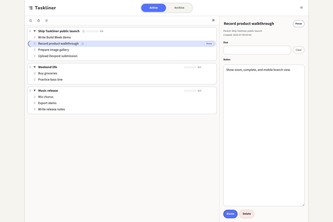
Taskliner is a self-reported keyboard-first task outliner for developers and power users. It is described as a local-first web application that stores data locally in the browser (IndexedDB) and optionally synchronizes across devices via Google Drive, without persisting task contents in an operator-managed database.
What changed
The project was submitted to the OpenAI 2026 hackathon on Devpost. The description indicates it evolved from a "vibe-coded prototype" into a release-ready application with features like real-time multi-device synchronization, offline support, and keyboard-driven workflows.
The single most important open question
Is there evidence of actual user adoption or commercial traction beyond the author's own development efforts?
What The Product Actually Is
The description states that Taskliner is:
- A fast, keyboard-first task outliner
- Built for developers and power users
- A lightweight web application using HTML, CSS, JavaScript
- Deployed through Cloudflare
- Uses IndexedDB as primary local database
- Optionally synchronizes via Google Drive
- Does not store task contents in its own database
It is described as a "local-first" tool that works offline and supports real-time multi-device editing.
Evidence The author's own write-up, source tags, and project description.
Inference It is a browser-based productivity tool with emphasis on developer workflow and data control.
Positioning & Claim Evolution
The description states:
- Taskliner was inspired by how developers naturally decompose complex problems into nested tasks
- It aims to be closer to "writing an outline" rather than traditional task managers that require project/list/category setup
- It positions itself as a fast, local-first tool for both personal and professional use
- It emphasizes not storing sensitive data in operator-managed databases
Evidence The author's own write-up.
Inference The positioning evolved from a developer-centric idea to a broader productivity tool with emphasis on privacy and control.
Target Customer & ICP
The description states:
- Target users are developers and power users
- It is designed for both personal and professional workflows involving project details, client work, development plans, and internal tasks
- The product is described as practical for "professional workflows involving project details, client work, development plans, and internal tasks that should remain under the user’s control"
Evidence The author's own write-up.
Inference The ICP appears to be technical professionals who value data privacy and keyboard-driven workflows.
Business Model & Pricing Evidence
The description states:
- No pricing information is provided
- It is described as a local-first tool that does not require an account for local use
- Optional multi-device synchronization uses storage controlled by the user
- Taskliner does not persist task contents in an operator-managed database
Evidence The author's own write-up.
Inference There is no commercial model or pricing structure described. It appears to be a free tool with optional paid features for synchronization.
Technical & Delivery Signals
The description states:
- Built with HTML, CSS, JavaScript
- Deployed through Cloudflare
- Uses IndexedDB as primary local database
- Synchronizes via Google Drive API and Cloudflare Workers
- Real-time coordination uses WebSockets
- Handles schema migrations, archived tasks, imports, exports, updates across browser tabs
- Uses Codex for development including computer-use and browser integration
- GPT-5.6 helped design synchronization behavior
Evidence The author's own write-up.
Inference The technical stack suggests a modern, client-side application with cloud infrastructure for coordination and synchronization.
Traction & Maturity Signals
The description states:
- It is described as a "release-ready application"
- It feels like a real product rather than a prototype
- It has been submitted to the OpenAI 2026 hackathon on Devpost
- The author mentions quality assurance, user-story coverage, error states, accessibility, responsive behavior, and interface details
Evidence The author's own write-up.
Inference There is no evidence of revenue, customers, or adoption beyond the author’s own development efforts.
Competitive Context
The description does not provide any information about competitors or market positioning.
Evidence Not evidenced.
Inference No competitive landscape or differentiation strategy is described.
Open Questions & Risks
The description states:
- The hardest challenge was synchronizing hierarchical data without using a central task database
- Mobile interaction was challenging due to keyboard-centric design
- Turning a vibe-coded prototype into a release-ready application required significant effort in quality assurance and edge cases
- The author notes that generative tools can speed up initial implementation but don't remove the need for engineering judgment
Evidence The author's own write-up.
Inference Key risks include:
- Limited mobile support
- Potential complexity in maintaining synchronization logic
- Risk of over-engineering or under-delivering on quality
- Lack of commercial traction or user feedback beyond development team
Questions the description leaves open
- What is the actual usage or adoption rate among developers?
- Are there any users who have paid for additional features or services?
- How do you plan to monetize this product if at all?
- What are the specific technical challenges you've faced in maintaining synchronization across devices?
- How do you handle data migration and compatibility with older versions?
- Do you have any plans for mobile support beyond web-based interaction?
Overall Assessment
The description states:
- It is a self-reported product built by one person (team size: 1)
- It was submitted to the OpenAI 2026 hackathon
- No revenue, customer or traction data is available beyond what the author states
- The author describes it as a release-ready application but does not provide evidence of commercial traction
Evidence The author's own write-up.
Inference There is no evidence of commercial viability or traction. The product appears to be a technical prototype with limited market validation. Investment or partnership potential is unclear without further evidence of user adoption, revenue, or scalability.
User Stories BotA demo video on every pull request
Get a demo video on every new feature
GitHub App that watches your pull requests and records a narrated, captioned demo.
Save time on demo prep and make informed decisions faster with a video walkthrough of every new feature.
Source
Submitted to the OpenAI 2026 hackathon on Devpost. Project home on Devpost. Back to the full gallery on Devpost.
This competitive analysis was produced by top-founders.com (opens in a new tab)
Generated by a language model from this project's public Devpost page — its tagline, the author's own write-up and any built-with tags listed there — as captured in August 2026. Short quotations are the author's words. It is an opinion on the idea as a business, not on the people behind it, and it reflects the description as published then. If the project has moved on, request a correction below. The analysis is not independent research and contains no verified traction, revenue or customer data.
An independent guide by KFG International LLC — not affiliated with, endorsed by, or connected to Devpost or OpenAI.