

Archive position — measured, not model output
0 likes on Devpost
2,263 of the 7,850 archived projects have more likes, and 5,587 share exactly 0 — so this project's #5,177 place in the like-ranked listing is a tie-break inside that group, not a ranking.
Projects (log scale)
Likes on Devpost. ▲ marks this project's group.
Show the figures
| Likes | Projects | Share of archive |
|---|---|---|
| 0 | 5,587 | 71.2% |
| 1 | 1,758 | 22.4% |
| 2 | 284 | 3.6% |
| 3–4 | 132 | 1.7% |
| 5–9 | 75 | 1.0% |
| 10+ | 14 | 0.2% |
 User Stories BotA demo video on every pull request
Get a demo video on every new feature
GitHub App that watches your pull requests and records a narrated, captioned demo.
Save time on demo prep and make informed decisions faster with a video walkthrough of every new feature.
Executive Summary
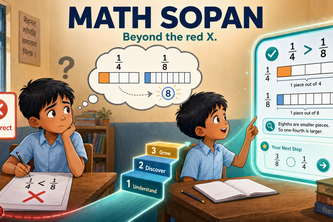
The company appears to be a single-person project (NIranjan Lamichhane) building an AI-powered adaptive math learning platform for Grade 4–5 students in Nepal, focused on fractions. The author states the goal is to assess learners' mathematical understanding beyond right/wrong answers and suggest next steps using GPT-5.6.
The single most important open question: What is the actual scope of the platform’s functionality, and how does it differ from or add value over existing tools for adaptive learning in math education?
Analysis is based entirely on self-reported evidence from the author's project description, submitted to the OpenAI 2026 hackathon. No independent verification or traction data is available.
What The Product Actually Is
The description states that Math Sopan is a web-based math assessment tool for Grade 4–5 learners in Nepal, aligned with the national curriculum. It uses AI (specifically GPT-5.6) to assess learners through short fraction questions and then provides personalized feedback and learning materials.
It also claims:
- The app adapts question selection based on learner answers.
- It offers lessons and practice in English and Nepali.
- Teachers can view learner progress and struggles.
- It uses a smart engine that identifies skill gaps and misunderstandings.
- It runs securely on Netlify, saves learning journeys, and works across devices.
Inference: The product appears to be an MVP for fraction-based adaptive math learning, built with React and Node.js, using OpenAI’s GPT models. It is not described as a full platform or scalable solution beyond its initial scope.
Positioning & Claim Evolution
The author states:
- The app aims to move beyond traditional grading by understanding why students are wrong.
- It allows learners to start from their current level, not the class pace.
- It uses AI to suggest next learning steps and generate content in English and Nepali.
Inference: The positioning is that of a diagnostic, adaptive learning tool for early math education, with an emphasis on personalization and teacher insights. However, no evidence is provided about how this differs from or improves upon existing tools or pedagogical approaches.
Target Customer & ICP
The description states:
- The primary users are Grade 4–5 learners in Nepal.
- Teachers can access reports and insights.
- Content is available in English and Nepali.
Inference: The target customer segment appears to be primary school students and teachers in Nepal, with a focus on math education. No evidence of broader market expansion or user segmentation beyond this scope.
Business Model & Pricing Evidence
The description does not state:
- Whether the app is free, paid, or subscription-based.
- How revenue would be generated (e.g., teacher licensing, student access, etc.).
- If there are any pricing tiers or monetization strategies.
Not evidenced: No business model or pricing information is provided by the author.
Technical & Delivery Signals
The description states:
- Built with React and Node.js.
- Uses GPT-5.6 for feedback generation.
- Deployed on Netlify.
- Works across devices.
- Saves learning journeys.
- Supports English and Nepali content.
Inference: The technical stack suggests a lightweight, web-based MVP, likely built quickly for a hackathon. No evidence of scalability, backend architecture, or long-term infrastructure planning is provided.
Traction & Maturity Signals
The description states:
- It is an MVP.
- It was built in the context of a hackathon (OpenAI 2026).
- The author mentions scoping challenges, suggesting early-stage development.
- No mention of user adoption, retention, or usage metrics.
Not evidenced: There is no evidence of traction, customer base, or product maturity beyond an initial prototype.
Competitive Context
The description does not provide:
- Information on competitors.
- Comparison with existing adaptive learning platforms.
- Market positioning relative to other tools in math education.
Not evidenced: No competitive analysis or market context is provided.
Open Questions & Risks
- Single-person development: The project is built by one individual, raising questions about scalability and long-term maintenance.
- Unverified AI integration: The use of GPT-5.6 is claimed but not demonstrated or validated in the description.
- Limited scope: The app currently focuses only on fractions for Grade 4–5 learners; no roadmap for expansion is evident.
- Hackathon MVP: The project was built as a hackathon submission, suggesting it may be incomplete or experimental.
Inference: The lack of independent validation, traction, and scalability planning raises concerns about the product’s viability beyond its initial form.
Questions the description leaves open
- What specific learning outcomes or skill gaps does the app identify, and how are they validated?
- How is the AI-generated feedback tested for accuracy and pedagogical value?
- Are there any plans to expand beyond fractions and Grade 4–5 learners?
- What is the intended business model, and how will it scale beyond a single developer?
- Has the app been tested with real students or teachers in Nepal?
Overall Assessment
Not evidenced: No data on valuation, funding, or commercial traction is available.
Inference: This appears to be an early-stage hackathon prototype, not yet a product ready for investment or partnership. The author’s own account indicates it is still in MVP form and lacks clear evidence of market fit, scalability, or monetization strategy. It may represent a promising idea but is not yet a commercial entity.
User Stories BotA demo video on every pull request
Get a demo video on every new feature
GitHub App that watches your pull requests and records a narrated, captioned demo.
Save time on demo prep and make informed decisions faster with a video walkthrough of every new feature.
Source
Submitted to the OpenAI 2026 hackathon on Devpost. Project home on Devpost. Back to the full gallery on Devpost.
This competitive analysis was produced by top-founders.com (opens in a new tab)
Generated by a language model from this project's public Devpost page — its tagline, the author's own write-up and any built-with tags listed there — as captured in August 2026. Short quotations are the author's words. It is an opinion on the idea as a business, not on the people behind it, and it reflects the description as published then. If the project has moved on, request a correction below. The analysis is not independent research and contains no verified traction, revenue or customer data.
An independent guide by KFG International LLC — not affiliated with, endorsed by, or connected to Devpost or OpenAI.