

Archive position — measured, not model output
0 likes on Devpost
2,263 of the 7,850 archived projects have more likes, and 5,587 share exactly 0 — so this project's #3,054 place in the like-ranked listing is a tie-break inside that group, not a ranking.
Projects (log scale)
Likes on Devpost. ▲ marks this project's group.
Show the figures
| Likes | Projects | Share of archive |
|---|---|---|
| 0 | 5,587 | 71.2% |
| 1 | 1,758 | 22.4% |
| 2 | 284 | 3.6% |
| 3–4 | 132 | 1.7% |
| 5–9 | 75 | 1.0% |
| 10+ | 14 | 0.2% |
 User Stories BotA demo video on every pull request
Get a demo video on every new feature
GitHub App that watches your pull requests and records a narrated, captioned demo.
Save time on demo prep and make informed decisions faster with a video walkthrough of every new feature.
Executive Summary
What the company appears to be
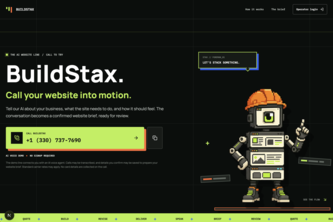
BuildStax is a self-reported autonomous sales agent that claims to build websites for local businesses without online presence. The project describes itself as an operator-facing command center that automates lead discovery, qualification, quoting, payment processing, website building, and delivery — all within a self-correcting loop.
What changed
The description indicates this is a hackathon submission (OpenAI 2026) with no evidence of prior traction or commercial deployment. It presents an end-to-end workflow for local business website creation but does not state whether it has been used beyond the prototype stage.
The single most important open question
Is there any evidence that BuildStax has been tested in real-world conditions with paying customers, or is this a fully self-reported prototype?
What The Product Actually Is
The description states that BuildStax is:
- A secure, login-protected command center for local business website creation.
- Designed to walk a local business from first contact through delivery.
- Built using Next.js, React, TypeScript, Tailwind CSS, PostgreSQL, Docker, OpenAI, Stripe, and Zero.xyz.
- Operates as an autonomous system with a self-correcting loop involving planning, acting, observing, and correcting.
It is described as a system that:
- Finds and qualifies leads (local businesses with weak or missing web presence).
- Makes initial calls to qualify prospects.
- Prices consistently using challenger pitch testing.
- Turns calls into scope, quotes, and Stripe-hosted checkout links.
- Builds only after payment verification.
- Publishes private, token-protected previews for customers.
- Collects feedback and tracks revisions until delivery is accepted.
The system uses a state machine approach rather than a chatbot with broad permissions. It treats all customer input as untrusted and enforces strict boundaries around pricing, provider selection, deployment targets, and credentials.
Evidence The author's own write-up.
Inference This appears to be a prototype or proof-of-concept built for a hackathon, not a production product.
Positioning & Claim Evolution
The description states that BuildStax is positioned as:
- An autonomous self-improving sales agent.
- A solution for local businesses without an online presence.
- A system that pulls together scattered lead management into one accountable, self-correcting loop.
It claims to be different from existing website builders by focusing on the full journey from first contact to delivery — not just page generation.
Evidence The author's own write-up.
Inference The positioning is based on a self-perception of solving inefficiencies in lead-to-delivery workflows, but there is no evidence that this has been validated with customers or markets.
Target Customer & ICP
The description states:
- Local businesses without an online presence.
- Businesses with weak web presence.
- Customers who need someone who understands their vision and follows through on revisions.
It also mentions that the system targets businesses that are "scattered across lead lists, phone calls, inboxes, payment links, website builders, and tools that forget everything as soon as you switch between them."
Evidence The author's own write-up.
Inference The ICP is local service-based businesses (e.g., plumbers, cleaners, consultants) that may not have digital presence but are looking for a structured way to get online. No data on actual customer segments or personas.
Business Model & Pricing Evidence
The description states:
- Pricing is consistent and tested using challenger versions of the pitch.
- The system keeps a record of what converts.
- It can never quote below a hard floor: whichever is higher, the operator's configured minimum or twice the estimated delivery cost.
- Payments are processed via Stripe-hosted checkout.
- Only verified payments (via signed webhook + database trigger) move projects forward.
There is no mention of recurring revenue models, subscription fees, or pricing tiers beyond the minimum price floor.
Evidence The author's own write-up.
Inference It appears to be a transactional model where each website build is priced and paid for individually. No evidence of SaaS or recurring revenue structure.
Technical & Delivery Signals
The description states:
- Built with Next.js 16, React 19, TypeScript, Tailwind CSS, Radix UI, Lucide.
- Uses InsForge (Postgres + Auth) as system of record.
- Nexla ingests agent events into a transformed dataset and exposes it through governed MCP tools.
- Zero.xyz is used for live capability routing.
- AkashML runs pitch-writing models.
- Stripe handles hosted checkout.
- Drizzle with file-backed SQLite provides local testing mode.
- Vitest, Playwright, and Axe cover workflow rules, auth boundaries, price-floor enforcement, feedback validation, health checks, layout, and accessibility.
It also mentions challenges like:
- Avoiding cached endpoints or prices.
- Ensuring idempotency and ownership checks in the database.
- Separating content from control to prevent prompt injection.
- Making sandbox-versus-live status explicit.
Evidence The author's own write-up.
Inference The technical stack suggests a modern, secure, and modular architecture. However, this is a prototype built for a hackathon — not a production-grade system.
Traction & Maturity Signals
The description states:
- BuildStax now runs the full operator workflow end to end.
- It has completed guarded transitions from discovery through delivery.
- It handles permanent do-not-call handling, price-floor enforcement, fulfillment only after verified payment, customer previews, revision tracking, visible integration health, and a tested mobile experience.
- A $0.01 search for Oakland businesses returned 25 records, 16 of which had no website listed.
There is no evidence of:
- Revenue or customers.
- Product-market fit validation.
- Commercial adoption.
- Any prior version or iteration beyond the hackathon submission.
Evidence The author's own write-up.
Inference This is a prototype with limited real-world testing. No evidence of traction, revenue, or customer base.
Competitive Context
The description does not mention any competitors directly.
However, it implies that BuildStax operates in a space where:
- Local business website builders exist.
- Lead management tools are used.
- Marketplace providers for web development services are available.
- There is a need for structured workflows from lead to delivery.
It positions itself as solving inefficiencies in current tools by centralizing the process and enforcing accountability through automation.
Evidence The author's own write-up.
Inference No competitive analysis or market positioning beyond self-description. No evidence of existing players or competitive differentiation.
Open Questions & Risks
- Unverified claims: All descriptions are self-reported and unverified.
- No traction or revenue: No evidence of customers, sales, or monetization.
- Prototype-only: The system is described as a hackathon submission with no indication of production use.
- High technical complexity: The architecture involves multiple integrations (Zero.xyz, Stripe, OpenAI, etc.), which may not be fully realized in this version.
- Unclear scalability: No evidence that the system can scale beyond a small team or prototype.
- Lack of commercial validation: No data on pricing effectiveness, customer feedback, or conversion rates.
Evidence The author's own write-up.
Inference This is a high-risk, early-stage idea with no proven market demand or execution track record.
Questions the description leaves open
- What real-world testing has been done beyond the hackathon?
- Has BuildStax been used by any actual local businesses or operators?
- How does it plan to scale beyond a two-person team?
- Are there any existing customers or pilot programs?
- What is the current status of integration with providers like Plivo and OpenAI Realtime phone bridge?
- How does the system handle edge cases in customer communication or payment failures?
- Is there a long-term vision for monetization beyond one-off website builds?
- What are the key assumptions about local business needs that have not yet been validated?
Overall Assessment
The description states that BuildStax is a hackathon submission and does not contain any evidence of traction, revenue, or commercial adoption.
It presents an ambitious idea with a strong technical foundation but lacks:
- Customer validation.
- Market data.
- Commercial viability indicators.
- Evidence of product-market fit.
Given the self-reported nature of the description and lack of external verification, this is a speculative opportunity at best.
Assessment Not evidenced. No commercial due-diligence signal to support investment or partnership interest. This appears to be an early-stage prototype with no demonstrated traction or market validation.
User Stories BotA demo video on every pull request
Get a demo video on every new feature
GitHub App that watches your pull requests and records a narrated, captioned demo.
Save time on demo prep and make informed decisions faster with a video walkthrough of every new feature.
Source
Submitted to the OpenAI 2026 hackathon on Devpost. Project home on Devpost. Back to the full gallery on Devpost.
This competitive analysis was produced by top-founders.com (opens in a new tab)
Generated by a language model from this project's public Devpost page — its tagline, the author's own write-up and any built-with tags listed there — as captured in August 2026. Short quotations are the author's words. It is an opinion on the idea as a business, not on the people behind it, and it reflects the description as published then. If the project has moved on, request a correction below. The analysis is not independent research and contains no verified traction, revenue or customer data.
An independent guide by KFG International LLC — not affiliated with, endorsed by, or connected to Devpost or OpenAI.