

Archive position — measured, not model output
0 likes on Devpost
2,263 of the 7,850 archived projects have more likes, and 5,587 share exactly 0 — so this project's #5,017 place in the like-ranked listing is a tie-break inside that group, not a ranking.
Projects (log scale)
Likes on Devpost. ▲ marks this project's group.
Show the figures
| Likes | Projects | Share of archive |
|---|---|---|
| 0 | 5,587 | 71.2% |
| 1 | 1,758 | 22.4% |
| 2 | 284 | 3.6% |
| 3–4 | 132 | 1.7% |
| 5–9 | 75 | 1.0% |
| 10+ | 14 | 0.2% |
 User Stories BotA demo video on every pull request
Get a demo video on every new feature
GitHub App that watches your pull requests and records a narrated, captioned demo.
Save time on demo prep and make informed decisions faster with a video walkthrough of every new feature.
Executive Summary
What the company appears to be
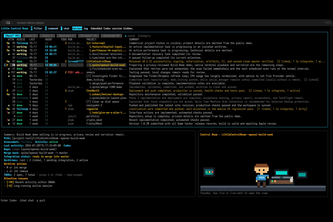
Little Control Room is a terminal-first IDE and control room for managing multiple Codex projects, agents, deferred prompts, and worktrees. It is described as a self-contained tool built by one developer (Davide Pasca) using bubble-tea framework.
What changed
During OpenAI Build Week 2026, the author extended Little Control Room with a rendered-frame recording and editing workflow designed for real daily use. This included source-driven terminal recording, capture-time masking for privacy, smart timing for demo pacing, and automated reframing of long sessions.
Single most important open question
Is there any evidence of actual usage or adoption beyond the author’s personal development environment?
What The Product Actually Is
The description states that Little Control Room is:
- A terminal-first IDE.
- A control room for multi-project Codex work.
- Designed to manage repositories, existing Codex sessions, and embedded live sessions.
- A tool that allows one-line AI summaries of agent activity without opening each session.
- A system with a central TODO workflow for capturing delayed prompts.
- Capable of handling worktrees, automated integration, and commit assistance.
- Built using the bubble-tea framework.
Inference It appears to be a developer-centric tool focused on managing parallel AI agent workflows in a terminal environment. It is not a commercial product but rather an open-source project submitted for a hackathon.
Positioning & Claim Evolution
The author positions Little Control Room as:
- A way to manage many Codex projects from one interface.
- An alternative to traditional IDEs where project lists are secondary.
- A tool that keeps the state of all active projects visible while allowing switching between them without context loss.
Inference The positioning reflects a shift in how developers interact with AI agents — moving from isolated sessions to a centralized view. The evolution during Build Week suggests an intent to make it suitable for real-world use, not just prototyping.
Target Customer & ICP
The description states:
- The tool is aimed at developers working across multiple repositories.
- It supports users who run several Codex agents simultaneously.
- Users want to see what each agent is doing without manually opening sessions.
- It targets those who value context preservation and parallel task management.
Inference The primary user is likely a developer or engineer using AI tools like Codex in a multi-project environment. The ICP seems narrow — focused on developers with specific workflows involving AI agents and Git worktrees.
Business Model & Pricing Evidence
Not evidenced.
Explanation
There is no mention of pricing, monetization strategy, or business model in the description. The project appears to be open-source and submitted for a hackathon.
Technical & Delivery Signals
The description states:
- Built with bubble-tea framework.
- Supports macOS and Linux; Windows not supported.
- Includes setup instructions, testing commands, and Build Week evidence.
- Uses GPT-5.6 Sol for deeper implementation work and GPT-5.6 Luna for high-frequency management tasks.
- Features source-driven terminal recording, capture-time masking, privacy review, smart timing, and automated reframing.
Inference The technical stack is minimal but functional — a TUI-based tool with AI integration. The delivery signals suggest it’s built for developers familiar with terminals and Git workflows.
Traction & Maturity Signals
Not evidenced.
Explanation
There is no evidence of revenue, customers, or adoption beyond the author's personal use case. No metrics, usage data, or user feedback are provided.
Competitive Context
Not evidenced.
Explanation
No mention of competitors or market positioning relative to existing tools for managing AI agents or multi-project workflows in terminals.
Open Questions & Risks
- Single-person development: The project is built by one person (Davide Pasca), which raises questions about long-term maintenance and scalability.
- Limited platform support: Only macOS and Linux are supported; no Windows support.
- No commercial traction: No evidence of users, customers, or revenue — it’s a hackathon submission.
- Unverified claims: All descriptions are self-reported and unverified.
Questions the description leaves open
- What is the actual utility of this tool beyond personal use?
- Are there any existing users or early adopters?
- How does the tool integrate with current workflows in practice?
- Is there a plan for ongoing development or maintenance?
- What are the technical limitations or scalability concerns?
- Has the author considered how to make this more accessible to non-technical users?
Overall Assessment
Not evidenced.
Explanation
There is no evidence of commercial viability, traction, or strategic fit for investment or partnership. The project is described as a hackathon submission with no indication of market readiness or business model.
User Stories BotA demo video on every pull request
Get a demo video on every new feature
GitHub App that watches your pull requests and records a narrated, captioned demo.
Save time on demo prep and make informed decisions faster with a video walkthrough of every new feature.
Source
Submitted to the OpenAI 2026 hackathon on Devpost. Project home on Devpost. Back to the full gallery on Devpost.
This competitive analysis was produced by top-founders.com (opens in a new tab)
Generated by a language model from this project's public Devpost page — its tagline, the author's own write-up and any built-with tags listed there — as captured in August 2026. Short quotations are the author's words. It is an opinion on the idea as a business, not on the people behind it, and it reflects the description as published then. If the project has moved on, request a correction below. The analysis is not independent research and contains no verified traction, revenue or customer data.
An independent guide by KFG International LLC — not affiliated with, endorsed by, or connected to Devpost or OpenAI.