

Archive position — measured, not model output
0 likes on Devpost
2,263 of the 7,850 archived projects have more likes, and 5,587 share exactly 0 — so this project's #6,980 place in the like-ranked listing is a tie-break inside that group, not a ranking.
Projects (log scale)
Likes on Devpost. ▲ marks this project's group.
Show the figures
| Likes | Projects | Share of archive |
|---|---|---|
| 0 | 5,587 | 71.2% |
| 1 | 1,758 | 22.4% |
| 2 | 284 | 3.6% |
| 3–4 | 132 | 1.7% |
| 5–9 | 75 | 1.0% |
| 10+ | 14 | 0.2% |
 User Stories BotA demo video on every pull request
Get a demo video on every new feature
GitHub App that watches your pull requests and records a narrated, captioned demo.
Save time on demo prep and make informed decisions faster with a video walkthrough of every new feature.
Executive Summary
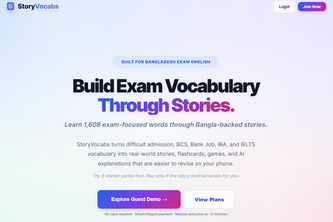
What the company appears to be: StoryVocabs is a self-reported bilingual vocabulary-learning platform for Bangladeshi students preparing for competitive exams. The author describes it as a mobile-friendly Progressive Web App (PWA) that uses interactive stories, active-recall games, and smart review to help learners master difficult English words through Bangla meanings.
What changed: The project was built during the OpenAI 2026 hackathon ("OpenAI Build Week"). During this time, the author used AI tools like GPT-5.6 (via Codex) for architecture mapping, testing, security hardening, and documentation. A credential-free Guest Demo was added for judges.
Single most important open question: Is there evidence of user adoption or engagement beyond the author's own use case? The description states no revenue, customers, or traction data exist beyond what is self-reported.
Note: This analysis is based entirely on the self-reported project description provided by the caller. No third-party verification, archived history, or independent sources are available. All claims are attributed to the author’s own account and should be treated as unverified.
What The Product Actually Is
The description states that StoryVocabs is a bilingual vocabulary-learning platform built for Bangladeshi students preparing for exams such as university admission, BCS, IBA, bank-job, and IELTS. It includes:
- 81 vocabulary packs
- 1,620 vocabulary records
- 1,608 unique words
- 405 contextual stories
Each word is presented with:
- English definitions
- Bengali meanings
- Example sentences
- Pronunciation
- Synonyms and antonyms
- Exam-focused usage guidance
Learners can engage through:
- Interactive stories
- Mastery Flashcards
- Arena Matching or Vocab Gambit games
- Bookmarking difficult words
- Review and progress tracking
It also includes Voco, a bilingual vocabulary assistant that explains words in English or Bangla.
The application works as a Progressive Web App (PWA), allowing installation on mobile devices with an app-like interface.
Inference: The platform appears to be designed around spaced repetition and contextual learning, though no explicit mention of algorithmic scheduling is made.
Positioning & Claim Evolution
The author positions StoryVocabs as a solution to the problem of disconnected vocabulary lists that fail to support recall during exams. It aims to provide a connected learning process where words are understood, seen in context, practiced, and reviewed.
Key positioning claims:
- Learners can understand a word, see it inside a memorable story, practice it, and return for review.
- The platform supports both English and Bengali meanings.
- It focuses on exam-relevant vocabulary and usage.
- It is mobile-friendly and installable as a PWA.
Claim vs Fact: These are self-reported claims about intent and design. No evidence of actual user feedback or adoption is provided.
Target Customer & ICP
The description states that StoryVocabs targets:
- Bangladeshi students preparing for competitive exams
- Specific exam categories: university admission, BCS, IBA, bank-job, IELTS
Inference: The target customer segment appears to be young learners in Bangladesh who are focused on standardized test preparation and require bilingual support.
Business Model & Pricing Evidence
There is no evidence of a business model or pricing structure in the description. The author mentions:
- A credential-free Guest Demo for judges
- No mention of paid features, subscriptions, or monetization strategies
Not evidenced: No information on how the product will generate revenue or whether it has any commercial offering beyond the demo.
Technical & Delivery Signals
The platform is built with:
- Frontend: React 19, JavaScript, Vite
- Backend: Supabase (PostgreSQL), server-side functions
- Deployment: Vercel
- AI Tools Used During Build Week: GPT-5.6 via Codex, Groq for Voco, OpenRouter as fallback
- Other Technologies: Web Speech API for pronunciation, ESLint, GitHub Actions
The author notes:
- Structured static data keeps core experience fast
- Supabase handles authentication and user learning state
- The app is installable as a PWA
- Automated checks and tests were implemented (12 passing tests)
- Zero-warning linting enforced
Inference: The technical stack suggests a modern, scalable architecture with attention to performance and developer experience.
Traction & Maturity Signals
The description states:
- 81 vocabulary packs
- 1,608 unique words
- 405 contextual stories
- A working Guest Demo available for judges until August 9, 2026
- Twelve automated tests pass
- Zero-warning ESLint
- Verified production build and PWA cache policy
Not evidenced: No data on actual users, retention rates, engagement metrics, or revenue. The platform exists in a pre-launch state with no commercial traction.
Competitive Context
No mention of competitors is provided in the description. The author does not reference existing tools or platforms for vocabulary learning or bilingual education.
Not evidenced: No competitive landscape analysis or differentiation strategy described.
Open Questions & Risks
- Lack of traction: No evidence of users, customers, or revenue.
- Unverified claims: All descriptions are self-reported and unverified.
- Limited scope: The product appears to be a prototype built for a hackathon with no indication of long-term viability or scalability.
- No commercialization plan: No pricing, monetization, or go-to-market strategy described.
- Single founder: Team size is listed as one person, which may limit execution capacity.
Inference: The project lacks commercial maturity and user validation, making it a high-risk investment or partnership opportunity without further evidence.
Questions the description leaves open
- What specific exam preparation goals does StoryVocabs aim to address?
- How many learners have used the platform outside of the demo environment?
- Are there any plans for monetization, and what is the intended business model?
- What are the long-term content creation and maintenance strategies?
- Has the author considered localization beyond Bangla/English or expansion into other markets?
- What is the plan for scaling beyond a single developer?
- How does the platform ensure quality control of vocabulary and story content?
Overall Assessment
Not evidenced: There is no evidence of revenue, customers, or traction to support an investment or partnership decision.
Confidence Level: Low — based on self-reported information only, with no third-party validation or commercial data.
The project appears to be a functional prototype built during a hackathon. It shows technical capability and clear intent but lacks any indication of real-world adoption or sustainable business model. Without further evidence of traction or scalability, it cannot be recommended for investment or strategic partnership at this time.
User Stories BotA demo video on every pull request
Get a demo video on every new feature
GitHub App that watches your pull requests and records a narrated, captioned demo.
Save time on demo prep and make informed decisions faster with a video walkthrough of every new feature.
Source
Submitted to the OpenAI 2026 hackathon on Devpost. Project home on Devpost. Back to the full gallery on Devpost.
This competitive analysis was produced by top-founders.com (opens in a new tab)
Generated by a language model from this project's public Devpost page — its tagline, the author's own write-up and any built-with tags listed there — as captured in August 2026. Short quotations are the author's words. It is an opinion on the idea as a business, not on the people behind it, and it reflects the description as published then. If the project has moved on, request a correction below. The analysis is not independent research and contains no verified traction, revenue or customer data.
An independent guide by KFG International LLC — not affiliated with, endorsed by, or connected to Devpost or OpenAI.