

Archive position — measured, not model output
0 likes on Devpost
2,263 of the 7,850 archived projects have more likes, and 5,587 share exactly 0 — so this project's #3,056 place in the like-ranked listing is a tie-break inside that group, not a ranking.
Projects (log scale)
Likes on Devpost. ▲ marks this project's group.
Show the figures
| Likes | Projects | Share of archive |
|---|---|---|
| 0 | 5,587 | 71.2% |
| 1 | 1,758 | 22.4% |
| 2 | 284 | 3.6% |
| 3–4 | 132 | 1.7% |
| 5–9 | 75 | 1.0% |
| 10+ | 14 | 0.2% |
 User Stories BotA demo video on every pull request
Get a demo video on every new feature
GitHub App that watches your pull requests and records a narrated, captioned demo.
Save time on demo prep and make informed decisions faster with a video walkthrough of every new feature.
Executive Summary
Company: BureauService
Self-reported basis: The description is entirely self-reported and unverified, based on a Devpost submission for an OpenAI 2026 hackathon project. No external corroboration exists.
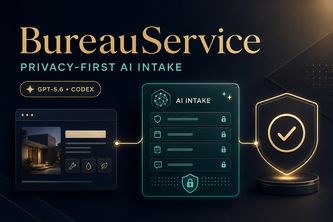
What it appears to be: A prototype workflow that uses GPT-5.6 to normalize operational service requests from small businesses into structured data, while maintaining strict privacy controls and human-in-the-loop decision-making. It is built as an isolated staging module for Telegram-based intake, with no production integration or real customer data.
What changed: During Build Week, the team implemented a privacy-filtered GPT-5.6 intake system that enforces strict schema validation and local source-binding checks before and after model responses. The prototype includes automated tests, fail-closed logic, and human-controlled request state transitions.
Most important open question: Is there evidence of traction, revenue, or real-world adoption beyond this isolated prototype? The description makes no claims about customers, usage, or monetization.
What The Product Actually Is
The description states that BureauService is a prototype workflow for small service businesses. It uses GPT-5.6 to process operational preferences from users (e.g., service type, duration, date/time, city) and returns structured data fields such as service_code, duration_minutes, preferred_date_or_period, etc.
Key technical features include:
- A local privacy gate that blocks personal identifiers like names, contact details, addresses, and health-related text.
- Integration with OpenAI's GPT-5.6 API, but only on allowlisted operational data.
- Structured output validation using local code to reject unsupported or invented values.
- A human-controlled review card where the business owner decides whether to approve, decline, or reschedule a request.
- The system is designed so that GPT-5.6 cannot make external actions, and all decisions remain under human control.
This is described as an isolated staging prototype using synthetic data and in-memory state, not connected to any production systems or real customer workflows.
Inference: The product appears to be a proof-of-concept for AI-assisted intake automation with strong privacy constraints. It does not appear to have any live or operational functionality beyond the prototype scope.
Positioning & Claim Evolution
The description states that BureauService was inspired by the founder’s experience as a self-employed mobile massage therapist and aims to solve a practical problem: how to handle repeated messages and operational requests without exposing sensitive data or delegating control to AI.
It positions itself as:
- A privacy-first solution for small service businesses.
- Designed for small operators, not large enterprises.
- Not focused on autonomous decision-making, but on narrow normalization between human input and review.
The claim evolution shows a shift from general problem-solving (handling messages) to a specific technical approach (using GPT-5.6 with strict privacy boundaries and validation).
Inference: The positioning is clear: small business owners need structured intake tools that protect their data and keep them in control. However, the description does not indicate any evolution toward commercial viability or market traction.
Target Customer & ICP
The description states:
- The target customer is small service businesses, such as mobile massage therapists, trainers, cleaners, repair specialists, tutors, etc.
- These are self-employed individuals who manage their own operations and do not use complex enterprise tools.
- The business owner keeps the final decision, which aligns with a human-in-the-loop model.
No explicit ICP (Ideal Customer Profile) is defined beyond this general category. No segmentation by industry, size, or geographic region is mentioned.
Inference: The ICP seems to be small, self-employed service providers who want automation but prioritize privacy and control. However, no evidence of actual customer targeting or feedback exists in the description.
Business Model & Pricing Evidence
The description does not provide any information on:
- Revenue model
- Pricing strategy
- Monetization plans
- Customer acquisition costs
- Unit economics
It only mentions that the project is a prototype, and that future steps include adding persistent storage, rate limits, retry handling, and legal/privacy review — but no commercial or pricing details are included.
Inference: No business model or pricing evidence is present. The project is described as a hackathon prototype with no indication of monetization plans.
Technical & Delivery Signals
The description provides several technical signals:
- Built using GPT-5.6, Codex, Python, PowerShell, Telegram, and OpenAI API.
- Implements a local privacy filter before model calls.
- Uses structured output schema validation post-model response.
- Includes automated tests (55 pass, 0 failures).
- Has fail-closed configuration, identity checks, and model-evidence verification.
- Uses version checks, idempotency, and state-machine transitions.
- Includes redacted evidence and reproduction instructions in the public repository.
Inference: The technical implementation is well-documented for a prototype. It shows attention to privacy, validation, and robustness — but again, this is within a prototype context with no production deployment.
Traction & Maturity Signals
The description states:
- This is an isolated staging prototype.
- It uses synthetic data and in-memory state.
- It is not connected to any public website, calendar, WhatsApp, payments, routes, or production systems.
- No real customer data has been used with the prototype.
There are no claims about:
- Customers
- Usage metrics
- Revenue
- Product-market fit
- Adoption rates
Inference: There is no evidence of traction or maturity beyond a hackathon prototype. The project has not moved into a live or operational phase.
Competitive Context
The description does not mention any competitors or direct market comparisons.
It implies that existing tools for small businesses are either:
- Too expensive
- Too complicated
- Designed for larger companies
But no specific names, products, or market players are identified.
Inference: The competitive context is unclear. No evidence of competitor analysis or positioning against existing solutions is provided.
Open Questions & Risks
Key risks and open questions based on the description:
- Prototype-only status: The system is not connected to any real-world tools or production workflows.
- No customer data or usage: No evidence of actual users, adoption, or feedback.
- No revenue or monetization: No indication of a business model or pricing strategy.
- Unproven scalability: The prototype uses in-memory state and synthetic data — no evidence of handling real-world scale.
- Unclear path to production: Future steps include storage, localization, accessibility testing, legal review — but no clear roadmap to market readiness.
Inference: The project is a technical demonstration with strong privacy controls, but lacks any commercial or operational foundation.
Questions the description leaves open
- What is the actual business context behind this prototype? Is there a real-world use case beyond the hackathon?
- Are there any existing customers or early adopters who have expressed interest in using this system?
- How does the team plan to transition from a prototype to a production-ready product?
- What are the specific privacy and legal risks that need to be addressed before deployment?
- Is there a clear monetization strategy or business model beyond the prototype?
- How will the system scale beyond Telegram, and what integrations are planned?
- What is the timeline for adding persistent storage, rate limits, and audit trails?
Overall Assessment
Not evidenced: The description does not provide any evidence of traction, revenue, customers, or a clear path to commercialization.
This is a technical prototype with strong privacy controls and validation logic. It shows potential for solving a real problem in small business intake workflows but lacks any indication of:
- Market fit
- Product-market traction
- Commercial viability
- Real-world adoption
Inference: At this stage, the project is not ready for investment or partnership consideration. It is a proof-of-concept with no demonstrated commercial value or operational readiness.
User Stories BotA demo video on every pull request
Get a demo video on every new feature
GitHub App that watches your pull requests and records a narrated, captioned demo.
Save time on demo prep and make informed decisions faster with a video walkthrough of every new feature.
Source
Submitted to the OpenAI 2026 hackathon on Devpost. Project home on Devpost. Back to the full gallery on Devpost.
This competitive analysis was produced by top-founders.com (opens in a new tab)
Generated by a language model from this project's public Devpost page — its tagline, the author's own write-up and any built-with tags listed there — as captured in August 2026. Short quotations are the author's words. It is an opinion on the idea as a business, not on the people behind it, and it reflects the description as published then. If the project has moved on, request a correction below. The analysis is not independent research and contains no verified traction, revenue or customer data.
An independent guide by KFG International LLC — not affiliated with, endorsed by, or connected to Devpost or OpenAI.