

Archive position — measured, not model output
0 likes on Devpost
2,263 of the 7,850 archived projects have more likes, and 5,587 share exactly 0 — so this project's #3,057 place in the like-ranked listing is a tie-break inside that group, not a ranking.
Projects (log scale)
Likes on Devpost. ▲ marks this project's group.
Show the figures
| Likes | Projects | Share of archive |
|---|---|---|
| 0 | 5,587 | 71.2% |
| 1 | 1,758 | 22.4% |
| 2 | 284 | 3.6% |
| 3–4 | 132 | 1.7% |
| 5–9 | 75 | 1.0% |
| 10+ | 14 | 0.2% |
 User Stories BotA demo video on every pull request
Get a demo video on every new feature
GitHub App that watches your pull requests and records a narrated, captioned demo.
Save time on demo prep and make informed decisions faster with a video walkthrough of every new feature.
Executive Summary
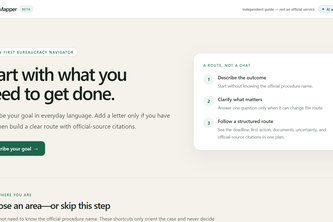
What the company appears to be: BurgerMapper is a self-reported AI-powered bureaucracy navigator for Berlin residents. The author describes building a tool that allows users to describe their bureaucratic goal in plain language and receive step-by-step guidance including deadlines, documents, and official sources.
What changed: The project evolved from a personal solution for the founder's own bureaucratic challenges into a general-purpose application intended for broader use. It was built during OpenAI Build Week 2026 as part of a hackathon submission.
Single most important open question: Does BurgerMapper actually work as described, or is it a prototype that has not yet been tested with real users?
What The Product Actually Is
The description states that BurgerMapper is an AI agent that helps users navigate Berlin's bureaucratic processes. It claims to:
- Accept user goals in plain language
- Provide deadline-first guidance
- Include next actions and required documents
- Use live search of official sources
- Output guides in English, German, or Arabic with RTL layout support
- Operate entirely client-side with privacy-by-architecture principles
The author reports using GPT-5.6 (via ChatGPT and Codex CLI), Node.js, React, Next.js, TypeScript, Vercel, and Zod for validation.
Inference: The product appears to be a web-based application that uses AI to interpret user requests and retrieve official information about bureaucratic processes in Berlin.
Positioning & Claim Evolution
The author positions BurgerMapper as:
- A "goal-first bureaucracy navigator"
- An alternative to chatbots or jargon-heavy systems
- A tool that lifts anxiety from bureaucratic tasks
- A privacy-safe solution that never logs or stores user input
Inference: The positioning evolved from a personal tool to a scalable service for others facing similar bureaucratic challenges. The claim of being "simple" and "effective" is central to its value proposition.
Target Customer & ICP
The description states:
- The founder was a Moroccan immigrant in Berlin who faced bureaucratic hurdles
- The app is intended for people needing to navigate Berlin's bureaucracy
- It supports English, German, and Arabic languages
Inference: The target customer appears to be immigrants or newcomers to Berlin who need help with bureaucratic processes. However, there is no evidence of specific segmentation beyond language support.
Business Model & Pricing Evidence
Not evidenced.
The description does not mention any pricing model, monetization strategy, or business model details.
Technical & Delivery Signals
The author reports:
- Built using GPT-5.6 (via ChatGPT and Codex CLI)
- Uses Node.js, React, Next.js, TypeScript, Vercel
- Implements Zod for validation
- Operates client-side with no logging or storage
- Includes privacy-safe features like browser-based download
- Has 165 automated tests and versioned evaluation gates
Inference: The technical stack suggests a modern web application built with AI integration. The emphasis on privacy and client-side processing indicates a deliberate design choice.
Traction & Maturity Signals
Not evidenced.
There is no mention of users, customers, revenue, or adoption metrics. The project is described as a hackathon submission.
Competitive Context
Not evidenced.
The description does not reference existing competitors or similar products in the bureaucratic navigation space.
Open Questions & Risks
- Unverified functionality: The product is described as built during a hackathon and has not been tested with real users.
- Lack of traction evidence: No data on usage, customers, or revenue.
- Privacy claims without verification: The privacy-by-architecture approach is self-reported.
- Single-person team: The project was built by one individual (Khalido 195).
- No commercial viability stated: There's no indication of how the product would generate revenue.
Questions the description leaves open
- How many real users have tested this tool beyond the founder?
- What is the actual process for gathering and validating official bureaucratic information?
- Can you demonstrate a working prototype with sample inputs and outputs?
- How do you plan to scale beyond Berlin's bureaucracy?
- What are the legal implications of providing unofficial guidance on official processes?
Overall Assessment
Not evidenced.
There is no evidence of funding, investment interest, or partnership discussions. The project appears to be a personal initiative built during a hackathon with no commercial traction or business development yet.
User Stories BotA demo video on every pull request
Get a demo video on every new feature
GitHub App that watches your pull requests and records a narrated, captioned demo.
Save time on demo prep and make informed decisions faster with a video walkthrough of every new feature.
Source
Submitted to the OpenAI 2026 hackathon on Devpost. Project home on Devpost. Back to the full gallery on Devpost.
This competitive analysis was produced by top-founders.com (opens in a new tab)
Generated by a language model from this project's public Devpost page — its tagline, the author's own write-up and any built-with tags listed there — as captured in August 2026. Short quotations are the author's words. It is an opinion on the idea as a business, not on the people behind it, and it reflects the description as published then. If the project has moved on, request a correction below. The analysis is not independent research and contains no verified traction, revenue or customer data.
An independent guide by KFG International LLC — not affiliated with, endorsed by, or connected to Devpost or OpenAI.