

Archive position — measured, not model output
0 likes on Devpost
2,263 of the 7,850 archived projects have more likes, and 5,587 share exactly 0 — so this project's #6,983 place in the like-ranked listing is a tie-break inside that group, not a ranking.
Projects (log scale)
Likes on Devpost. ▲ marks this project's group.
Show the figures
| Likes | Projects | Share of archive |
|---|---|---|
| 0 | 5,587 | 71.2% |
| 1 | 1,758 | 22.4% |
| 2 | 284 | 3.6% |
| 3–4 | 132 | 1.7% |
| 5–9 | 75 | 1.0% |
| 10+ | 14 | 0.2% |
 User Stories BotA demo video on every pull request
Get a demo video on every new feature
GitHub App that watches your pull requests and records a narrated, captioned demo.
Save time on demo prep and make informed decisions faster with a video walkthrough of every new feature.
Executive Summary
What the company appears to be: Strata19 is a self-reported project-intelligence and verification plugin for Codex, built as a free local tool that indexes repositories and provides shared context between developers and AI agents. It aims to solve problems of tracking unfinished work, verifying task completion, and maintaining coherent project understanding in AI-assisted development workflows.
What changed: The description indicates this is a hackathon submission (submitted to the OpenAI 2026 hackathon) that represents an early-stage prototype or proof-of-concept. It was built using Codex as its primary environment and includes a local repository index, deterministic checks, and a completion gate.
Single most important open question: Is there evidence of traction, revenue, or customer adoption beyond the author's own use case? The description contains no data on users, customers, or monetization.
Note: This analysis is based entirely on the self-reported, unverified project description supplied by the caller. No external verification or historical data are available. All claims in this report are labeled as either "evidenced" or "inferred" where appropriate.
What The Product Actually Is
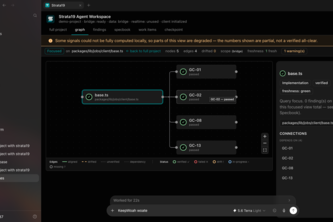
The description states that Strata19 is a free, local project-intelligence and verification plugin for Codex. It builds a shared project reference from the repository itself, using:
- A local repository index
- Deterministic repository checks
- Codex task-lifecycle hooks
- A native project workspace inside Codex
- Checkpoints, findings, work items, and specification context
- GPT-5.6 assistance for explanation and drafting, isolated from the assessment
It is described as a standalone local package built around these components.
Evidenced: The product is defined by the author’s own description. No independent verification or technical documentation exists outside this account.
Positioning & Claim Evolution
The author claims that Strata19 addresses a growing problem in AI-assisted development: as agents become more capable, the bottleneck shifts from writing code to tracking and verifying what has been written.
It positions itself as:
- A tool for developers and Codex agents to share a common understanding of the repository
- A way to prevent false completions by checking repository state before allowing tasks to end
- A solution that preserves human decisions in project records rather than losing them in chat transcripts
It also claims that it separates deterministic checks from AI-generated explanations, with the latter used only for language-heavy tasks.
Inferred: The evolution of positioning appears to be from a problem (AI-generated code being hard to track) to a solution (shared reference and verification). There is no evidence of prior versions or market positioning beyond this single submission.
Target Customer & ICP
The description states that Strata19 targets:
- Developers working with Codex
- AI agents in coding workflows, particularly those using Codex
- Users who want to track unfinished work, verify task completion, and maintain coherence in large projects where AI-generated code is prevalent
It does not specify a broader customer segment beyond this niche use case.
Evidenced: The target audience is described directly by the author. No evidence of segmentation or broader market targeting.
Business Model & Pricing Evidence
The description states that Strata19 is offered as a free plugin and runs locally without requiring an account.
It also mentions that there is a larger platform beyond the free plugin, which would include features like:
- Guided discovery
- Authoritative specifications
- Continuous spec-to-code synchronization
- Multi-agent coordination
However, no pricing information or monetization strategy for either the plugin or the platform is provided.
Evidenced: The free nature of the plugin is stated. No evidence of revenue model, pricing tiers, or paid features beyond the free version.
Technical & Delivery Signals
The author reports that Strata19 was built using:
- Codex as the primary development environment
- Kotlin, TypeScript, PostgreSQL, and pgvector
- A local repository index
- MCP tools
- Deterministic detectors
- Codex lifecycle hooks
- A native project workspace inside Codex
It includes a test proving that verification results stay identical with or without the model enabled.
Evidenced: The technical stack and architecture are described. No evidence of production deployment, scalability, or performance metrics.
Traction & Maturity Signals
The description makes no claims about traction, adoption, or usage beyond the author’s own experience during a hackathon.
It notes that:
- The plugin was tested against its own source code
- It includes an unfinished finding in the demo to demonstrate real-world utility
- It was built under deadline pressure and focused on functionality over polish
There is no mention of users, customers, or market validation.
Evidenced: No traction data, customer feedback, or usage metrics are provided. The project is described as a hackathon submission.
Competitive Context
The description does not provide any information about competitors or the competitive landscape.
It does not reference similar tools or platforms that address repository tracking, AI agent coordination, or code verification in development workflows.
Not evidenced: No competitive analysis or positioning relative to other tools is available.
Open Questions & Risks
- The project is described as a hackathon submission, suggesting it may be an early prototype with limited functionality.
- There is no evidence of revenue, customers, or traction beyond the author’s own use case.
- The product is not independently verified, and all claims are self-reported.
- The free plugin is local-only, which may limit scalability or adoption in enterprise settings.
- The description implies a larger platform exists, but no details on its development stage, roadmap, or commercial viability are given.
Inferred: These risks stem from the lack of external validation and evidence of product-market fit.
Questions the description leaves open
- What is the current status of the larger Strata19 platform? Is it under active development?
- How does the plugin handle edge cases or complex repository structures?
- Are there plans to expand beyond Codex or support other IDEs?
- Has the plugin been tested in real-world team environments, or only by the author?
- What is the roadmap for monetization, if any?
- How does Strata19 integrate with existing CI/CD pipelines or version control systems?
- Can the deterministic checks be extended or customized by users?
Note: These questions are based on the limited information provided in the description.
Overall Assessment
The description presents Strata19 as a proof-of-concept tool built during a hackathon, with no evidence of traction, revenue, or customer adoption. It is described as a free plugin for Codex, designed to solve a problem in AI-assisted development where agents generate code faster than humans can track it.
There is no indication of commercial viability, market demand, or scalability beyond the author’s own use case.
Inferred: Given the lack of evidence for product-market fit, revenue, or adoption, and the fact that this is a hackathon submission, there is little basis for investment or partnership consideration at this stage.
User Stories BotA demo video on every pull request
Get a demo video on every new feature
GitHub App that watches your pull requests and records a narrated, captioned demo.
Save time on demo prep and make informed decisions faster with a video walkthrough of every new feature.
Source
Submitted to the OpenAI 2026 hackathon on Devpost. Project home on Devpost. Back to the full gallery on Devpost.
This competitive analysis was produced by top-founders.com (opens in a new tab)
Generated by a language model from this project's public Devpost page — its tagline, the author's own write-up and any built-with tags listed there — as captured in August 2026. Short quotations are the author's words. It is an opinion on the idea as a business, not on the people behind it, and it reflects the description as published then. If the project has moved on, request a correction below. The analysis is not independent research and contains no verified traction, revenue or customer data.
An independent guide by KFG International LLC — not affiliated with, endorsed by, or connected to Devpost or OpenAI.