

Archive position — measured, not model output
0 likes on Devpost
2,263 of the 7,850 archived projects have more likes, and 5,587 share exactly 0 — so this project's #6,984 place in the like-ranked listing is a tie-break inside that group, not a ranking.
Projects (log scale)
Likes on Devpost. ▲ marks this project's group.
Show the figures
| Likes | Projects | Share of archive |
|---|---|---|
| 0 | 5,587 | 71.2% |
| 1 | 1,758 | 22.4% |
| 2 | 284 | 3.6% |
| 3–4 | 132 | 1.7% |
| 5–9 | 75 | 1.0% |
| 10+ | 14 | 0.2% |
 User Stories BotA demo video on every pull request
Get a demo video on every new feature
GitHub App that watches your pull requests and records a narrated, captioned demo.
Save time on demo prep and make informed decisions faster with a video walkthrough of every new feature.
Executive Summary
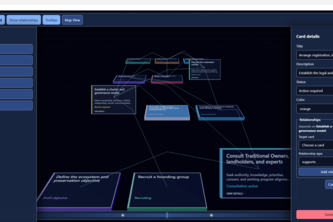
The company appears to be a solo developer project named Strategic Planner, which the author describes as a 3D visual strategy planning tool built using AI-assisted development tools (Codex, GPT models) and desktop technologies (Electron, Three.js). The description states that it is intended for local-first use and aims to replace flat spreadsheet-like interfaces with immersive 3D navigation of strategic goals. No revenue, customers or traction data are evidenced.
What changed
The project was submitted to the OpenAI 2026 hackathon, indicating a development phase focused on rapid prototyping using AI tools. It is described as a personal project built in short time with few iterations.
The single most important open question
Is there any evidence of user adoption or market demand beyond the author's own use and intention to open-source?
What The Product Actually Is
- The description states that Strategic Planner is a local-first desktop application.
- It uses node.js, Electron, and Three.js for interface development.
- It was built using Codex GPT 5.6 models and the OpenSpec workflow.
- The tool allows users to arrange and navigate strategy as a 3D visual landscape rather than using flat lists or spreadsheets.
- It is described as an immersive workspace for strategic planning.
Not evidenced: whether this product has been released, tested, or used by others beyond the author.
Positioning & Claim Evolution
- The description states that Strategic Planner aims to replace flat, spreadsheet-like interfaces with a 3D visual approach.
- It is positioned as a tool for strategic planning, allowing users to "see how it all comes together" in 3D.
- The author claims the tool allows people to "look at the road ahead", "put things in perspective", and "focus on that goal".
- It is described as a visual landscape for strategy, not just a list of records.
Inferred: This is a self-positioned product for personal or internal strategic planning. No evidence of market positioning or competitive differentiation beyond the author’s own claims.
Target Customer & ICP
- The description does not name specific customer segments.
- It is implied that the tool targets individuals or teams who engage in strategic planning.
- The tool is described as a local-first desktop workspace, suggesting it may be aimed at users who prefer local, offline tools.
Not evidenced: No evidence of target personas, buyer personas, or specific customer types. The author does not describe any user research or market validation.
Business Model & Pricing Evidence
- There is no mention of pricing, monetization, or business model in the description.
- The author states that they plan to open source the project once they use it themselves.
- No evidence of revenue streams, subscriptions, or paid features.
Not evidenced: No indication of how the product would be monetized or whether any commercialization has occurred.
Technical & Delivery Signals
- Built with node.js, Electron, and Three.js.
- Developed using Codex GPT 5.6 models in VS Code.
- The author used the OpenSpec workflow for development.
- It is a desktop application (local-first).
- The tool was built quickly, with few iterations, and the author reports being able to "get the hang of the Codex models" quickly.
Inferred: The use of AI-assisted tools like Codex suggests a modern, rapid-development approach. No evidence of scalability, performance, or production-grade delivery.
Traction & Maturity Signals
- The project was submitted to a hackathon (OpenAI 2026).
- The author reports that the tool was built in short time, with very few iterations.
- It is described as a personal project by one developer (Steven Bowden).
- No evidence of user adoption, customer base, or product usage metrics.
Not evidenced: No signs of traction, growth, or product-market fit. The tool has not been released to the public or used beyond the author’s own experience.
Competitive Context
- The description does not mention any competitors.
- It is implied that current alternatives are flat, spreadsheet-like interfaces.
- No evidence of market analysis or competitive positioning.
Not evidenced: No information about existing tools in this space or how Strategic Planner compares to them.
Open Questions & Risks
- The project is a single-person effort, with no team or external validation.
- It is described as a hackathon submission and not yet released or tested by others.
- There is no evidence of user feedback, testing, or adoption.
- The tool is intended to be open-sourced, which may indicate lack of commercial intent or product-market fit.
- No pricing, monetization, or business model are evident.
Inferred: Risk of low market demand or lack of product-market fit due to absence of traction and user validation.
Questions the description leaves open
- What specific strategic planning problems does this tool solve that existing tools do not?
- Have you tested the tool with others, or is it purely a personal project?
- How do you plan to monetize or scale this product if at all?
- What are your plans for ongoing development and support after open-sourcing?
- What feedback have you received from users (if any)?
- Are there any technical limitations or scalability concerns with the current architecture?
Overall Assessment
- The description states that Strategic Planner is a personal project built by one developer.
- It is described as a hackathon submission, not yet released to the public.
- No evidence of traction, revenue, customers, or commercialization.
- The author intends to open-source it after personal use.
Not evidenced: There is no basis for investment or partnership consideration at this stage. The project appears to be in early development with no demonstrated market demand or product-market fit.
User Stories BotA demo video on every pull request
Get a demo video on every new feature
GitHub App that watches your pull requests and records a narrated, captioned demo.
Save time on demo prep and make informed decisions faster with a video walkthrough of every new feature.
Source
Submitted to the OpenAI 2026 hackathon on Devpost. Project home on Devpost. Back to the full gallery on Devpost.
This competitive analysis was produced by top-founders.com (opens in a new tab)
Generated by a language model from this project's public Devpost page — its tagline, the author's own write-up and any built-with tags listed there — as captured in August 2026. Short quotations are the author's words. It is an opinion on the idea as a business, not on the people behind it, and it reflects the description as published then. If the project has moved on, request a correction below. The analysis is not independent research and contains no verified traction, revenue or customer data.
An independent guide by KFG International LLC — not affiliated with, endorsed by, or connected to Devpost or OpenAI.