

Archive position — measured, not model output
1 like on Devpost
505 of the 7,850 archived projects have more likes, and 1,758 share exactly 1 — so this project's #1,097 place in the like-ranked listing is a tie-break inside that group, not a ranking.
Projects (log scale)
Likes on Devpost. ▲ marks this project's group.
Show the figures
| Likes | Projects | Share of archive |
|---|---|---|
| 0 | 5,587 | 71.2% |
| 1 | 1,758 | 22.4% |
| 2 | 284 | 3.6% |
| 3–4 | 132 | 1.7% |
| 5–9 | 75 | 1.0% |
| 10+ | 14 | 0.2% |
 User Stories BotA demo video on every pull request
Get a demo video on every new feature
GitHub App that watches your pull requests and records a narrated, captioned demo.
Save time on demo prep and make informed decisions faster with a video walkthrough of every new feature.
Executive Summary
What the company appears to be
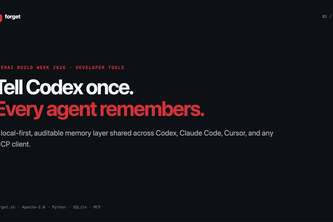
Forget is a self-reported local-first memory layer for coding agents, designed to enable durable, scoped, and auditable decision-making across multiple AI coding tools (e.g., Codex, Claude Code, Cursor). It claims to offer non-destructive updates, scoped recall, and receipts back to the original decision source (e.g., Git commits), with a focus on preventing context contamination and enabling auditability.
What changed
The project evolved during OpenAI Build Week, with enhancements including local-first hardening, scoped MCP routing, Git decision mining with provenance receipts, and evaluation harnesses. The authors state that prior to the event, the engine and first connector were already functional. The submission reflects a squashed, sanitized version of the development work.
The single most important open question
Is there evidence of real-world usage or adoption of Forget beyond the author’s own development and testing? The description contains no data on customers, revenue, or actual deployment in production environments.
What The Product Actually Is
The description states that Forget is a local-first, auditable memory layer for coding agents. It supports integration with tools like Codex, Claude Code, Cursor, and others via MCP (Model Control Protocol). Key features include:
- Shared memory across multiple clients.
- An observation gate to filter low-value content.
- Scoped retrieval by user and project, with temporal reranking.
- Non-destructive updates that supersede old decisions without erasing history.
- Git decision mining with receipts showing commit, author, and date.
- A default runtime using a local SQLite file and deterministic embeddings.
The product is described as not requiring an API key for the judge demo and uses Python 3.11, FastAPI, SQLite, and streamable HTTP MCP. It includes a Node.js CLI (forget-connect) to safely connect supported clients without overwriting existing configurations.
Inference The system appears to be a local memory management tool, not a cloud-based or centralized solution. It is built for developers working in AI-assisted coding environments.
Positioning & Claim Evolution
The description states that Forget started from the belief:
“the model may change, but the developer should own the memory.”
It positions itself as an alternative to transcript archiving, which it argues is not a solution due to noise and stale context. Instead, it promotes forgetting well — i.e., retaining only what matters and discarding irrelevant or harmful information.
Key claims:
- Forget is not another transcript archive.
- It enables fresh agents to answer questions like “Why did we switch payment providers?” with current decision, reason, and source commit.
- It preserves prior decisions for audit.
- It uses deterministic local embeddings and does not require API keys for core functionality.
Inference The positioning has evolved from a conceptual memory architecture to a practical tool, with emphasis on scope isolation, provenance, and auditability. The project’s evolution during Build Week suggests a shift toward making the product more robust and testable.
Target Customer & ICP
The description does not explicitly name target customers or personas. However, it implies that Forget is aimed at developers using AI coding agents such as Codex, Claude Code, Cursor, and others.
It also suggests that users value:
- Auditability of decisions.
- Context isolation across projects and users.
- Non-destructive memory updates.
- Provenance tracking (e.g., Git commits).
Inference The ICP likely includes technical teams or individual developers who rely on AI-assisted coding tools and are concerned with maintaining clean, traceable, and scoped decision-making in their workflows.
Business Model & Pricing Evidence
The description does not mention any pricing model, revenue streams, or monetization strategy. It states that the project is open source under Apache-2.0 and that encrypted sync is still in design and not shipped.
Inference No business model or pricing evidence is provided. The product appears to be free and open-source, with optional paid features (e.g., encrypted sync) still under development.
Technical & Delivery Signals
The project is built using:
- Python 3.11
- FastAPI
- SQLite
- Streamable HTTP MCP
- Node.js CLI (
forget-connect)
It includes:
- Scoped storage and retrieval.
- Temporal reranking.
- Supersession logic (new decisions override old ones without erasing history).
- Git decision mining with receipts.
- Deterministic local embeddings.
- Evaluation harnesses like LongMemEval and DirtyStores.
The authors claim to have used GPT-5.6 for final integration, review, and documentation but emphasize that it did not create the core engine or earlier benchmark results.
Inference The technical stack is Python-based, with a focus on local-first execution and developer tooling. It shows evidence of engineering rigor in evaluation and testing, including cross-system validation and contamination experiments.
Traction & Maturity Signals
The description states that:
- The project existed before Build Week.
- Development included 51 dated commits from July 13–20 KST.
- A public repository was submitted as a squashed, sanitized snapshot.
- Validation result: 78 tests passed, 1 skipped, plus the judge demo passed in both human-readable and JSON modes.
However, there is no evidence of customers, revenue, usage metrics, or adoption beyond the author’s own testing and development.
Inference The project shows early-stage maturity, with a functional prototype and evaluation framework. It lacks real-world traction or user data.
Competitive Context
The description does not mention specific competitors. However, it positions itself as an alternative to:
- Transcript archiving.
- Generic memory systems that do not support scope isolation or provenance.
It is implied to be in the developer tooling space, possibly competing with tools that manage context or memory for AI agents, though no direct competitor names are listed.
Inference The competitive landscape includes tools focused on AI agent memory management, but no specific names or market positioning are provided. The project appears to be early-stage and unproven in the marketplace.
Open Questions & Risks
- No evidence of real-world usage or adoption: The product is described only as a prototype, with no data on customers or revenue.
- Unverified claims: All claims are self-reported; there is no third-party validation or benchmarking data beyond internal tests.
- Open-source and non-commercial: No monetization strategy or business model is evident.
- Encrypted sync not shipped: The team acknowledges that encrypted multi-device sync is still in design, not production-ready.
- Limited scope of testing: Benchmarks are limited to internal evaluation harnesses, with no external validation.
Inference The project is highly speculative, with no commercial traction or proven product-market fit. It may be a research prototype or proof-of-concept rather than a viable product.
Questions the description leaves open
- What specific use cases have you identified for Forget in real-world development workflows?
- How do you plan to validate the effectiveness of scope isolation and provenance tracking in practice?
- Are there any early adopters or pilot users who are testing the product?
- What is your roadmap for monetization, if any?
- How do you intend to scale beyond a single developer’s use case?
- What are the limitations of the current evaluation harnesses (e.g., LongMemEval, DirtyStores)?
- Can you provide more details on how the observation gate filters low-value content?
Overall Assessment
Not evidenced.
The description provides no data on revenue, customers, or traction. It is a self-reported prototype, built for an open-source hackathon and not yet commercialized.
Confidence Low. This is a conceptual or early-stage tool, with no evidence of product-market fit, adoption, or monetization. The project appears to be a research experiment or proof-of-concept, not a viable investment or partnership opportunity at this stage.
User Stories BotA demo video on every pull request
Get a demo video on every new feature
GitHub App that watches your pull requests and records a narrated, captioned demo.
Save time on demo prep and make informed decisions faster with a video walkthrough of every new feature.
Source
Submitted to the OpenAI 2026 hackathon on Devpost. Project home on Devpost. Back to the full gallery on Devpost.
This competitive analysis was produced by top-founders.com (opens in a new tab)
Generated by a language model from this project's public Devpost page — its tagline, the author's own write-up and any built-with tags listed there — as captured in August 2026. Short quotations are the author's words. It is an opinion on the idea as a business, not on the people behind it, and it reflects the description as published then. If the project has moved on, request a correction below. The analysis is not independent research and contains no verified traction, revenue or customer data.
An independent guide by KFG International LLC — not affiliated with, endorsed by, or connected to Devpost or OpenAI.