

Archive position — measured, not model output
1 like on Devpost
505 of the 7,850 archived projects have more likes, and 1,758 share exactly 1 — so this project's #1,099 place in the like-ranked listing is a tie-break inside that group, not a ranking.
Projects (log scale)
Likes on Devpost. ▲ marks this project's group.
Show the figures
| Likes | Projects | Share of archive |
|---|---|---|
| 0 | 5,587 | 71.2% |
| 1 | 1,758 | 22.4% |
| 2 | 284 | 3.6% |
| 3–4 | 132 | 1.7% |
| 5–9 | 75 | 1.0% |
| 10+ | 14 | 0.2% |
 User Stories BotA demo video on every pull request
Get a demo video on every new feature
GitHub App that watches your pull requests and records a narrated, captioned demo.
Save time on demo prep and make informed decisions faster with a video walkthrough of every new feature.
Executive Summary
What the company appears to be
FormCrash Lab is a developer tool for testing application resilience by replaying user journeys and injecting deterministic failures to detect timing-dependent bugs that may not crash an app but cause data inconsistencies.
What changed
The project evolved from a broad browser recording and failure testing tool into a focused, local-first workbench for transactional journey resilience testing. It narrowed its focus to a specific workflow: Critical Journey → Critical Action → Controlled Failure → Outcome Check → Before/After Proof.
The single most important open question
Does FormCrash Lab demonstrate a clear need in the market for developers to test timing-dependent bugs that are hard to reproduce manually, or is it a hackathon prototype without traction?
What The Product Actually Is
The description states that FormCrash Lab is a local-first, pre-production resilience-testing workbench for transactional browser journeys. It allows developers to:
- Record successful user journeys in Chromium
- Save those journeys as immutable versions
- Identify and approve a Critical Action (a state-changing request)
- Generate reusable tests that simulate repeated interactions or delayed requests
- Run those tests and inspect evidence including screenshots, network requests, assertions, and final assessments
It uses Playwright for browser automation and deterministic rules to recommend which network requests are most likely associated with the Critical Action and what assertions should be made.
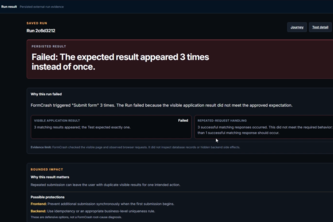
The bundled checkout demonstrates a vulnerable version that creates duplicate orders on double-submit and a fixed version that prevents this using client-side locking and server-side idempotency.
Evidence The author describes how it works technically, including its architecture (Next.js dashboard, Fastify control server, Playwright automation), persistence model (SQLite), and recommendation systems (deterministic scoring of requests and assertions).
Inference It is a developer tool for testing edge cases in web applications that are difficult to reproduce manually.
Positioning & Claim Evolution
The author states that the project started with a broad idea around browser recording, replay, and general failure testing but gradually became more focused. The key evolution was narrowing the product thesis to one question:
"Can I reproduce a failure around an important user action and clearly prove that the same problem no longer happens after it is fixed?"
This shift indicates a move from a generic tool toward a specific use case: resilience testing for transactional flows.
The author also notes that early versions were too broad, leading to confusion about why someone would use FormCrash instead of writing Playwright tests directly. The current version focuses on a clear workflow and avoids expanding the feature set unnecessarily.
Evidence The write-up describes how the idea evolved from "many features" to a focused workflow with explicit steps.
Inference This suggests that the team is trying to avoid feature creep and define a niche within the broader developer tooling space, likely targeting teams working on complex transactional web apps where timing-dependent bugs are common.
Target Customer & ICP
The description states that FormCrash Lab targets developers working on transactional browser journeys, particularly those who encounter timing-dependent bugs such as:
- Duplicate orders
- Duplicate payments
- Inconsistent records
- Interfaces appearing successful despite failed requests
It is positioned for use in pre-production environments and is described as a local-first tool, meaning it runs locally without requiring cloud infrastructure or external APIs.
The bundled checkout demonstrates how the tool works against a real-world SaaS application, suggesting that its target users are likely developers building or maintaining web applications with complex user flows.
Evidence The write-up mentions testing against their own SaaS and identifies specific types of bugs (duplicate orders, inconsistent records) that it addresses.
Inference The ICP is likely mid-to-large tech teams working on e-commerce, finance, or other domains where transactional integrity matters and manual testing fails to catch timing-related edge cases.
Business Model & Pricing Evidence
Not evidenced.
The description does not contain any information about pricing models, monetization strategies, or business model assumptions. There is no mention of whether FormCrash Lab will be sold as a SaaS product, open-source tool, or freemium offering.
Evidence None provided.
Technical & Delivery Signals
FormCrash Lab is built as a TypeScript monorepo managed with pnpm, using:
- Next.js and React for the dashboard UI
- Fastify for backend control
- Playwright for browser automation
- SQLite for persistence
- Zod for shared contracts between frontend and backend
- Server-Sent Events for live execution progress
It supports:
- Recording and replaying journeys in Chromium
- Deterministic request scoring to identify critical actions
- Assertion recommendations based on captured evidence
- Local-first architecture with durable records (journeys, tests, runs)
- Authentication-state capture and restoration
- Support for external applications via authentication handling and variable injection
The author notes that it uses AI tools like Codex and GPT-5.6 during development but does not require an OpenAI API key or runtime AI.
Evidence The technical stack, architecture, and implementation details are described in detail.
Inference This is a technically sound prototype with a clear separation of concerns and good use of modern web tooling. However, the UI remains less polished than the underlying system.
Traction & Maturity Signals
Not evidenced.
There is no mention of revenue, customers, usage metrics, or adoption data beyond the author's own testing against their own SaaS application. The project is described as a hackathon submission and not yet ready for general production use.
Evidence None provided.
Competitive Context
Not evidenced.
The description does not include any information about competitors in the developer tooling space, nor does it compare FormCrash Lab to existing tools like Playwright, Cypress, or other resilience-testing platforms.
Evidence None provided.
Open Questions & Risks
- No traction or revenue evidence: The project is described as a hackathon submission and lacks any data on adoption, customer feedback, or monetization.
- Unproven market need: While the author identifies a problem (timing-dependent bugs), there is no indication that developers are actively seeking solutions like this one.
- Limited maturity: The UI is noted to be less polished, and the tool is described as not yet ready for general production use.
- Dependency on developer expertise: The tool requires manual identification of Critical Actions and Outcome Checks, which may limit scalability or adoption without significant training.
- No clear path to monetization: There is no indication of how FormCrash Lab will generate revenue or scale beyond the author’s personal use case.
Evidence These are inferred from the lack of traction data, product maturity, and business model clarity.
Questions the description leaves open
- What specific types of timing-dependent bugs do you observe in your own SaaS, and how often do they occur?
- Have you identified any potential customers or use cases outside of your own application?
- How do you plan to address the reliability of authentication capture and replay across different applications?
- Is there a roadmap for simplifying the UI and reducing technical noise for non-expert users?
- What is the long-term vision for monetization — SaaS, freemium, open-source, or enterprise licensing?
- How do you intend to onboard external projects beyond the bundled checkout?
- Are there any known limitations in how well FormCrash Lab works with modern SPA frameworks or complex authentication flows?
Overall Assessment
Not evidenced.
There is no evidence of funding history, valuation, team traction, or strategic partnerships. The project is described as a hackathon submission and lacks any commercial indicators such as revenue, customers, or market validation.
Evidence None provided.
Confidence Level Low — this analysis is based entirely on self-reported information with no external corroboration or evidence of traction, revenue, or customer adoption.
User Stories BotA demo video on every pull request
Get a demo video on every new feature
GitHub App that watches your pull requests and records a narrated, captioned demo.
Save time on demo prep and make informed decisions faster with a video walkthrough of every new feature.
Source
Submitted to the OpenAI 2026 hackathon on Devpost. Project home on Devpost. Back to the full gallery on Devpost.
This competitive analysis was produced by top-founders.com (opens in a new tab)
Generated by a language model from this project's public Devpost page — its tagline, the author's own write-up and any built-with tags listed there — as captured in August 2026. Short quotations are the author's words. It is an opinion on the idea as a business, not on the people behind it, and it reflects the description as published then. If the project has moved on, request a correction below. The analysis is not independent research and contains no verified traction, revenue or customer data.
An independent guide by KFG International LLC — not affiliated with, endorsed by, or connected to Devpost or OpenAI.