

Archive position — measured, not model output
0 likes on Devpost
2,263 of the 7,850 archived projects have more likes, and 5,587 share exactly 0 — so this project's #6,982 place in the like-ranked listing is a tie-break inside that group, not a ranking.
Projects (log scale)
Likes on Devpost. ▲ marks this project's group.
Show the figures
| Likes | Projects | Share of archive |
|---|---|---|
| 0 | 5,587 | 71.2% |
| 1 | 1,758 | 22.4% |
| 2 | 284 | 3.6% |
| 3–4 | 132 | 1.7% |
| 5–9 | 75 | 1.0% |
| 10+ | 14 | 0.2% |
 User Stories BotA demo video on every pull request
Get a demo video on every new feature
GitHub App that watches your pull requests and records a narrated, captioned demo.
Save time on demo prep and make informed decisions faster with a video walkthrough of every new feature.
Executive Summary
What the company appears to be
Stradviso & Decision Studio is a self-reported project by Stefan Raijmakers, a 42-year-old product architect based in Tiel, Netherlands. The project describes a system designed to manage ambiguous client requests in project collaboration, using AI to propose options while maintaining human control over final decisions. It includes an authenticated backoffice, customer workspace, and a "Decision Studio" that governs how AI-generated inputs are processed into bounded, traceable changes.
What changed
The author states that the project evolved from a pre-existing concept and vision for Stradviso Business OS, which was developed during Build Week (July 2026). The core innovation lies in the "Decision Studio" — a controlled layer where AI proposes options but does not directly write to project state. Human approval is required before any change occurs.
Single most important open question
Is there evidence of real-world usage or customer feedback beyond synthetic demonstrations and self-reported claims?
What The Product Actually Is
The description states that Stradviso & Decision Studio consists of:
- An authenticated Business OS backoffice
- A role-aware customer project workspace
- Project collaboration and controlled record workflows
- Decision Studio, which governs how AI-generated inputs are handled in decision-making processes
Decision Studio is described as a system for handling unclear client questions by:
- Returning one focused blocking question when information is missing (no scenarios or approvals)
- Presenting three bounded scenario options when sufficient context exists
- Requiring human approval for any change, with deterministic application code checking authorization and freshness before applying updates
- Ensuring that model output has no direct database authority
The system uses:
- PHP 8.3, Laravel 13, Livewire 4, MySQL, SQLite, JavaScript, Tailwind CSS 4, Vite, PHPUnit
- Codex and GPT-5.6-sol via OpenAI Responses API with
store:false - Synthetic project data for demonstrations
Not evidenced No actual product usage, customer feedback, or commercial traction is described.
Positioning & Claim Evolution
The author positions Stradviso as a solution to the problem of unclear client requests leading to unaccountable decisions. The key claim is:
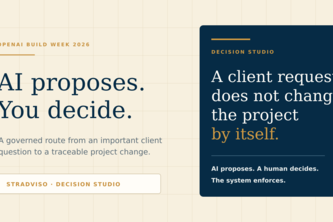
"AI proposes. Humans decide."
This positioning emphasizes human control over AI-generated outputs and accountability in project decision-making.
The project evolved from an idea developed before Build Week, with the core functionality (Decision Studio) being built during the event. It was not intended as a full business OS but rather as a proof-of-concept for one specific boundary — how to manage AI-assisted decisions without allowing them to write directly to project records.
Inference The positioning reflects an attempt to differentiate from generic AI tools by focusing on governance and traceability in decision-making workflows.
Not evidenced No claims about market fit, competitive advantage, or adoption beyond the author's own description.
Target Customer & ICP
The target customer is described as:
- Clients who ask ambiguous questions that affect multiple parts of a project
- Project teams working within structured environments where decisions must be accountable and traceable
The system is designed for:
- Project collaboration across email, messages, calls, meetings, and documents
- Situations where context gets lost or an idea becomes a promise before consequences are understood
Not evidenced No specific customer segments, personas, or use cases beyond the synthetic examples provided.
Business Model & Pricing Evidence
The description does not contain any information about:
- Revenue streams
- Pricing models
- Customer acquisition strategies
- Monetization plans
It also does not mention whether there are any existing customers or paid users.
Not evidenced No business model or pricing evidence is provided.
Technical & Delivery Signals
Technical stack includes:
- PHP 8.3, Laravel 13, Livewire 4, MySQL, SQLite
- JavaScript, Tailwind CSS 4, Vite, PHPUnit
- Integration with Codex and GPT-5.6-sol via OpenAI Responses API (
store:false) - Reproducible tests, evidence, privacy controls, and release safeguards
The system is described as:
- Having deterministic application code that checks authorization and freshness before allowing updates
- Using bounded allowlists for changes (Decision, Risk, Milestone)
- Implementing stale-context refusal with zero writes if the context has changed since approval
- Supporting recovery through clearing old approval states
Not evidenced No information about scalability, performance metrics, or production deployment.
Traction & Maturity Signals
The description indicates:
- The project was built during Build Week (July 2026)
- A separate public website project began after the submission period opened
- Synthetic demo data is used for walkthroughs
- No real-world customer handling or commercial validation is claimed
Not evidenced No evidence of traction, revenue, customers, or adoption beyond synthetic demonstrations.
Competitive Context
The description does not provide:
- Information about competitors
- Market analysis
- Competitive positioning
- Differentiation from similar tools in project management or AI-assisted decision-making
Not evidenced No competitive landscape or benchmarking data is available.
Open Questions & Risks
Key risks and open questions include:
- Lack of real-world validation: All evidence is synthetic and self-reported.
- Single-person team: Only one member (Stefan Raijmakers) involved in development.
- No commercial traction: No mention of customers, revenue, or usage beyond the author’s own claims.
- Limited scope: The system only supports a narrow set of record types (Decision, Risk, Milestone).
- Dependency on AI output quality: Model output can be incomplete or wrong; human approval remains mandatory.
- No external integrations: CRM platforms and other systems are not integrated.
Inference The project may struggle to scale without further development or validation from actual users.
Questions the description leaves open
- What specific problems do you observe in current project collaboration workflows?
- How do you plan to validate the effectiveness of Decision Studio with real clients?
- Are there any early adopters or pilot customers using this system?
- What are your plans for expanding beyond the current limited record types (Decision, Risk, Milestone)?
- How will you ensure consistent quality and reliability of AI-generated inputs?
- What is your roadmap for integrating with external systems like CRM platforms?
- How do you intend to scale beyond a single developer?
- Have you considered how this system would behave under high-volume or concurrent decision-making scenarios?
Overall Assessment
Confidence Level: Low
The project is described as a self-contained prototype built during a hackathon, with no evidence of commercial traction, revenue, customers, or adoption beyond synthetic demonstrations. While the concept of governing AI-assisted decisions in collaborative environments is interesting, there is insufficient evidence to assess viability or scalability.
Conclusion
This is a conceptual and technical proof-of-concept that shows some thoughtful design around human control and accountability in decision-making. However, it lacks any measurable commercial signal or real-world validation. It should be viewed as an early-stage idea with potential for further development but not yet ready for investment or partnership consideration.
User Stories BotA demo video on every pull request
Get a demo video on every new feature
GitHub App that watches your pull requests and records a narrated, captioned demo.
Save time on demo prep and make informed decisions faster with a video walkthrough of every new feature.
Source
Submitted to the OpenAI 2026 hackathon on Devpost. Project home on Devpost. Back to the full gallery on Devpost.
This competitive analysis was produced by top-founders.com (opens in a new tab)
Generated by a language model from this project's public Devpost page — its tagline, the author's own write-up and any built-with tags listed there — as captured in August 2026. Short quotations are the author's words. It is an opinion on the idea as a business, not on the people behind it, and it reflects the description as published then. If the project has moved on, request a correction below. The analysis is not independent research and contains no verified traction, revenue or customer data.
An independent guide by KFG International LLC — not affiliated with, endorsed by, or connected to Devpost or OpenAI.