

Archive position — measured, not model output
0 likes on Devpost
2,263 of the 7,850 archived projects have more likes, and 5,587 share exactly 0 — so this project's #3,055 place in the like-ranked listing is a tie-break inside that group, not a ranking.
Projects (log scale)
Likes on Devpost. ▲ marks this project's group.
Show the figures
| Likes | Projects | Share of archive |
|---|---|---|
| 0 | 5,587 | 71.2% |
| 1 | 1,758 | 22.4% |
| 2 | 284 | 3.6% |
| 3–4 | 132 | 1.7% |
| 5–9 | 75 | 1.0% |
| 10+ | 14 | 0.2% |
 User Stories BotA demo video on every pull request
Get a demo video on every new feature
GitHub App that watches your pull requests and records a narrated, captioned demo.
Save time on demo prep and make informed decisions faster with a video walkthrough of every new feature.
Executive Summary
What the company appears to be
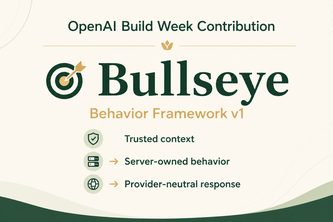
Bullseye is a self-reported team-native AI fan assistant built as a hackathon project. The author describes it as a system that uses trusted sports team data and a deterministic behavior framework to produce consistent, grounded responses about teams — in contrast to generic chatbots. It includes a server-owned behavior layer that selects and applies contextual behaviors before sending prompts to an LLM.
What changed
The project evolved from a simple idea of using AI as an engineering multiplier during development into a structured system with a behavior framework designed to control how LLMs respond about specific teams. The author notes that this is not just a longer persona prompt but a platform for team-native experiences.
Single most important open question
Is there any evidence of traction, revenue, or real-world adoption beyond the author’s own development and synthetic data use?
What The Product Actually Is
The description states that Bullseye is "A Team-Native AI Fan Assistant". It uses trusted team data (roster, schedules, standings, injury info, etc.) to answer questions about a configured sports team.
It implements a behavior framework between the team data and the language model. This framework:
- normalizes trusted team context
- classifies user requests
- resolves applicable behavior components
- selects one primary and at most one secondary contextual behavior
- applies priority and suppression rules
- projects compact typed evidence into the final prompt
- sends a provider-neutral request to the configured model
The system currently includes:
- 10 always-on behavior components
- 9 contextual behavior components
It is built with:
- Next.js, React, TypeScript, Node.js
- Supabase (PostgreSQL), OpenAI APIs, Gemini, Codex, GPT-5.6
- Uses a server-owned composition pipeline to ensure safe and consistent output.
Not evidenced There is no evidence of actual deployed users, customer feedback, or real team integrations beyond synthetic data used for validation.
Positioning & Claim Evolution
The author positions Bullseye as:
- A grounded sports assistant
- That knows the team, protects its identity, and talks like a real fan—not a generic chatbot
- Not just a longer persona prompt but a behavioral platform
The evolution described shows:
- Initial idea: Use AI to accelerate development.
- Shift toward building a structured behavior layer around LLMs.
- Focus on deterministic application behavior, not probabilistic model outputs.
Inference This suggests an intent to move from a prototype into a scalable, team-native assistant platform — though no evidence supports commercial traction or product-market fit.
Target Customer & ICP
The description states that Bullseye is designed for sports teams and their fans, particularly those who want a consistent, grounded AI assistant that reflects the team's identity.
It targets:
- Team staff or admins who manage content
- Fans looking for accurate, contextualized information about their favorite teams
Not evidenced No explicit customer personas, segmentation, or use cases beyond synthetic data validation are provided. No evidence of actual customers or fan engagement.
Business Model & Pricing Evidence
The description does not mention any business model or pricing structure.
It states that the author plans to:
- Integrate real team data
- Add admin tooling for registered teams
- Collect production usage and quality analytics
Not evidenced No revenue streams, monetization strategy, or pricing models are described. The project is presented as a hackathon submission with no indication of commercial viability.
Technical & Delivery Signals
The system uses:
- Server-owned behavior pipeline
- Postgres-backed trusted data storage
- Provider-neutral prompt assembly
- Deterministic behavior selection
- Typed evidence projection
- AI-assisted development workflow involving:
- Human (decision-maker)
- Overseer AI (architecture and review)
- Codex (implementation agent)
The architecture includes:
- Behavior registry and resolver
- Request classification
- Prompt assembly with typed evidence
- Tests (751 passing tests across 44 files)
- Auditable AI run logging
Inference This shows a strong technical foundation for a behavior-controlled assistant, but no indication of scalability or production deployment.
Traction & Maturity Signals
The project is described as:
- A contest submission (Devpost, OpenAI 2026 hackathon)
- Built in one week during Build Week
- Includes a frozen contest build with:
- 10 always-on behavior components
- 9 contextual behavior components
- 751 passing tests
- Successful lint, typecheck, and production build validation
Not evidenced No real-world usage, customer feedback, or adoption metrics are provided. The demo uses synthetic data and is not described as having any live users.
Competitive Context
The description does not mention competitors or market positioning beyond general chatbot categories.
It implies a niche in team-native AI assistants, which may overlap with:
- Fan engagement tools
- Team-specific AI chatbots
- Sports data platforms integrating AI
Not evidenced No competitive analysis, market size estimates, or differentiation from existing solutions.
Open Questions & Risks
- No traction or revenue: The project is a hackathon submission with no evidence of real-world adoption.
- Unproven commercial viability: No business model or monetization strategy described.
- Limited scope: Only one team (Animamate Rockets) and synthetic data used for validation.
- AI-assisted development dependency: Reliance on AI tools for implementation may not scale without human oversight.
- Unclear scalability: The architecture is described as server-owned, but no evidence of production deployment or infrastructure.
Questions the description leaves open
- What are the actual use cases and target teams you're considering?
- How do you plan to integrate real team data sources?
- Have you validated the behavior framework with actual fans or team staff?
- Is there a plan for monetization or commercial deployment?
- What are the limitations of the current deterministic behavior system when scaled?
- How will you handle edge cases in behavior selection or model output?
- Are there any plans to support multiple AI providers beyond Gemini and OpenAI?
Overall Assessment
Not evidenced There is no evidence of revenue, customers, or traction that would support an investment or partnership decision.
The project is described as a hackathon prototype, not a product in the market. While it shows technical sophistication and a clear architectural intent, there is no indication of:
- Commercial viability
- Real-world adoption
- Scalability
- Product-market fit
Confidence level Low This analysis is based entirely on self-reported information. No external validation or evidence of traction exists.
User Stories BotA demo video on every pull request
Get a demo video on every new feature
GitHub App that watches your pull requests and records a narrated, captioned demo.
Save time on demo prep and make informed decisions faster with a video walkthrough of every new feature.
Source
Submitted to the OpenAI 2026 hackathon on Devpost. Project home on Devpost. Back to the full gallery on Devpost.
This competitive analysis was produced by top-founders.com (opens in a new tab)
Generated by a language model from this project's public Devpost page — its tagline, the author's own write-up and any built-with tags listed there — as captured in August 2026. Short quotations are the author's words. It is an opinion on the idea as a business, not on the people behind it, and it reflects the description as published then. If the project has moved on, request a correction below. The analysis is not independent research and contains no verified traction, revenue or customer data.
An independent guide by KFG International LLC — not affiliated with, endorsed by, or connected to Devpost or OpenAI.