

Archive position — measured, not model output
1 like on Devpost
505 of the 7,850 archived projects have more likes, and 1,758 share exactly 1 — so this project's #576 place in the like-ranked listing is a tie-break inside that group, not a ranking.
Projects (log scale)
Likes on Devpost. ▲ marks this project's group.
Show the figures
| Likes | Projects | Share of archive |
|---|---|---|
| 0 | 5,587 | 71.2% |
| 1 | 1,758 | 22.4% |
| 2 | 284 | 3.6% |
| 3–4 | 132 | 1.7% |
| 5–9 | 75 | 1.0% |
| 10+ | 14 | 0.2% |
 User Stories BotA demo video on every pull request
Get a demo video on every new feature
GitHub App that watches your pull requests and records a narrated, captioned demo.
Save time on demo prep and make informed decisions faster with a video walkthrough of every new feature.
Executive Summary
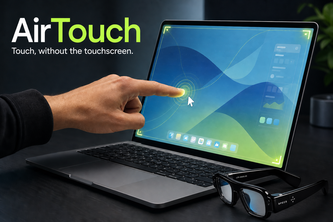
AirTouch is a self-reported proof-of-concept project that enables users to interact with a laptop screen using hand gestures tracked by Snap Spectacles, without modifying the device or adding physical touch sensors. The author, Krunal MB Gediya, built it as a personal experiment and hackathon submission for the OpenAI 2026 hackathon.
The project claims to turn any laptop into a spatial touchscreen through four-corner calibration, gesture recognition, and translation of finger movements into mouse events via a desktop companion app. It uses Snap Spectacles' hand-tracking capabilities, WebSocket communication, and native OS APIs (Quartz on macOS, User32 on Windows) to simulate cursor control, clicking, dragging, scrolling, and other interactions.
There is no evidence of commercial traction, revenue, customers, or adoption beyond the author’s own account. The project is described as a prototype with no external validation or third-party data. It does not appear to have moved past the experimental phase.
The single most important open question
Is there any indication that this concept has been validated in real-world use cases or has potential for productization beyond a hackathon demo?
What The Product Actually Is
The description states that AirTouch allows users to interact with a laptop screen using hand gestures tracked by Snap Spectacles. It uses:
- Snap Spectacles for tracking finger positions in 3D space
- A four-corner calibration process to map the virtual screen surface
- WebSocket communication between Spectacles and a desktop companion app
- Translation of normalized coordinates into mouse events using native OS APIs (macOS Quartz / Windows User32)
- Support for basic gestures like cursor movement, clicking, dragging, scrolling
The system does not require any physical modifications to the laptop or addition of touch overlays.
It is described as an end-to-end implementation built with Codex and GPT-5.6 for code inspection and improvement.
Inference The product is a spatial interaction interface prototype designed to simulate touchscreen-like behavior using wearable computing.
Positioning & Claim Evolution
The author positions AirTouch as a way to "turn any laptop into a spatial touchscreen" by leveraging existing hardware (Snap Spectacles) rather than requiring new physical input mechanisms.
It began as a personal frustration with not being able to touch a MacBook screen and evolved into an exploration of how wearable computing can enhance existing devices without replacing them.
The project's claim is that touch does not have to be a physical feature of a display, but instead a relationship between finger, screen, and spatial coordinate system.
Inference The positioning reflects a shift from a simple hack to a conceptual framework for rethinking human-computer interaction through wearable devices.
Target Customer & ICP
The description does not identify specific target customers or personas. However, it implies an audience interested in:
- Wearable computing
- Spatial interaction interfaces
- Accessibility solutions
- Innovative input methods for laptops
There is no evidence of market segmentation or customer interviews.
Inference The likely early adopters would be developers, tech enthusiasts, and users experimenting with new forms of interaction. No formal ICP was defined.
Business Model & Pricing Evidence
No business model or pricing information is provided in the description.
The project is presented as a personal experiment and hackathon submission.
Not evidenced
Technical & Delivery Signals
Key technical components include:
- Use of Snap Spectacles Interaction Kit
- Hand tracking in world space
- Four-corner calibration
- Bilinear quadrilateral projection
- WebSocket communication
- Native OS API integration (Quartz on macOS, User32 on Windows)
- Support for both macOS and Windows
The author mentions using Codex with GPT-5.6 to improve code quality.
Inference The project demonstrates a working prototype with cross-platform support and some advanced technical features like adaptive smoothing and gesture handling.
Traction & Maturity Signals
There is no evidence of revenue, customers, or adoption beyond the author’s own account.
The description indicates this was submitted as a hackathon project, suggesting it has not progressed beyond the prototype stage.
Not evidenced
Competitive Context
No mention of competitors or existing solutions in the description.
It appears to be a novel approach within the space of spatial interaction and wearable computing, though no comparison with other tools or platforms is made.
Not evidenced
Open Questions & Risks
- Prototype only: No evidence of real-world usage or productization
- Hardware dependency: Relies entirely on Snap Spectacles, limiting accessibility
- Limited scope: Focuses on basic mouse gestures; lacks advanced features like double-clicks or pinch-to-zoom
- No commercial viability: No indication of monetization strategy or market demand
- Unverified claims: All descriptions are self-reported and unvalidated
Inference The project is a creative experiment with no clear path to commercialization or scalability.
Questions the description leaves open
- What real-world use cases have you identified for this technology?
- Have you tested AirTouch with non-technical users or in different environments?
- How do you plan to address latency and accuracy issues at scale?
- Are there any partnerships or integrations planned with hardware vendors (e.g., Snap Spectacles)?
- What is the roadmap for expanding beyond macOS and Windows?
- Have you considered accessibility implications or built-in support for users with disabilities?
Overall Assessment
There is no evidence of commercial traction, revenue, or customer adoption.
The project is described as a hackathon submission and personal experiment with no indication of product-market fit or scalability.
It does not appear to be ready for investment or partnership at this stage.
Assessment Not ready for commercialization or investment. The concept may have potential, but it lacks validation and execution beyond the prototype phase.
User Stories BotA demo video on every pull request
Get a demo video on every new feature
GitHub App that watches your pull requests and records a narrated, captioned demo.
Save time on demo prep and make informed decisions faster with a video walkthrough of every new feature.
Source
Submitted to the OpenAI 2026 hackathon on Devpost. Project home on Devpost. Back to the full gallery on Devpost.
This competitive analysis was produced by top-founders.com (opens in a new tab)
Generated by a language model from this project's public Devpost page — its tagline, the author's own write-up and any built-with tags listed there — as captured in August 2026. Short quotations are the author's words. It is an opinion on the idea as a business, not on the people behind it, and it reflects the description as published then. If the project has moved on, request a correction below. The analysis is not independent research and contains no verified traction, revenue or customer data.
An independent guide by KFG International LLC — not affiliated with, endorsed by, or connected to Devpost or OpenAI.