

Archive position — measured, not model output
1 like on Devpost
505 of the 7,850 archived projects have more likes, and 1,758 share exactly 1 — so this project's #578 place in the like-ranked listing is a tie-break inside that group, not a ranking.
Projects (log scale)
Likes on Devpost. ▲ marks this project's group.
Show the figures
| Likes | Projects | Share of archive |
|---|---|---|
| 0 | 5,587 | 71.2% |
| 1 | 1,758 | 22.4% |
| 2 | 284 | 3.6% |
| 3–4 | 132 | 1.7% |
| 5–9 | 75 | 1.0% |
| 10+ | 14 | 0.2% |
 User Stories BotA demo video on every pull request
Get a demo video on every new feature
GitHub App that watches your pull requests and records a narrated, captioned demo.
Save time on demo prep and make informed decisions faster with a video walkthrough of every new feature.
Executive Summary
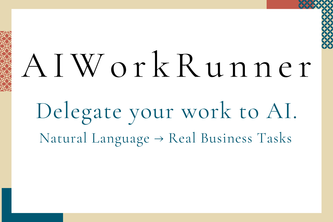
The company appears to be a solo developer project named AIWorkRunner, self-described as an AI workflow execution engine that transforms natural language into real business tasks using tools like GPT-5.6, Cloud Run, and Google Workspace APIs. The author states they use it daily for actual business operations but provides no evidence of revenue, customers, or adoption beyond personal usage.
What changed: The project evolved from a simple chatbot to an AI workflow execution engine designed to "amplify what one person can accomplish" by automating business tasks through natural language input. This shift was driven by the limitation that AI could answer questions but not execute work reliably.
The single most important open question: Is there evidence of actual business impact or user adoption beyond the founder's personal use, and how scalable is this approach to other users?
What The Product Actually Is
- The description states: "AIWorkRunner is an AI workflow execution engine that transforms natural language into real business tasks."
- It executes business operations by coordinating multiple AI systems (GPT-5.6, Codex, Python) and APIs (Google Workspace, Cloud Run).
- The system is described as being able to create optimized sales routes, search customer history, update Google Sheets, and execute real business workflows.
- It is built using technologies including: cloudrun, codex, github, googledriveapi, googlesheets, googleworkspaceapi, gpt-5.6, markdown, openaiapi, python.
Inference: The product appears to be a personal automation tool that uses AI to execute business tasks rather than just generate responses or answers.
Positioning & Claim Evolution
- The description states: "I didn't build AIWorkRunner for a hackathon. I built it because I genuinely needed it."
- It positions itself as an extension of human capability, not replacement.
- The author claims: "AI should not replace human potential. It should amplify it."
- The project evolved from being a chatbot to an execution engine focused on workflow automation.
- The tagline is: "Delegate work to AI. Turn natural language into real tasks—and amplify what one person can accomplish."
Inference: The positioning has shifted from general-purpose AI assistance to specialized task execution, with emphasis on personal productivity and amplification of individual capacity.
Target Customer & ICP
- The description states: "I am not a professional software engineer. I'm someone who wanted to work better."
- The author describes their own use case as involving daily tasks like planning routes, searching past conversations, looking up customer history, updating spreadsheets, and writing follow-up notes.
- There is no explicit mention of other users or target personas beyond the founder's personal experience.
Not evidenced: No clear identification of specific customer segments or ideal customer profiles (ICP) beyond the author’s own use case.
Business Model & Pricing Evidence
- The description does not contain any information about pricing, monetization strategy, or business model.
- It is unclear whether this is intended to be a commercial product or personal tool.
- No evidence of revenue streams, subscription models, or paid features.
Not evidenced: No indication of how the project intends to generate value or income.
Technical & Delivery Signals
- Built with: cloudrun, codex, github, googledriveapi, googlesheets, googleworkspaceapi, gpt-5.6, markdown, openaiapi, python.
- The system coordinates GPT-5.6, Codex, Python, Cloud Run, Google Workspace APIs, and multiple workflow components to execute real business operations.
- The architecture was redesigned to move away from chatbot functionality toward workflow coordination.
- The author mentions using AI to coordinate workflows instead of generating responses.
Inference: The technical stack suggests a hybrid approach combining LLMs with backend services and APIs for task execution. The shift in architecture indicates focus on reliability and execution over simple reasoning.
Traction & Maturity Signals
- The description states: "I use it every day for actual business operations, including route planning, project history retrieval, workflow execution, and business record updates."
- It was submitted to the OpenAI 2026 hackathon.
- No evidence of external users, customers, or adoption beyond the founder’s personal usage.
- No mention of revenue, user growth, or product maturity metrics.
Not evidenced: No data on traction, customer base, or business performance beyond self-reported usage.
Competitive Context
- The description does not provide any information about competitors or market positioning.
- No mention of similar tools or platforms in the AI workflow automation space.
- No indication of competitive advantages or differentiation from existing solutions.
Not evidenced: No competitive landscape analysis or comparison to other products.
Open Questions & Risks
- Single-person development: The team size is listed as 1, which raises concerns about scalability and long-term maintenance.
- Lack of external validation: No evidence of users, customers, or third-party adoption beyond the founder’s personal use.
- Unverified claims: All statements are self-reported without independent verification.
- Limited business model clarity: No indication of monetization strategy or revenue generation.
- Technical complexity assumptions: The system relies on advanced AI coordination and API integrations, which may be difficult to scale or replicate for others.
Inference: The lack of external validation and unclear commercial viability pose significant risks to the project’s potential success beyond the founder's personal use.
Questions the description leaves open
- What specific business outcomes have you achieved using AIWorkRunner, and how do they compare to manual methods?
- How does the system handle errors or failures in workflow execution?
- Are there any plans for expanding beyond your current personal use cases?
- What are your thoughts on building a scalable version of this tool for others?
- Have you considered potential security or privacy implications of automating business workflows with AI?
Overall Assessment
- Not evidenced: No data to support commercial viability, traction, or scalability.
- The project is described as a personal tool used daily by the founder but lacks evidence of broader adoption or monetization.
- The author's vision aligns with AI amplification rather than replacement, which may appeal to certain audiences.
- However, due to lack of external validation and unclear business model, there is insufficient basis for investment or partnership consideration at this stage.
Confidence level: Low — based entirely on self-reported information without corroboration.
User Stories BotA demo video on every pull request
Get a demo video on every new feature
GitHub App that watches your pull requests and records a narrated, captioned demo.
Save time on demo prep and make informed decisions faster with a video walkthrough of every new feature.
Source
Submitted to the OpenAI 2026 hackathon on Devpost. Project home on Devpost. Back to the full gallery on Devpost.
This competitive analysis was produced by top-founders.com (opens in a new tab)
Generated by a language model from this project's public Devpost page — its tagline, the author's own write-up and any built-with tags listed there — as captured in August 2026. Short quotations are the author's words. It is an opinion on the idea as a business, not on the people behind it, and it reflects the description as published then. If the project has moved on, request a correction below. The analysis is not independent research and contains no verified traction, revenue or customer data.
An independent guide by KFG International LLC — not affiliated with, endorsed by, or connected to Devpost or OpenAI.