

Archive position — measured, not model output
1 like on Devpost
505 of the 7,850 archived projects have more likes, and 1,758 share exactly 1 — so this project's #580 place in the like-ranked listing is a tie-break inside that group, not a ranking.
Projects (log scale)
Likes on Devpost. ▲ marks this project's group.
Show the figures
| Likes | Projects | Share of archive |
|---|---|---|
| 0 | 5,587 | 71.2% |
| 1 | 1,758 | 22.4% |
| 2 | 284 | 3.6% |
| 3–4 | 132 | 1.7% |
| 5–9 | 75 | 1.0% |
| 10+ | 14 | 0.2% |
 User Stories BotA demo video on every pull request
Get a demo video on every new feature
GitHub App that watches your pull requests and records a narrated, captioned demo.
Save time on demo prep and make informed decisions faster with a video walkthrough of every new feature.
Executive Summary
What the company appears to be
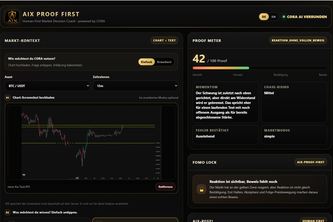
AIX PROOF FIRST is a self-reported human-first trading assistant that analyzes chart screenshots and answers structured questions about evidence, confirmation, invalidation, momentum, and risk — without generating buy/sell signals or predictions.
What changed
The project was submitted as part of the OpenAI 2026 hackathon. It describes an early-stage prototype built with Python, Flask, HTML/CSS/JS, and OpenAI’s API, deployed on Railway, with security enhancements from Codex.
Single most important open question
Is there any evidence that users are engaging with or adopting this tool beyond the prototype stage?
Note: This analysis is based entirely on the self-reported description provided by the author. No independent verification, revenue data, customer base, traction metrics or third-party sources are available. All claims are treated as stated by the author and not proven.
What The Product Actually Is
The description states that AIX PROOF FIRST is a Human-First market decision coach. It allows users to upload chart screenshots and ask questions such as:
- What do we actually see?
- Is this only a reaction or already proof?
- What would confirm or invalidate the idea?
It returns structured explanations including:
- Visible chart evidence
- Missing proof
- Confirmation conditions
- Invalidation conditions
- Momentum assessment
- Chase-risk assessment
- Proof Meter
- FOMO Lock
The system uses OpenAI Responses API to interpret visual market information and transform it into readable output.
Inference: The product is described as a tool that helps traders slow down decision-making, separate evidence from assumptions, and avoid FOMO-driven behavior. It does not claim to predict price movements or replace user judgment.
Positioning & Claim Evolution
The author states:
- Trading tools often tell people what to do (buy, sell).
- Many bad decisions happen because traders confuse reaction with confirmation.
- AIX PROOF FIRST asks: What is actually visible and proven in the chart right now?
- The goal is not to predict or replace judgment but to slow down decision-making and clarify evidence.
It positions itself as a human-first assistant, focused on proof before opinion, designed to protect users from chasing moves or acting impulsively.
Claim: The product aims to reduce FOMO-driven decisions by emphasizing clarity over certainty.
Inference: This is a shift from traditional trading tools that offer signals or predictions, toward a tool that emphasizes uncertainty and risk awareness.
Target Customer & ICP
The description states:
- AIX PROOF FIRST targets traders who are concerned with avoiding FOMO, chasing moves, or acting on incomplete evidence.
- It supports both beginners and experienced traders, offering simple and expert modes.
- The interface includes German and English language options.
Claim: The tool is aimed at traders seeking clarity in their decision-making process.
Inference: Based on the description, the ICP likely includes active traders who are risk-aware but may be influenced by emotional or impulsive behavior. However, no specific customer segments or personas are defined.
Business Model & Pricing Evidence
The description states:
- The next development stage includes:
- User accounts and authentication
- Usage quotas and transparent pricing
- Persistent rate limiting through Redis or an API gateway
There is no evidence of current pricing, monetization strategy, or revenue model.
Claim: Future plans include implementing usage-based pricing.
Inference: The business model appears to be in early conceptualization. No actual pricing or monetization data is provided.
Technical & Delivery Signals
The application was built with:
- Backend: Python, Flask
- Frontend: HTML5, CSS3, JavaScript
- AI Integration: OpenAI Responses API
- Deployment: Railway
- Security Enhancements: Codex reviewed the app; includes:
- JSON and request-size limits
- Image validation (Base64, signature, MIME-type)
- Rate limiting
- Prompt-injection boundaries
- No permanent storage of screenshots
The source code is maintained in a private GitHub repository.
Automated tests currently pass all 11 tests.
Claim: The application has been built with security and testability in mind.
Inference: This suggests a minimal viable product (MVP) with some development rigor, but no indication of scale or production readiness beyond the prototype stage.
Traction & Maturity Signals
The description states:
- A working end-to-end product exists: upload chart → ask question → receive structured analysis.
- The team is proud that it does not reward impulsive behavior.
- It was built for a hackathon and deployed as a prototype.
- No mention of users, adoption, or usage metrics.
Claim: The tool works end-to-end in its current form.
Inference: There is no evidence of user engagement, retention, or product-market fit beyond the prototype stage. No data on active users, feedback loops, or growth indicators are provided.
Competitive Context
The description does not provide any information about competitors or market positioning relative to existing trading tools or AI assistants.
Claim: None.
Inference: No evidence of competitive landscape, differentiation, or market analysis is available. The product is described in isolation without reference to similar offerings.
Open Questions & Risks
- No traction or adoption data: The tool exists only as a prototype, with no evidence of users or usage.
- Unverified claims: All features and benefits are self-reported; no third-party validation or performance data.
- Limited product maturity: The system is described as an MVP with security improvements from Codex, but lacks production-scale infrastructure or user feedback mechanisms.
- Unclear monetization path: Pricing and business model are speculative at best.
- No customer or market validation: No evidence of target users engaging with the tool beyond the prototype.
Inference: The project is in early development and has not yet demonstrated commercial viability or market demand.
Questions the description leaves open
- What specific user problems are you solving, and how do you know?
- Have you conducted any user testing or feedback collection with traders?
- How do you plan to scale beyond the current prototype?
- What is your go-to-market strategy for reaching traders?
- Are there any existing tools in this space that you're directly competing with?
- What are the key assumptions behind your product vision, and how might they be wrong?
- How do you intend to monetize this tool, and what pricing model are you considering?
Overall Assessment
Not evidenced
There is no evidence of revenue, customers, traction, or commercial viability beyond a hackathon prototype.
Claim: The project is an early-stage idea with a clear positioning.
Inference: While the concept appears thoughtful and aligned with current trends in AI-assisted trading, there is insufficient evidence to assess its potential for investment or partnership. The lack of user data, product-market fit, or monetization strategy makes it difficult to evaluate commercial risk or opportunity.
User Stories BotA demo video on every pull request
Get a demo video on every new feature
GitHub App that watches your pull requests and records a narrated, captioned demo.
Save time on demo prep and make informed decisions faster with a video walkthrough of every new feature.
Source
Submitted to the OpenAI 2026 hackathon on Devpost. Project home on Devpost. Back to the full gallery on Devpost.
This competitive analysis was produced by top-founders.com (opens in a new tab)
Generated by a language model from this project's public Devpost page — its tagline, the author's own write-up and any built-with tags listed there — as captured in August 2026. Short quotations are the author's words. It is an opinion on the idea as a business, not on the people behind it, and it reflects the description as published then. If the project has moved on, request a correction below. The analysis is not independent research and contains no verified traction, revenue or customer data.
An independent guide by KFG International LLC — not affiliated with, endorsed by, or connected to Devpost or OpenAI.