

Archive position — measured, not model output
1 like on Devpost
505 of the 7,850 archived projects have more likes, and 1,758 share exactly 1 — so this project's #582 place in the like-ranked listing is a tie-break inside that group, not a ranking.
Projects (log scale)
Likes on Devpost. ▲ marks this project's group.
Show the figures
| Likes | Projects | Share of archive |
|---|---|---|
| 0 | 5,587 | 71.2% |
| 1 | 1,758 | 22.4% |
| 2 | 284 | 3.6% |
| 3–4 | 132 | 1.7% |
| 5–9 | 75 | 1.0% |
| 10+ | 14 | 0.2% |
 User Stories BotA demo video on every pull request
Get a demo video on every new feature
GitHub App that watches your pull requests and records a narrated, captioned demo.
Save time on demo prep and make informed decisions faster with a video walkthrough of every new feature.
Executive Summary
What the company appears to be
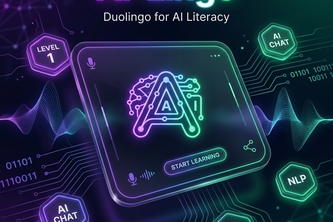
The project described as "Al-Lingo (Duolingo for AI Literacy)" is a self-reported web-based educational platform designed to teach artificial intelligence concepts through gamified and interactive learning modules. It draws inspiration from Duolingo’s language-learning model, applying similar psychological hooks to introduce users to AI literacy.
What changed
The author states that the project was built over a short timeframe (presumably during a hackathon), using modern frontend technologies like React, TypeScript, and Supabase. It includes interactive elements such as a match-3 game, audio podcasts, reading materials, and a dynamic news feed to explain AI in everyday contexts.
Single most important open question
Is there any evidence of user engagement or adoption beyond the single developer’s self-reported build? The description contains no data on users, usage metrics, or traction — only claims about what the product does and how it was built.
What The Product Actually Is
The description states that AI-Lingo is a website which teaches AI literacy through:
- AI Cascade Game: A 7x6 match-3 game where players swap tiles to match AI concepts (e.g., Data, Model, Prompt) to clear columns and reveal glossary definitions.
- Interactive Audio Podcasts: TTS-voiced tech podcasts with suggestions and continuation sidebars.
- Reading Stories: Multi-layered text content (beginner, curious, deep-dive) with translation overlays.
- Daily Life AI Connections: Child-friendly explanations of how algorithms work in common situations like cafés or meetings.
- Dynamic News Feed: Live updates on AI developments with filters, read views, and pagination.
The platform is described as a single-page application built using React, TypeScript, Vite, Tailwind CSS, Supabase, and browser-based speech synthesis APIs.
Inference This appears to be an experimental educational prototype aimed at introducing non-technical users to AI concepts via gamification and storytelling. It is not a commercial product with revenue or customers yet.
Positioning & Claim Evolution
The author claims that AI-Lingo is inspired by Duolingo, aiming to teach AI literacy in the same way language learning is taught — through bite-sized, engaging loops.
Claim
AI-Lingo aims to bridge the gap between technical AI knowledge and general public understanding, particularly targeting those who feel left behind by the AI boom.
Inference The positioning reflects a desire to democratize AI education, but there is no evidence of market research or prior user feedback. The author’s own narrative suggests this is an idea developed in isolation.
Target Customer & ICP
The description states that the target audience includes:
- People who feel intimidated or confused by AI.
- Non-tech individuals trying to understand how LLMs work.
- Users seeking a simplified introduction to AI concepts without needing technical background.
It also mentions that the content is designed for "child-friendly explanations" and aims to make complex models like CNNs, recommenders, and voice transformers understandable to young learners or beginners.
Inference The ICP seems to be broad — ranging from general public to early-stage learners. However, no specific segment or persona is defined beyond “non-tech people” or “those who feel left behind.”
Business Model & Pricing Evidence
There is no evidence of a business model or pricing strategy in the description.
Claim
The author does not state whether AI-Lingo will be monetized, offered free-of-charge, or sold as part of a subscription service.
Inference No commercial structure is evident. The project appears to be a prototype built for demonstration purposes rather than a scalable business model.
Technical & Delivery Signals
The author reports building the platform using:
- Frontend: React, TypeScript, Vite
- Styling: Tailwind CSS, glassmorphism design
- Audio: Browser-based Text-to-Speech (TTS) with custom queue manager
- Game Logic: Match-3 algorithm implemented in React without direct state mutation
- Backend: Supabase for data persistence and leaderboard tracking
- AI Tools Used: Codex for grid physics, GPT-5.6 for UI mapping and concept translation
Inference The technical stack is modern and well-suited for a web-based interactive experience. However, the use of browser-native TTS and custom game logic implies a limited scope and potential scalability challenges.
Traction & Maturity Signals
There is no evidence of traction or user adoption beyond the single developer's account.
Claim
The author built the entire product in one go (presumably during a hackathon), with no mention of beta testing, user feedback loops, or iterative development.
Inference This project is at an early prototype stage. There are no metrics on user retention, engagement, or performance beyond self-reported accomplishments.
Competitive Context
The description does not reference any competitors or existing solutions in the AI literacy space.
Claim
The author draws a comparison to Duolingo but provides no analysis of other platforms offering similar content or delivery methods.
Inference It is unclear whether there are comparable tools in the market, and if so, how this product differentiates itself. The lack of competitive awareness makes it difficult to assess positioning or viability.
Open Questions & Risks
- No traction or user data: The project has no demonstrated users, engagement, or adoption.
- Single developer: The entire system was built by one person, raising questions about scalability and long-term maintenance.
- Unproven market demand: There is no evidence of prior market research or validated need for this type of product.
- Technical limitations: Use of browser-native TTS may limit audio quality or reliability; match-3 game logic in React could be fragile.
- Lack of monetization strategy: No indication of how the platform will generate revenue or sustain itself.
Questions the description leaves open
- What specific problem are you solving, and who exactly is facing it?
- Have you tested this with any real users? If so, what were their reactions?
- How do you plan to scale beyond a single developer’s effort?
- Are there existing tools in the AI literacy space that you’re competing against or learning from?
- What are your plans for monetization and long-term sustainability?
- How will you ensure accuracy of technical content while keeping it accessible?
Overall Assessment
Not evidenced
There is no evidence of revenue, customers, traction, or financial performance to support an investment or partnership decision.
The project is described as a hackathon prototype built by one individual with no commercial infrastructure or market validation. While the idea has potential, there is no basis for assessing its viability as a business or product at this stage.
Confidence Level Low — based entirely on self-reported claims and no external data.
User Stories BotA demo video on every pull request
Get a demo video on every new feature
GitHub App that watches your pull requests and records a narrated, captioned demo.
Save time on demo prep and make informed decisions faster with a video walkthrough of every new feature.
Source
Submitted to the OpenAI 2026 hackathon on Devpost. Project home on Devpost. Back to the full gallery on Devpost.
This competitive analysis was produced by top-founders.com (opens in a new tab)
Generated by a language model from this project's public Devpost page — its tagline, the author's own write-up and any built-with tags listed there — as captured in August 2026. Short quotations are the author's words. It is an opinion on the idea as a business, not on the people behind it, and it reflects the description as published then. If the project has moved on, request a correction below. The analysis is not independent research and contains no verified traction, revenue or customer data.
An independent guide by KFG International LLC — not affiliated with, endorsed by, or connected to Devpost or OpenAI.