

Archive position — measured, not model output
0 likes on Devpost
2,263 of the 7,850 archived projects have more likes, and 5,587 share exactly 0 — so this project's #2,545 place in the like-ranked listing is a tie-break inside that group, not a ranking.
Projects (log scale)
Likes on Devpost. ▲ marks this project's group.
Show the figures
| Likes | Projects | Share of archive |
|---|---|---|
| 0 | 5,587 | 71.2% |
| 1 | 1,758 | 22.4% |
| 2 | 284 | 3.6% |
| 3–4 | 132 | 1.7% |
| 5–9 | 75 | 1.0% |
| 10+ | 14 | 0.2% |
 User Stories BotA demo video on every pull request
Get a demo video on every new feature
GitHub App that watches your pull requests and records a narrated, captioned demo.
Save time on demo prep and make informed decisions faster with a video walkthrough of every new feature.
Executive Summary
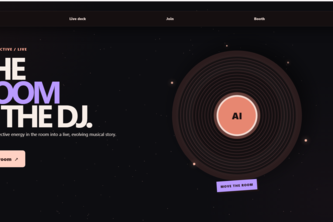
The company appears to be a two-person team building an experimental, real-time music mixing system that uses live sensor data from audience phones to drive a procedurally generated set — without playlists or traditional DJing. The core idea is to let crowd energy shape the music in real time.
What changed
This project was submitted as part of the OpenAI 2026 hackathon, indicating it's an early-stage prototype built over a short timeframe (one week) by two developers.
Single most important open question
Is there a viable commercial use case for this technology beyond a hackathon demo? The description does not provide evidence of any revenue model, customer traction or market validation.
What The Product Actually Is
The description states that AI-DJ is a system where:
- Audience phones connect via browser (no app install)
- Phones read motion (camera) and sound (mic) locally
- Sensor data is reduced to small JSON vectors and streamed over WebSocket
- A server aggregates this into a "room state" signal
- This drives a live mixing engine using Tone.js procedural audio
- No recordings are made; each phone discards raw media after processing
- The music is generated from fixed loops locked to one musical scale, ensuring no wrong notes
Inference The system appears to be an experimental proof-of-concept rather than a production-ready product.
Positioning & Claim Evolution
The author claims:
- Most "AI DJ" projects are just smart playlists
- They wanted the room itself to be the input, not just a listener
- The crowd's movement steers the music live
- No playlist, no booth — the room is the DJ
Inference This positions AI-DJ as a novel approach to DJing that removes human agency in favor of collective audience behavior. It’s framed as an alternative to traditional or AI-assisted playlist systems.
Target Customer & ICP
The description does not state any specific customer or target market beyond the general idea of "crowd energy shaping music."
Not evidenced No indication of who would pay for this, what venues or events it targets, or whether there is a defined ICP.
Business Model & Pricing Evidence
There is no mention of pricing, monetization, or business model in the description.
Not evidenced No evidence of revenue streams, customer acquisition costs, or any commercial framework.
Technical & Delivery Signals
The team built:
- On-device signal extraction (motion via frame-differencing, sound via RMS/onset detection)
- Lightweight JSON vector streaming over WebSocket
- Aggregation logic on server side
- Procedural engine using Tone.js with fixed loops and musical scale constraints
- Quantized parameter changes to avoid glitchy transitions
Inference The system is technically feasible but limited in scope — built for demo purposes, not scalable or robust enough for commercial deployment.
Traction & Maturity Signals
The project was completed in one week by two people as a hackathon submission.
Not evidenced No evidence of:
- Customers
- Revenue
- Product usage metrics
- Iteration history
- Any form of traction beyond the demo itself
Competitive Context
The description states that most existing "AI DJ" projects are just smart playlists, implying a gap in the market for more interactive or crowd-driven systems.
Inference The team sees themselves as solving a problem with current AI DJ tools by introducing real-time audience participation — though they do not name competitors or describe their competitive advantage beyond novelty.
Open Questions & Risks
- Novelty vs. Viability: The concept is experimental and may not translate into a sustainable product.
- Scalability Concerns: Built for demo, not scale; mobile browser limitations (camera throttling, HTTPS requirements) suggest technical constraints.
- Lack of Commercialization Evidence: No indication of monetization strategy or customer interest beyond the hackathon.
- Limited Scope: The system uses fixed loops and musical scales — may not evolve into a rich or varied experience over time.
Questions the description leaves open
- What is your plan to validate demand for this type of music mixing experience?
- Have you tested this with real crowds in real venues?
- How do you intend to monetize the product, and what are your go-to-market strategies?
- What are the technical limitations that prevent scaling beyond a small group of phones?
- Are there any legal or privacy concerns around collecting sensor data from users' phones?
Overall Assessment
Not evidenced No evidence of commercial viability, traction, or clear path to monetization.
Confidence Level: Low — this is a hackathon prototype with no demonstrated market need, revenue model, or customer base. The idea is intriguing but unproven in practice.
Assessment: Not ready for investment or partnership at this stage. Requires significant development, market validation, and commercial strategy before any serious consideration.
User Stories BotA demo video on every pull request
Get a demo video on every new feature
GitHub App that watches your pull requests and records a narrated, captioned demo.
Save time on demo prep and make informed decisions faster with a video walkthrough of every new feature.
Source
Submitted to the OpenAI 2026 hackathon on Devpost. Project home on Devpost. Back to the full gallery on Devpost.
This competitive analysis was produced by top-founders.com (opens in a new tab)
Generated by a language model from this project's public Devpost page — its tagline, the author's own write-up and any built-with tags listed there — as captured in August 2026. Short quotations are the author's words. It is an opinion on the idea as a business, not on the people behind it, and it reflects the description as published then. If the project has moved on, request a correction below. The analysis is not independent research and contains no verified traction, revenue or customer data.
An independent guide by KFG International LLC — not affiliated with, endorsed by, or connected to Devpost or OpenAI.