

Archive position — measured, not model output
0 likes on Devpost
2,263 of the 7,850 archived projects have more likes, and 5,587 share exactly 0 — so this project's #2,541 place in the like-ranked listing is a tie-break inside that group, not a ranking.
Projects (log scale)
Likes on Devpost. ▲ marks this project's group.
Show the figures
| Likes | Projects | Share of archive |
|---|---|---|
| 0 | 5,587 | 71.2% |
| 1 | 1,758 | 22.4% |
| 2 | 284 | 3.6% |
| 3–4 | 132 | 1.7% |
| 5–9 | 75 | 1.0% |
| 10+ | 14 | 0.2% |
 User Stories BotA demo video on every pull request
Get a demo video on every new feature
GitHub App that watches your pull requests and records a narrated, captioned demo.
Save time on demo prep and make informed decisions faster with a video walkthrough of every new feature.
Executive Summary
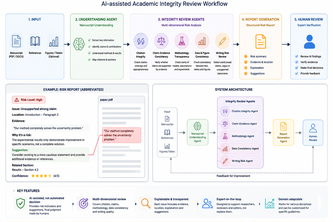
The company appears to be a solo project, IntegrityGuard AI, submitted to the OpenAI 2026 hackathon. The author states it is an AI-assisted academic integrity review workflow designed to help researchers and editors identify potential academic integrity risks in research manuscripts. It uses OpenAI models with a structured agent workflow to analyze citation issues, claim-evidence consistency, methodology transparency, data consistency, and writing risks. The system outputs risk locations, explanations, and actionable suggestions for human review.
The key change is the introduction of an AI-powered tool that automates parts of the academic integrity review process, shifting from manual checking to an interactive workflow.
The single most important open question is: What is the actual commercial viability or adoption potential of this tool? The description provides no evidence of traction, revenue, customers, or market validation beyond a hackathon submission.
What The Product Actually Is
- The description states that IntegrityGuard AI is an AI-assisted academic integrity review workflow.
- It is designed to analyze research manuscripts and provide structured risk reports.
- The system focuses on identifying potential issues rather than making automatic judgments.
- It helps users review:
- Citation integrity
- Claim-evidence consistency
- Methodology transparency
- Data and figure consistency
- Research writing risks
- The output includes risk locations, explanations, and actionable suggestions for human review.
- It uses OpenAI models with a structured agent workflow, decomposing manuscript review into specialized analysis tasks:
- Manuscript understanding agent
- Integrity review agents
- Report generation agent
- The system uses structured prompts and reusable review templates to make the analysis more consistent and reproducible.
Positioning & Claim Evolution
- The description states that the project was inspired by the increasing reliance on AI tools in scientific research and the associated challenges for academic integrity.
- It positions itself as an AI assistant that helps researchers, reviewers, and editors identify potential integrity risks before publication.
- The author claims it transforms traditional manual manuscript checking into an interactive review process.
- It is positioned to support expert workflows rather than replace human expertise, emphasizing that AI models should not replace editors or reviewers.
- The project’s claim evolution shows a shift from a general problem (AI in research) to a specific solution (structured AI-assisted integrity review).
Target Customer & ICP
- The description states the tool is intended for researchers, reviewers, and editors.
- It is aimed at users who are involved in manuscript review and academic integrity checks.
- The target audience includes those who spend significant time manually reviewing manuscripts and checking whether conclusions are sufficiently supported by evidence.
- No further segmentation or ICP details are provided.
Business Model & Pricing Evidence
- Not evidenced. The description does not state any business model, pricing structure, monetization strategy, or revenue streams.
Technical & Delivery Signals
- Built using OpenAI models (specifically GPT-4o and GPT-5).
- Uses a structured agent workflow.
- Decomposes manuscript review into:
- Manuscript understanding agent
- Integrity review agents
- Report generation agent
- The system uses structured prompts and reusable review templates.
- The tool is described as being built with Python, GitHub, and Markdown, among other technologies.
Traction & Maturity Signals
- Not evidenced. There is no mention of revenue, customers, usage metrics, or adoption beyond the hackathon submission.
- The project was submitted to a hackathon (OpenAI 2026).
- It is described as a solo project by one team member (ZHENG XU).
- No evidence of product-market fit, user feedback, or market traction.
Competitive Context
- Not evidenced. The description does not mention any existing competitors or the competitive landscape in academic integrity tools or AI-assisted manuscript review.
- No information on how this tool compares to other solutions in the space.
Open Questions & Risks
- Solo project: Only one team member is mentioned, which raises concerns about execution capability and scalability.
- No commercial traction: The tool was submitted as a hackathon project with no evidence of market adoption or revenue.
- Unclear commercial viability: No business model, pricing, or monetization strategy is described.
- High-risk domain: Academic integrity review involves legal and ethical considerations; the risk of false accusations is significant.
- Limited scope: The tool focuses on identifying risks but does not replace human judgment, which may limit its perceived value in a competitive market.
Questions the description leaves open
- What specific academic or publishing institutions are you targeting with this tool?
- Are there any existing partnerships or pilot programs with research institutions or journals?
- How do you plan to monetize the tool, and what is your pricing model?
- What are the legal and ethical considerations around AI-generated integrity reports?
- How does the tool handle edge cases or ambiguous scenarios in manuscript review?
- Are there any plans for integration with existing academic platforms or reference management systems?
- What is the current development stage of the product, and what are your timelines for market readiness?
Overall Assessment
- Not evidenced. The description provides no information on valuation, funding rounds, or investment interest.
- The project is a self-reported hackathon submission with no evidence of traction, revenue, or customer validation.
- The tool’s positioning as an AI assistant for academic integrity is promising in concept but lacks commercial proof-of-concept.
- Given the lack of evidence for market fit, adoption, or business model, any investment or partnership decision would be based on speculative future potential rather than current viability.
User Stories BotA demo video on every pull request
Get a demo video on every new feature
GitHub App that watches your pull requests and records a narrated, captioned demo.
Save time on demo prep and make informed decisions faster with a video walkthrough of every new feature.
Source
Submitted to the OpenAI 2026 hackathon on Devpost. Project home on Devpost. Back to the full gallery on Devpost.
This competitive analysis was produced by top-founders.com (opens in a new tab)
Generated by a language model from this project's public Devpost page — its tagline, the author's own write-up and any built-with tags listed there — as captured in August 2026. Short quotations are the author's words. It is an opinion on the idea as a business, not on the people behind it, and it reflects the description as published then. If the project has moved on, request a correction below. The analysis is not independent research and contains no verified traction, revenue or customer data.
An independent guide by KFG International LLC — not affiliated with, endorsed by, or connected to Devpost or OpenAI.