

Archive position — measured, not model output
0 likes on Devpost
2,263 of the 7,850 archived projects have more likes, and 5,587 share exactly 0 — so this project's #2,542 place in the like-ranked listing is a tie-break inside that group, not a ranking.
Projects (log scale)
Likes on Devpost. ▲ marks this project's group.
Show the figures
| Likes | Projects | Share of archive |
|---|---|---|
| 0 | 5,587 | 71.2% |
| 1 | 1,758 | 22.4% |
| 2 | 284 | 3.6% |
| 3–4 | 132 | 1.7% |
| 5–9 | 75 | 1.0% |
| 10+ | 14 | 0.2% |
 User Stories BotA demo video on every pull request
Get a demo video on every new feature
GitHub App that watches your pull requests and records a narrated, captioned demo.
Save time on demo prep and make informed decisions faster with a video walkthrough of every new feature.
Executive Summary
The description states that the project is an AI-assisted workbench for editing 3D avatar models in Blender, using natural language to guide users through complex workflows without requiring deep technical knowledge of Blender or 3D modeling. The author describes building a collaborative workflow between user, AI (Codex), and Blender, where AI generates Python scripts that are executed in Blender and reviewed by the user before further refinement.
The project appears to be an early-stage prototype submitted to a hackathon. It is not evidenced to have any revenue, customers, or traction beyond its own self-description. The author claims it enables users without specialized knowledge to iteratively refine avatars through natural language, but there is no evidence of actual adoption or usage metrics.
The single most important open question is: What is the actual scope and viability of this AI-assisted workflow approach for real-world creative professionals?
What The Product Actually Is
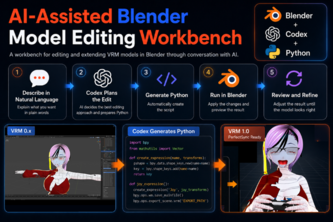
The description states that it is an "AI-assisted workbench" for editing 3D avatar models in Blender. It uses natural language input to guide users through complex workflows, generating Blender Python scripts via AI (specifically Codex) and executing them within Blender.
The author describes a workflow where:
- Users describe desired edits in natural language
- AI generates Blender Python scripts
- Scripts are executed in Blender
- Results are reviewed by user
- Workflow repeats until satisfied
It is built around the combination of Blender, Python scripting, and AI collaboration. The workbench was developed from one-off scripts into a reusable system.
Not evidenced: What specific types of avatar edits it supports, what tools or APIs it uses beyond those mentioned, or whether it's a standalone application or plugin.
Positioning & Claim Evolution
The description states that the project positions itself as an AI-assisted workbench that guides creators through complex 3D avatar editing workflows using natural language instead of requiring expert Blender knowledge. It claims to act as a "technical collaborator" rather than replacement for users, allowing creative decisions to remain with humans while delegating repetitive scripting tasks to AI.
The author states that the project evolved from one-off scripts into a reusable workbench, extracting prompts and workflows for generalization. The positioning appears to be shifting toward broader applicability across different content creation tools (e.g., Live2D), not just Blender-based VRM editing.
Not evidenced: How this compares to existing tools or workflows in the market, what specific competitive advantages it claims, or whether there are any stated target users beyond "creators without specialized knowledge."
Target Customer & ICP
The description states that the target customer is "users without specialized Blender or 3D modeling knowledge" who want to perform advanced avatar editing. It also mentions people with "very little Blender or 3D modeling knowledge" and those who "want to make changes" but lack technical expertise.
The author notes that users often need to learn Blender's interface, terminology, and workflow before beginning editing, which creates a barrier for non-experts. The workbench aims to lower this barrier by guiding the workflow itself.
Not evidenced: Specific demographics, job titles, or usage patterns of target customers; whether there are different user segments (e.g., hobbyists vs. professionals); or how many such users exist in the market.
Business Model & Pricing Evidence
The description does not state any business model or pricing information. It is self-reported that this is a hackathon project submitted to OpenAI 2026, with no indication of monetization strategy, pricing tiers, or revenue streams.
Not evidenced: Any commercial aspects including how the product would be sold, who pays for it, or what value proposition drives payment.
Technical & Delivery Signals
The description states that the workbench combines Blender, Python scripting, and AI (specifically Codex). It uses an iterative workflow where:
- Natural language inputs are processed by AI
- AI generates Blender Python scripts
- Scripts are executed in Blender
- Results are reviewed and refined iteratively
It was built around reusable prompts, workflows, and editing procedures extracted from one-off scripts. The author mentions that the system is designed to be extensible beyond Blender-based VRM editing into Live2D creation.
Not evidenced: Technical architecture details, scalability assumptions, or performance metrics; whether it's a desktop application, web tool, or plugin; or how it handles different types of 3D models or editing tasks.
Traction & Maturity Signals
The description states that this is a hackathon project submitted to the OpenAI 2026 hackathon on Devpost. It was built by one team member ("Nameless Zombie") and has no evidence of traction, customers, revenue, or adoption beyond its own submission.
Not evidenced: Any user base, customer feedback, usage statistics, or product maturity beyond prototype status.
Competitive Context
The description does not provide any information about competitive landscape or existing alternatives. It is self-reported that the author wanted to build a workbench that guides editing workflows rather than simply generating code, but there is no evidence of how this compares to other tools in the space.
Not evidenced: Who the competitors are, what they do, or whether similar approaches already exist in the market.
Open Questions & Risks
The description states that one major challenge was the complexity of Blender itself, which required the workflow to guide users rather than just generate scripts. This suggests a fundamental technical barrier that may limit adoption.
Another risk is that the project appears to be a hackathon submission with no commercial traction or evidence of real-world usage. The author's stated goal is to expand beyond Blender but there is no evidence of progress toward that goal.
There is also a risk that the AI-assisted approach may not scale well if it requires significant human review and refinement at each step, potentially limiting its utility for large-scale production workflows.
Not evidenced: Specific market risks, technical limitations, or competitive threats beyond what's described in the project itself.
Questions the description leaves open
- What specific types of avatar edits can be performed using this system?
- How does it handle different VRM model formats and compatibility issues?
- What is the current state of development beyond the hackathon prototype?
- Have you tested this with actual users who lack Blender experience?
- How do you plan to monetize or commercialize this workbench?
- What are the technical limitations of the current approach that might prevent scaling?
- How does it compare to existing tools in the 3D modeling and avatar editing space?
- What is your roadmap for expanding beyond Blender into other content creation tools?
Overall Assessment
The description states that this is a hackathon project submitted to OpenAI 2026, built by one person ("Nameless Zombie"). There is no evidence of any revenue, customers, or traction beyond its own submission.
The author claims the system enables users without specialized knowledge to iteratively refine avatars through natural language, but there is no verification of this capability or adoption metrics. The project appears to be an early-stage prototype with no commercial viability demonstrated.
Inferences:
- The approach may have potential for creative professionals who lack technical skills
- The AI collaboration model seems novel in its focus on workflow guidance rather than code generation alone
- However, the lack of evidence for any real-world usage or commercialization makes it difficult to assess true market opportunity
Not evidenced: Any commercial viability, market size, competitive positioning, or financial metrics that would support investment or partnership decisions.
User Stories BotA demo video on every pull request
Get a demo video on every new feature
GitHub App that watches your pull requests and records a narrated, captioned demo.
Save time on demo prep and make informed decisions faster with a video walkthrough of every new feature.
Source
Submitted to the OpenAI 2026 hackathon on Devpost. Project home on Devpost. Back to the full gallery on Devpost.
This competitive analysis was produced by top-founders.com (opens in a new tab)
Generated by a language model from this project's public Devpost page — its tagline, the author's own write-up and any built-with tags listed there — as captured in August 2026. Short quotations are the author's words. It is an opinion on the idea as a business, not on the people behind it, and it reflects the description as published then. If the project has moved on, request a correction below. The analysis is not independent research and contains no verified traction, revenue or customer data.
An independent guide by KFG International LLC — not affiliated with, endorsed by, or connected to Devpost or OpenAI.