

Archive position — measured, not model output
0 likes on Devpost
2,263 of the 7,850 archived projects have more likes, and 5,587 share exactly 0 — so this project's #6,467 place in the like-ranked listing is a tie-break inside that group, not a ranking.
Projects (log scale)
Likes on Devpost. ▲ marks this project's group.
Show the figures
| Likes | Projects | Share of archive |
|---|---|---|
| 0 | 5,587 | 71.2% |
| 1 | 1,758 | 22.4% |
| 2 | 284 | 3.6% |
| 3–4 | 132 | 1.7% |
| 5–9 | 75 | 1.0% |
| 10+ | 14 | 0.2% |
 User Stories BotA demo video on every pull request
Get a demo video on every new feature
GitHub App that watches your pull requests and records a narrated, captioned demo.
Save time on demo prep and make informed decisions faster with a video walkthrough of every new feature.
Executive Summary
What the company appears to be
RPGlish AI: Adaptive English Adventure is a self-reported language-learning platform that combines adaptive coaching, an animated RPG-style companion, and gamified practice (e.g., falling-word games) to make English learning feel like play. It uses AI for lesson generation, localization, and contextual explanations but keeps core learning state and progress tracking server-side.
What changed
The project evolved from a browser-based trainer into a more complex system during Build Week, incorporating AI-generated lessons, adaptive mistake correction, RPG-style gameplay, and support for multiple languages (English, Ukrainian, Russian). It also introduced gamepad controls, persistent character progression, and structured testing workflows.
Single most important open question
Is there evidence of traction or user adoption beyond the demo account? The description states no revenue, customers, or usage data are available — only a closed beta with one test account provided for judges.
What The Product Actually Is
The description states that RPGlish AI is an adaptive English trainer with:
- An animated companion (WebPet)
- Mini-tests and dictation
- Mistake review and remedial lessons
- Placement assessment
- RPG-style falling-word game
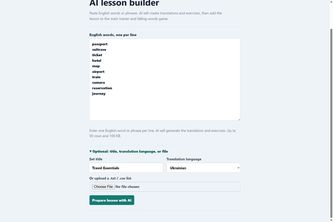
- Support for learner-generated vocabulary lists
- Localization into English, Ukrainian, and Russian
It also includes:
- AI-powered lesson enrichment using GPT-5.6
- Structured practice workflows
- Game mechanics such as movement, jumping, attacking obstacles, and skill usage powered by HP, MP, stamina
- Keyboard, touch, and gamepad controls (including Sony DualSense)
- Server-side validation of AI outputs to prevent unauthorized changes in learning state
The platform runs on Laravel, PHP, MySQL, and uses OpenAI services for structured content generation.
Inference This is a self-contained language-learning application with gamification elements designed to engage users through interactive storytelling and progress tracking. It does not appear to be a marketplace or SaaS product offering — rather, it's an educational tool built around AI-assisted learning paths.
Positioning & Claim Evolution
The author claims:
- Most language-learning products separate studying, correcting mistakes, and playing games.
- The goal was to connect these activities into one continuous learning adventure.
- Mistakes should return until they are mastered.
- Progress is turned into a visible RPG journey.
- Repetition should be meaningful.
These claims suggest an evolution from traditional language apps toward a more immersive, adaptive experience that blends education with entertainment.
Inference The positioning appears to target learners who want a fun and engaging way to learn English, especially those who may find conventional drills monotonous. However, there is no evidence of how this positioning was tested or validated in the market.
Target Customer & ICP
The description does not clearly define the intended customer segment beyond general language learners. It mentions:
- Learners entering their own vocabulary lists
- Use of AI to generate lessons based on those inputs
- Support for multiple languages (English, Ukrainian, Russian)
There is no indication of whether the product targets students, professionals, or casual learners.
Inference The ICP likely includes individuals seeking personalized English learning experiences, particularly those interested in gamified tools. However, without explicit segmentation data or user feedback, this remains speculative.
Business Model & Pricing Evidence
No evidence of pricing structure, monetization strategy, or business model is provided in the description.
Inference The product appears to be in closed beta with a demo account available for judges. There is no mention of paid features, subscriptions, or commercial partnerships.
Technical & Delivery Signals
The platform:
- Uses Laravel (PHP), MySQL, Blade templates
- Integrates OpenAI services via GPT-5.6
- Implements Gamepad API and Web Audio API
- Runs on Nginx with FastPanel
- Caches AI-generated media to reduce API costs
- Maintains deterministic progress tracking despite AI involvement
- Supports multiple input methods (keyboard, touch, gamepad)
- Has automated production release workflows
The description also notes:
- 168 tests with 1,916 assertions
- Private media storage and rate limiting
- Database migrations and atomic releases
- Known rollback version support
Inference Technical architecture suggests a mature development process with attention to scalability, security, and maintainability. The use of AI in controlled ways indicates an understanding of risk management.
Traction & Maturity Signals
The description states:
- The project existed before Build Week as an early LIM-based browser trainer
- During Build Week, it was substantially extended with new features
- A closed beta is running behind authentication
- Demo account provided for judges (no registration required)
- No public-facing sign-up or open self-registration
There is no mention of:
- Revenue
- Customers
- User engagement metrics
- Active users
- Conversion rates
- Retention data
Inference The product shows signs of iterative development and technical maturity but lacks any evidence of traction or real-world adoption.
Competitive Context
No direct competitors are named in the description. The author references “most language-learning products” as separating activities, implying a gap in the market for integrated solutions.
Inference While not explicitly stated, the product likely competes with traditional language apps and some gamified platforms like Duolingo or Memrise. However, no competitive analysis or differentiation strategy is provided.
Open Questions & Risks
Key risks include:
- Lack of traction: No evidence of users beyond a demo account.
- AI dependency without clear governance: While AI is used in constrained ways, the risk of over-reliance on unverified outputs remains.
- Closed beta only: No public access or feedback loop implies limited validation.
- Single founder team: One-person operation raises concerns about scalability and operational capacity.
- Unproven commercial viability: No pricing model, monetization plan, or revenue data.
Inference The project is technically advanced but lacks commercial proof of concept. The lack of user data and market testing makes it difficult to assess its potential for growth or impact.
Questions the description leaves open
- What specific problems did users encounter during the closed beta?
- How do you plan to transition from a closed beta to a scalable, monetized product?
- Are there any plans for community building or user feedback loops?
- What is your strategy for expanding beyond English and into other languages?
- How are you planning to validate that the gamification elements improve learning outcomes?
- Do you have any data on how long users stay engaged with the platform?
- What are the key assumptions about user behavior that underpin this product?
Overall Assessment
Confidence Level: Low
The description provides a detailed technical overview and self-reported progress, but no evidence of traction, revenue, or customer adoption. The product is in closed beta with limited access, and there is no indication of market validation.
Findings
- Strong technical execution
- Clear vision for integrating AI and gamification
- No evidence of commercial success or user engagement
Assessment This project demonstrates strong engineering capability and a compelling concept, but lacks the foundational signals needed to evaluate its investment potential. It should be considered a prototype with high development maturity but low commercial readiness.
User Stories BotA demo video on every pull request
Get a demo video on every new feature
GitHub App that watches your pull requests and records a narrated, captioned demo.
Save time on demo prep and make informed decisions faster with a video walkthrough of every new feature.
Source
Submitted to the OpenAI 2026 hackathon on Devpost. Project home on Devpost. Back to the full gallery on Devpost.
This competitive analysis was produced by top-founders.com (opens in a new tab)
Generated by a language model from this project's public Devpost page — its tagline, the author's own write-up and any built-with tags listed there — as captured in August 2026. Short quotations are the author's words. It is an opinion on the idea as a business, not on the people behind it, and it reflects the description as published then. If the project has moved on, request a correction below. The analysis is not independent research and contains no verified traction, revenue or customer data.
An independent guide by KFG International LLC — not affiliated with, endorsed by, or connected to Devpost or OpenAI.