

Archive position — measured, not model output
1 like on Devpost
505 of the 7,850 archived projects have more likes, and 1,758 share exactly 1 — so this project's #579 place in the like-ranked listing is a tie-break inside that group, not a ranking.
Projects (log scale)
Likes on Devpost. ▲ marks this project's group.
Show the figures
| Likes | Projects | Share of archive |
|---|---|---|
| 0 | 5,587 | 71.2% |
| 1 | 1,758 | 22.4% |
| 2 | 284 | 3.6% |
| 3–4 | 132 | 1.7% |
| 5–9 | 75 | 1.0% |
| 10+ | 14 | 0.2% |
 User Stories BotA demo video on every pull request
Get a demo video on every new feature
GitHub App that watches your pull requests and records a narrated, captioned demo.
Save time on demo prep and make informed decisions faster with a video walkthrough of every new feature.
Executive Summary
What the company appears to be
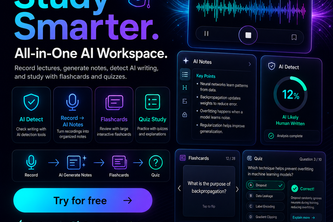
AIWoven is a self-reported AI-powered learning workspace designed for students to convert lectures and documents into structured notes, flashcards, quizzes, and matching activities. It integrates multiple AI models through a unified interface and aims to streamline note-taking and study workflows.
What changed
The project was reportedly enhanced during OpenAI Build Week using GPT-5.6 and Codex, with improvements made to user experience, modular management, UI layout, and core components like the AI note-taking assistant and learning flows.
Single most important open question — the commercial due-diligence read
Is there any evidence of actual student adoption or usage beyond the author’s personal experience? The description does not indicate whether the product has been tested with real users or if it has achieved any measurable traction.
What The Product Actually Is
The description states that AIWoven is an AI-powered learning workspace. It allows students to:
- Convert lecture recordings into structured notes.
- Import those notes or slides into “AI Study” mode, which generates quizzes and flashcards.
- Use a unified platform for note-taking, studying, and productivity.
It integrates multiple LLMs through a single interface, with each model playing a specific role in generating outputs. The system supports workflows related to learning, note-taking, research, writing, and AI-assisted productivity.
The author describes it as more than a standalone tool—it creates a connected workflow from audio input to study material generation.
Evidence
- The description states that lecture recordings are converted into notes.
- Notes can be imported into “AI Study” mode for quiz and flashcard creation.
- Multiple LLMs are used, with cross-verification for quality output.
- It supports workflows for learning, note-taking, research, writing, and productivity.
Inference The product appears to be a full-stack AI application built using Next.js, TypeScript, Prisma, PostgreSQL, and various LLM providers. It includes features like audio segmentation during recording and silence detection to reduce API costs and improve performance.
Positioning & Claim Evolution
The author positions AIWoven as a solution for students who struggle with fast-paced lectures and fragmented AI tools. The key claims include:
- Solving the problem of missing information due to rapid lecture pacing.
- Offering a single platform that integrates multiple AI functions (note-taking, flashcards, quizzes).
- Making these features accessible for free where possible.
During OpenAI Build Week, the author claims significant enhancements were made using GPT-5.6 and Codex, including:
- Prompt engineering for better code generation.
- Redesign of core components such as navigation, AI assistant, learning flows, flashcards, and quiz features.
Evidence
- The author states that AIWoven was already a primary project before OpenAI Build Week but was improved during the event.
- GPT-5.6 was used for outlining product adjustments and generating structured prompts.
- Codex was used to accelerate code implementation, debugging, refactoring, and repetitive tasks.
Inference The evolution of AIWoven suggests an iterative development process driven by AI collaboration rather than traditional software engineering methods.
Target Customer & ICP
The target customer is described as students in university settings. The author notes that many professors lecture at a rapid pace, making it difficult for students to keep up while taking notes.
Evidence
- The inspiration comes from personal experience during university studies.
- The product addresses challenges faced by students who want to listen attentively but also capture key points.
- It is designed with student needs in mind, especially around accessibility and ease of use.
Inference The ICP likely centers on undergraduate or graduate students seeking efficient tools for managing academic content. However, no explicit segmentation beyond "students" is provided.
Business Model & Pricing Evidence
There is no evidence of pricing or business model details in the description. The author mentions that they want to make features accessible to students for free whenever possible, but does not elaborate on monetization strategies or paid tiers.
Evidence
- The author states their goal was to make it accessible to students for free.
- No mention of subscriptions, freemium models, or revenue streams.
Inference It is unclear whether AIWoven intends to offer a freemium model, charge per use, or pursue other monetization approaches. This remains an open question.
Technical & Delivery Signals
The project is built using:
- Frontend: Next.js, TypeScript
- Backend: Node.js, PostgreSQL, Prisma
- AI Integration: Multiple LLM providers via a unified interface
- Deployment: Vercel
- Payment Processing: Stripe
Key technical decisions include:
- Handling large audio files by segmenting them during recording.
- Using silence detection to reduce unnecessary API usage.
- Implementing automatic merging of segments into complete transcripts.
Evidence
- The author lists technologies used in building the platform.
- Specific engineering challenges were addressed through redesigning the recording process.
- Audio segmentation and silence detection are mentioned as solutions to infrastructure issues.
Inference The technical architecture shows a focus on robustness, particularly around handling large data inputs and optimizing resource usage. However, no evidence of scalability or production deployment is provided.
Traction & Maturity Signals
There is no evidence of traction, revenue, customers, or adoption beyond the author’s personal experience. The project was submitted to the OpenAI 2026 hackathon on Devpost, but there are no indicators of real-world usage or user feedback.
Evidence
- The description states that this is a self-developed project.
- No mention of users, customers, or market validation.
- Submission to a hackathon does not constitute traction.
Inference The product appears to be in early development stage, possibly prototype-level. There is no evidence of any measurable impact or user engagement.
Competitive Context
The author notes that while there are many AI tools addressing parts of the problem—such as generating notes from recordings, creating flashcards, summarizing PDFs, or providing access to various AI models—their drawbacks include:
- Strict free usage limits.
- Fragmented experience across multiple platforms.
- High cost for advanced features.
AIWoven aims to integrate these functions into one platform and make them accessible to students for free.
Evidence
- The author identifies existing tools as solving only partial aspects of the problem.
- Criticizes fragmentation, strict free limits, and high pricing in competing solutions.
Inference The competitive landscape includes a range of AI productivity and education tools, but no specific names or direct competitors are named. The positioning is based on perceived gaps in current offerings.
Open Questions & Risks
Several risks and open questions emerge from the self-reported description:
- Lack of traction: No evidence of real users or adoption.
- Single-person team: Only one developer (Vins Liu) is involved, which raises concerns about scalability and long-term maintenance.
- Unverified claims: All statements are self-reported without external validation.
- Unclear monetization strategy: No indication of how the product will generate revenue.
- Technical complexity: The project involves complex audio processing and AI integration, which may pose significant engineering challenges.
Evidence
- Only one member listed in the team.
- No mention of users or customers.
- No pricing or business model details provided.
- The author acknowledges technical difficulties but does not describe how they were resolved beyond redesigning the recording process.
Inference The lack of independent verification and limited team size suggest that this is likely a prototype or proof-of-concept rather than a mature product ready for market entry.
Questions the description leaves open
- What specific feedback have you received from students who have used the tool?
- How do you plan to monetize the platform, and what is your go-to-market strategy?
- Can you provide evidence of how the audio processing pipeline handles real-world classroom conditions (e.g., background noise, multiple speakers)?
- What are the key assumptions underlying your product design, and how have they been validated?
- How do you intend to scale beyond a single developer, especially in terms of engineering and product development?
Overall Assessment
Not evidenced.
The description provides no information about financials, revenue, customer base, or traction that would support an investment or partnership decision. The project is described as a personal initiative by one individual, with no indication of commercial viability or market validation.
Confidence Level Low This analysis is based entirely on self-reported content and lacks any external corroboration. There is insufficient evidence to assess the product's readiness for commercialization or investment.
User Stories BotA demo video on every pull request
Get a demo video on every new feature
GitHub App that watches your pull requests and records a narrated, captioned demo.
Save time on demo prep and make informed decisions faster with a video walkthrough of every new feature.
Source
Submitted to the OpenAI 2026 hackathon on Devpost. Project home on Devpost. Back to the full gallery on Devpost.
This competitive analysis was produced by top-founders.com (opens in a new tab)
Generated by a language model from this project's public Devpost page — its tagline, the author's own write-up and any built-with tags listed there — as captured in August 2026. Short quotations are the author's words. It is an opinion on the idea as a business, not on the people behind it, and it reflects the description as published then. If the project has moved on, request a correction below. The analysis is not independent research and contains no verified traction, revenue or customer data.
An independent guide by KFG International LLC — not affiliated with, endorsed by, or connected to Devpost or OpenAI.