

Archive position — measured, not model output
0 likes on Devpost
2,263 of the 7,850 archived projects have more likes, and 5,587 share exactly 0 — so this project's #2,539 place in the like-ranked listing is a tie-break inside that group, not a ranking.
Projects (log scale)
Likes on Devpost. ▲ marks this project's group.
Show the figures
| Likes | Projects | Share of archive |
|---|---|---|
| 0 | 5,587 | 71.2% |
| 1 | 1,758 | 22.4% |
| 2 | 284 | 3.6% |
| 3–4 | 132 | 1.7% |
| 5–9 | 75 | 1.0% |
| 10+ | 14 | 0.2% |
 User Stories BotA demo video on every pull request
Get a demo video on every new feature
GitHub App that watches your pull requests and records a narrated, captioned demo.
Save time on demo prep and make informed decisions faster with a video walkthrough of every new feature.
Executive Summary
What the company appears to be
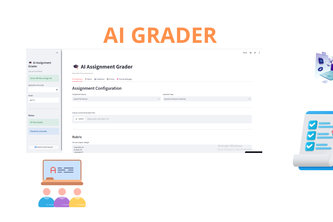
The project described is an AI-powered grading application for academic writing, built as a prototype by one developer (Syukur Daulay) for the OpenAI 2026 hackathon. It uses GPT-5.6 and other tools to automate parts of the essay-grading process, including rubric-based scoring, feedback generation, and result visualization. The system allows lecturers to upload student assignments in PDF or DOCX formats, define grading rubrics, and receive structured AI-generated results that can be manually reviewed and exported.
What changed
This is a self-reported prototype submitted for a hackathon. There is no evidence of prior development, funding, or commercial traction beyond the project description itself.
The single most important open question — the commercial due-diligence read
Is there any evidence that this product has moved beyond a proof-of-concept into real-world use by academic institutions or educational platforms? The author states it was built for a hackathon and includes no mention of customers, revenue, or adoption.
What The Product Actually Is
The description states:
- It is an AI-powered grading app for essays and academic writing.
- It uses GPT-5.6 as the core engine for evaluating student submissions.
- It supports PDF and DOCX document formats.
- It allows lecturers to define rubrics, extract answers, generate feedback, and visualize class performance.
- It includes manual override capabilities before publishing final grades.
- It exports results to Excel or CSV.
- It is built using Python, Streamlit, OpenAI APIs, pandas, plotly, pymupdf, python-docx.
Inference The product appears to be a tool for automating parts of the grading process in higher education settings. It integrates with LMS systems (planned) and supports structured rubric-based scoring.
Positioning & Claim Evolution
The description states:
- The app aims to reduce hours spent on manual grading by automating essay evaluation using GPT-5.6.
- It positions itself as a solution for university lecturers dealing with open-ended assignments.
- It emphasizes that final decisions remain with the lecturer, suggesting a hybrid model of AI + human review.
Inference The positioning is focused on reducing lecturer workload through automation while maintaining human oversight. The claim evolution suggests an intent to scale into institutional tools rather than just a one-off hackathon prototype.
Target Customer & ICP
The description states:
- Primary users are university lecturers who grade essays and academic writing.
- It targets educational institutions where open-ended assignments are common.
Inference The target customer is likely educators or administrators in higher education environments, particularly those using LMS platforms like Moodle or Google Classroom. The ICP appears to be early-stage academic users looking for time-saving tools.
Business Model & Pricing Evidence
The description states:
- No explicit pricing model is mentioned.
- It is described as a prototype built for a hackathon.
- There is no indication of monetization strategy or revenue streams.
Inference There is no evidence of any business model or pricing structure beyond the initial prototype. The app does not appear to be commercially available or sold.
Technical & Delivery Signals
The description states:
- Built using Python and Streamlit.
- Uses OpenAI APIs, pandas, plotly, pymupdf, python-docx.
- Runs in Google Cloud Run (planned), currently hosted on Streamlit.
- Supports PDF and DOCX document extraction.
- Integrates with LMS systems (future development).
- Includes JSON schema validation for responses.
Inference The technical stack indicates a lightweight, developer-focused prototype. The use of Streamlit suggests ease-of-use but also limits scalability. The planned integration with LMS platforms shows intent to expand functionality.
Traction & Maturity Signals
The description states:
- This is a hackathon submission (OpenAI 2026).
- It was built by one person (Syukur Daulay).
- No mention of users, customers, or adoption.
- No revenue, funding, or headcount data provided.
Inference There is no evidence of traction or maturity beyond a prototype. The project has not been commercialized or deployed in real-world settings.
Competitive Context
The description states:
- No direct competitors are named.
- It focuses on AI-powered grading with rubric customization and feedback generation.
- It mentions future integrations with Moodle, Google Classroom, and LMS APIs.
Inference While not explicitly named, the concept overlaps with existing tools in educational AI and automated grading systems. However, no competitive analysis or differentiation is provided in the description.
Open Questions & Risks
The description states:
- It is a hackathon prototype with no commercial deployment.
- The app uses GPT-5.6 (which may not exist), and the author does not clarify if this refers to an actual model or a placeholder name.
- No mention of data privacy, security, or institutional compliance measures.
Inference
Key risks include:
- Lack of real-world testing or deployment.
- Unclear validity of GPT-5.6 reference (could be fictional).
- Absence of any user feedback or product-market fit validation.
- No evidence of scalability, institutional integration, or compliance with educational standards.
Questions the description leaves open
- What is the actual model being used? Is GPT-5.6 a real model or a placeholder?
- Has this prototype been tested in any real academic setting?
- Are there plans to integrate with specific LMS platforms (e.g., Moodle, Canvas)?
- How does the system handle edge cases like multi-language submissions or complex formatting?
- What are the data privacy and security measures for handling student work?
- Is there a roadmap for monetization or commercial deployment?
Overall Assessment
The description states:
- This is a hackathon submission with no evidence of traction, revenue, or customer base.
- The project is not commercially viable or scalable as described.
Inference At this stage, the project is a prototype with no demonstrated commercial viability. It lacks any evidence of product-market fit, institutional adoption, or monetization strategy. Any investment or partnership would be speculative and contingent on significant development beyond the current state.
User Stories BotA demo video on every pull request
Get a demo video on every new feature
GitHub App that watches your pull requests and records a narrated, captioned demo.
Save time on demo prep and make informed decisions faster with a video walkthrough of every new feature.
Source
Submitted to the OpenAI 2026 hackathon on Devpost. Project home on Devpost. Back to the full gallery on Devpost.
This competitive analysis was produced by top-founders.com (opens in a new tab)
Generated by a language model from this project's public Devpost page — its tagline, the author's own write-up and any built-with tags listed there — as captured in August 2026. Short quotations are the author's words. It is an opinion on the idea as a business, not on the people behind it, and it reflects the description as published then. If the project has moved on, request a correction below. The analysis is not independent research and contains no verified traction, revenue or customer data.
An independent guide by KFG International LLC — not affiliated with, endorsed by, or connected to Devpost or OpenAI.