

Archive position — measured, not model output
0 likes on Devpost
2,263 of the 7,850 archived projects have more likes, and 5,587 share exactly 0 — so this project's #4,502 place in the like-ranked listing is a tie-break inside that group, not a ranking.
Projects (log scale)
Likes on Devpost. ▲ marks this project's group.
Show the figures
| Likes | Projects | Share of archive |
|---|---|---|
| 0 | 5,587 | 71.2% |
| 1 | 1,758 | 22.4% |
| 2 | 284 | 3.6% |
| 3–4 | 132 | 1.7% |
| 5–9 | 75 | 1.0% |
| 10+ | 14 | 0.2% |
 User Stories BotA demo video on every pull request
Get a demo video on every new feature
GitHub App that watches your pull requests and records a narrated, captioned demo.
Save time on demo prep and make informed decisions faster with a video walkthrough of every new feature.
Executive Summary
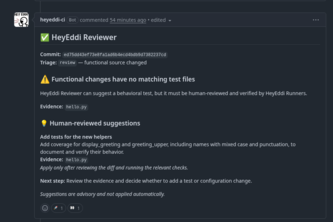
The company appears to be a solo project (1 person) named HeyEddi CI — an AI-powered GitHub pull-request reviewer with evidence-backed suggestions and safe CI execution capabilities. The author states that it is built as a GitHub App using FastAPI, Vue, Firebase/Firestore, Google Cloud Run, Pub/Sub, Terraform, and the OpenAI API. It operates by analyzing diffs in PRs, detecting functional changes or missing tests, identifying risks, and publishing findings directly to GitHub with reactions for visibility.
The key change is that this tool aims to replace deprecated automated code review tools like Gemini Code Assist, offering a transparent, cost-aware, and evidence-based alternative.
The single most important open question is: What is the actual commercial viability of this tool? The author describes a product that could be valuable for teams looking for better PR reviews, but there is no evidence of revenue, customers, or adoption beyond self-reported claims and a sandbox test.
What The Product Actually Is
The description states that HeyEddi CI is:
- A GitHub App that reviews pull requests.
- It uses AI-assisted analysis, specifically leveraging the OpenAI API.
- It operates with bounded context, meaning it only analyzes changes in a PR and not the entire repository.
- It detects functional changes, missing tests, security or quality risks.
- It suggests code changes and behavioral tests.
- It publishes findings directly to GitHub.
- It supports commands like
/heyeddi review,/heyeddi again, etc. - Suggestions are advisory and never applied automatically.
- It includes evidence-linked findings, meaning outputs reference only changed files.
- It uses FastAPI, Vue.js, Firebase/Firestore, Google Cloud Run, Pub/Sub, Terraform for implementation.
This is a developer tooling product, focused on improving code review workflows in GitHub environments.
Claim: The product is an AI-powered GitHub App that reviews PRs and publishes findings.
Evidence: Yes — from the author's own write-up.
Positioning & Claim Evolution
The author states:
- The project was inspired by the deprecation of Gemini Code Assist’s GitHub review experience.
- They wanted to build their own alternative that is:
- Transparent
- Cost-aware
- Evidence-based
- Fully owned by the HeyEddi product
This suggests a positioning shift from generic AI code review tools to one that emphasizes trust, cost control, and ownership.
Claim: The tool replaces deprecated automated code review tools with a more transparent and cost-aware alternative.
Evidence: Yes — from the author's own write-up.
Inference: This implies a niche in teams seeking better control over their review process and cost management.
Note: No evidence of market positioning beyond this self-description.
Target Customer & ICP
The description states:
- The tool is designed for developers working with GitHub PRs.
- It supports commands like
/heyeddi review, which suggests it's intended to be used by developers or DevOps engineers in a CI/CD workflow. - It is built as a GitHub App, targeting teams using GitHub.
It does not explicitly name specific customer segments, but the use of GitHub and PRs implies:
- ICP: Developers or engineering teams using GitHub for code collaboration.
- Use case: Improving code review quality and speed via AI-assisted feedback.
Claim: The target is developers or DevOps engineers working in GitHub environments.
Evidence: Yes — inferred from GitHub App use and PR-focused functionality.
Inference: Likely to appeal to teams with CI/CD pipelines and code review workflows.
Note: No evidence of specific customer types, size, or adoption.
Business Model & Pricing Evidence
The description does not provide any information about:
- Pricing
- Revenue model
- Monetization strategy
- Subscription tiers
- Paid features
It only describes the tool’s functionality and architecture.
Claim: There is no evidence of a business model or pricing.
Evidence: Not evidenced — the author does not describe monetization or pricing.
Technical & Delivery Signals
The description states:
- Built as a GitHub App using:
- FastAPI
- Vue.js
- Firebase/Firestore
- Google Cloud Run
- Pub/Sub
- Terraform
- OpenAI API
- Uses bounded context and deterministic triage
- Implements asynchronous processing, idempotency, and secret management
- Supports PR reactions for visibility (👀, 🚀)
- Includes Terraform destroy protection
- Tested against a real sandbox pull request
Claim: The tool is built with modern infrastructure and delivery practices.
Evidence: Yes — from the author's own write-up.
Inference: Suggests a mature engineering approach, but no evidence of production use or scale.
Traction & Maturity Signals
The description states:
- It was built for the OpenAI 2026 hackathon
- It includes:
- A working GitHub App
- Production webhook gateway
- AI-generated findings and suggestions
- Immediate PR reactions
- Bounded repository overviews
- Terraform deployment with safety controls
- It was tested against a sandbox pull request
It does not mention:
- Any customers or users
- Revenue or monetization
- Adoption metrics
- Product usage data
Claim: The tool is in an early stage, built for a hackathon.
Evidence: Yes — from the author's own write-up.
Inference: Likely not yet in production use by teams.
Note: No evidence of traction or adoption beyond self-reported sandbox testing.
Competitive Context
The description states:
- It was inspired by the deprecation of Gemini Code Assist
- It aims to be a transparent, cost-aware, and evidence-based alternative
It does not mention:
- Other specific competitors
- Market share or competitive positioning
- Product differentiation in detail
Claim: The tool is positioned as an alternative to tools like Gemini Code Assist.
Evidence: Yes — from the author's own write-up.
Inference: Likely competes with other AI code review tools, but no evidence of market analysis or competitive landscape.
Open Questions & Risks
- The project is self-reported and unverified.
- It is a 1-person team, which may limit scalability or product development velocity.
- No evidence of:
- Revenue
- Customers
- Product adoption
- Market traction
- The tool is described as built for a hackathon, not yet in production use.
- It is unclear how it would scale beyond sandbox testing.
- No mention of security, data privacy, or compliance considerations.
Claim: Key risks include lack of traction, scalability concerns, and unverified claims.
Evidence: Not evidenced — but inferred from the self-reported nature and early-stage description.
Questions the description leaves open
- What is your plan for monetization or revenue generation?
- Have you tested this tool with real teams or in production environments?
- How do you plan to scale beyond a single developer’s use case?
- What are the specific cost controls and infrastructure limitations of the current implementation?
- Are there any known security or compliance risks with how AI outputs are validated and published?
- How does this tool differ from existing GitHub App integrations or AI code review tools in the market?
Overall Assessment
The description states that this is a self-built project for a hackathon, not yet in production use, and lacks any evidence of revenue, customers, or traction.
Claim: The tool is an early-stage idea with no commercial viability yet.
Evidence: Not evidenced — the author describes a prototype, not a product in market.
Inference: Not suitable for investment or partnership at this stage without further development and evidence of traction.
Confidence Level: Low — based on self-reported, unverified, and minimal evidence.
User Stories BotA demo video on every pull request
Get a demo video on every new feature
GitHub App that watches your pull requests and records a narrated, captioned demo.
Save time on demo prep and make informed decisions faster with a video walkthrough of every new feature.
Source
Submitted to the OpenAI 2026 hackathon on Devpost. Project home on Devpost. Back to the full gallery on Devpost.
This competitive analysis was produced by top-founders.com (opens in a new tab)
Generated by a language model from this project's public Devpost page — its tagline, the author's own write-up and any built-with tags listed there — as captured in August 2026. Short quotations are the author's words. It is an opinion on the idea as a business, not on the people behind it, and it reflects the description as published then. If the project has moved on, request a correction below. The analysis is not independent research and contains no verified traction, revenue or customer data.
An independent guide by KFG International LLC — not affiliated with, endorsed by, or connected to Devpost or OpenAI.