

Archive position — measured, not model output
0 likes on Devpost
2,263 of the 7,850 archived projects have more likes, and 5,587 share exactly 0 — so this project's #4,503 place in the like-ranked listing is a tie-break inside that group, not a ranking.
Projects (log scale)
Likes on Devpost. ▲ marks this project's group.
Show the figures
| Likes | Projects | Share of archive |
|---|---|---|
| 0 | 5,587 | 71.2% |
| 1 | 1,758 | 22.4% |
| 2 | 284 | 3.6% |
| 3–4 | 132 | 1.7% |
| 5–9 | 75 | 1.0% |
| 10+ | 14 | 0.2% |
 User Stories BotA demo video on every pull request
Get a demo video on every new feature
GitHub App that watches your pull requests and records a narrated, captioned demo.
Save time on demo prep and make informed decisions faster with a video walkthrough of every new feature.
Executive Summary
What the company appears to be
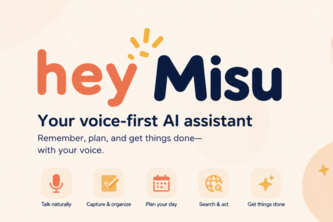
heyMisu is a voice-first personal AI assistant for macOS, built by a solo developer. The product claims to help users remember context, perform tasks, and transform conversations into actionable insights using GPT-5.6. It integrates with screen context, meeting recording, task creation, and structured output generation.
What changed
The project was submitted as part of the OpenAI 2026 hackathon, indicating a prototype or early-stage product. The author describes it as a personal assistant that avoids traditional chatbot patterns by focusing on continuity, action, and outcome-oriented AI use.
Single most important open question
Is there evidence of user adoption, revenue, or traction beyond the self-reported description? The project is described as a solo developer effort with no external validation or customer data.
What The Product Actually Is
The description states that heyMisu is a voice-first personal AI assistant for macOS. It can be activated via keyboard shortcut and supports:
- Creating tasks, reminders, calendar events
- Searching the web and comparing information
- Opening websites and applications
- Capturing notes from conversations
- Remembering context for future interactions
- Reviewing unfinished work and preparing daily briefs
- Understanding screen context when activated
- Recording meetings and turning them into transcripts, summaries, decisions, and action items
- Transforming conversations into structured insights using GPT 5.6
It is described as a macOS application with a compact interface that stays available without taking over the user’s screen.
Inference The product appears to be a desktop tool focused on personal productivity, integrating voice interaction with AI reasoning and task automation.
Positioning & Claim Evolution
The author states that heyMisu was built to feel less like a chatbot and more like someone quietly helping throughout the day, aiming for an assistant that helps users stay on track without interrupting workflow.
Key claims include:
- It remembers context across interactions.
- It performs tasks automatically, not just answers questions.
- It transforms conversations into actionable insights using GPT 5.6.
- It is designed to help users reach useful outcomes faster, rather than spending time talking to AI.
The positioning evolves from a simple voice assistant to one that supports:
- Continuous workflow
- Structured outputs (e.g., summaries, comparisons)
- Meeting analysis and transcription
- Task automation
Inference The product positions itself as a personal productivity tool, not a general-purpose chatbot or conversational AI.
Target Customer & ICP
The author describes their own use case:
“As a full time employee and part time solo developer managing projects, meetings, ideas, reminders, and everyday tasks…”
This suggests the initial target is:
- Tech professionals
- Solo developers
- Knowledge workers who manage multiple tools and workflows
- Users seeking context-aware AI assistance
The product is built for macOS users, implying a technical audience with high-end computing needs.
Inference The ICP likely includes highly productive individuals or teams who want seamless integration of voice, context, and task execution within their workflow.
Business Model & Pricing Evidence
Not evidenced.
The description does not mention pricing models, monetization strategies, or any business model details.
Technical & Delivery Signals
The app is built as a macOS application, using:
- GPT realtime 2.1 mini for low-latency conversation and tool calls
- GPT-5.6 for deeper reasoning and structured outputs
- Codex was used throughout development as a “development partner”
Key technical features include:
- Voice interaction with keyboard activation
- Screen context awareness (when activated)
- Meeting recording and transcription
- Structured Insight generation from conversations
- Local storage of insights
The author emphasizes:
- Separation of real-time and reasoning models
- Use of Codex for rapid prototyping, debugging, and code refinement
- Focus on predictable actions and clear tool execution
Inference The product is a desktop-first AI assistant, leveraging both real-time and deep reasoning models. It uses a hybrid approach to deliver performance and functionality.
Traction & Maturity Signals
Not evidenced.
There is no mention of:
- Revenue
- Customers
- User base
- Adoption metrics
- Product usage data
The project is described as a solo developer effort, built for the OpenAI 2026 hackathon, suggesting it is in an early prototype or MVP stage.
Inference No traction or maturity signals are evident beyond the author's own description. The product may be pre-revenue and pre-customer.
Competitive Context
Not evidenced.
The description does not reference:
- Competitors
- Market positioning relative to existing tools
- Differentiation from similar products
However, based on the features described (voice assistant, context-awareness, task automation, meeting analysis), it likely competes with:
- Voice-based personal assistants
- AI productivity tools
- Meeting transcription and summarization platforms
- Task management systems with AI capabilities
Inference The competitive landscape is implied to include voice-enabled productivity tools, but no specific competitors are named.
Open Questions & Risks
- Solo developer model:
- Risk of limited scalability or long-term maintenance.
- No team structure for product evolution or support.
- Unverified claims:
- The use of GPT-5.6 is self-reported; no confirmation of actual model version or capabilities.
- No evidence of real-world performance or user feedback.
- No traction or monetization:
- No data on users, revenue, or adoption — raises questions about product-market fit.
- Technical complexity vs. execution risk:
- Integrating voice, screen context, meeting recording, and AI reasoning is technically challenging.
- Risk of under-delivery due to scope or technical limitations.
- Privacy implications:
- Recording meetings and capturing screen context raises privacy concerns that are not addressed in the description.
Questions the description leaves open
- What is the actual model version used? Is GPT-5.6 confirmed, or is this a self-reported label?
- How does the assistant handle permissions and user control over data capture (e.g., screen context, audio)?
- Are there any early users or feedback loops in place?
- What are the plans for monetization or product roadmap beyond the hackathon submission?
- How is the separation between GPT-5.6 and real-time models implemented technically?
- What are the limitations of the current version, and how does the team plan to scale beyond a solo developer model?
Overall Assessment
Not evidenced.
The description provides no information on:
- Financials
- Revenue
- Customer traction
- Market size or opportunity
- Team experience or track record
This is a pre-revenue, pre-customer prototype submitted to a hackathon. The author describes the product as a personal assistant with voice and AI features, but there is no evidence of commercial viability or traction.
Inference This project is in an early development stage and lacks commercial due-diligence signals. It may be a promising concept for further exploration, but it does not yet demonstrate readiness for investment or partnership.
User Stories BotA demo video on every pull request
Get a demo video on every new feature
GitHub App that watches your pull requests and records a narrated, captioned demo.
Save time on demo prep and make informed decisions faster with a video walkthrough of every new feature.
Source
Submitted to the OpenAI 2026 hackathon on Devpost. Project home on Devpost. Back to the full gallery on Devpost.
This competitive analysis was produced by top-founders.com (opens in a new tab)
Generated by a language model from this project's public Devpost page — its tagline, the author's own write-up and any built-with tags listed there — as captured in August 2026. Short quotations are the author's words. It is an opinion on the idea as a business, not on the people behind it, and it reflects the description as published then. If the project has moved on, request a correction below. The analysis is not independent research and contains no verified traction, revenue or customer data.
An independent guide by KFG International LLC — not affiliated with, endorsed by, or connected to Devpost or OpenAI.