

Archive position — measured, not model output
1 like on Devpost
505 of the 7,850 archived projects have more likes, and 1,758 share exactly 1 — so this project's #577 place in the like-ranked listing is a tie-break inside that group, not a ranking.
Projects (log scale)
Likes on Devpost. ▲ marks this project's group.
Show the figures
| Likes | Projects | Share of archive |
|---|---|---|
| 0 | 5,587 | 71.2% |
| 1 | 1,758 | 22.4% |
| 2 | 284 | 3.6% |
| 3–4 | 132 | 1.7% |
| 5–9 | 75 | 1.0% |
| 10+ | 14 | 0.2% |
 User Stories BotA demo video on every pull request
Get a demo video on every new feature
GitHub App that watches your pull requests and records a narrated, captioned demo.
Save time on demo prep and make informed decisions faster with a video walkthrough of every new feature.
Executive Summary
What the company appears to be
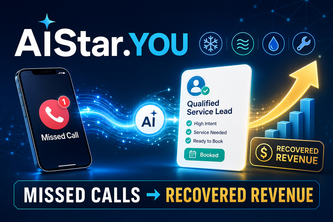
The project described by the author is a self-contained workflow engine for handling missed calls in HVAC and plumbing businesses, designed to turn these into qualified leads before opportunities are lost. It uses n8n as its workflow engine, with deterministic logic and human review layers, and includes AI-assisted development tools (Codex, GPT-5.6) but does not integrate live communication or revenue claims.
What changed
The project is a V1 demonstration submitted to the OpenAI 2026 hackathon, built in a zero-budget environment with no production integrations. It focuses on proving a controlled decision-making system for missed-call recovery, without claiming actual revenue generation or live automation.
Single most important open question
Is there any evidence of traction, revenue, or customer adoption beyond this demo? The description states the project is not yet production-ready and does not claim to have generated revenue.
What The Product Actually Is
The description states that AIStar.YOU is a consent-aware missed-call recovery workflow built in n8n. It processes simulated missed-call events through a series of steps including:
- normalization of incoming data;
- validation of required fields and test-mode conditions;
- checking consent, opt-out, and suppression status;
- blocking duplicates;
- applying qualification and urgency rules;
- assigning one of three handoff outcomes:
- READY_FOR_HANDOFF
- HUMAN_REVIEW_REQUIRED
- URGENT_HUMAN_REVIEW_REQUIRED;
- preparing labeled records for auditing and testing;
- returning structured webhook results.
The V1 demonstration does not send live SMS or email, book appointments, make autonomous safety decisions, or claim recovered revenue.
Inference The system is a decision-making framework, not a full automation or communication tool. It is designed to be a compliance-aware lead qualification engine with human oversight.
Positioning & Claim Evolution
The description states that the product aims to "turn missed calls into qualified, actionable leads for HVAC and plumbing businesses—before opportunities go cold."
It positions itself as a consent-aware AI workflow, emphasizing compliance and safety. The author notes that this is a demo, not a production-ready service.
Inference The positioning is early-stage, focused on demonstrating a controlled system rather than delivering a commercial product or service. It does not claim to be a revenue-generating platform, nor does it imply any existing customer base or market traction.
Target Customer & ICP
The description states that the product is intended for HVAC and plumbing businesses.
It also mentions that the system is designed to "turn missed calls into qualified, actionable leads", suggesting a focus on businesses where lead conversion from missed calls is valuable.
Inference The target customer segment is B2B service providers in HVAC and plumbing, with an ICP likely centered around small-to-medium enterprises (SMEs) that rely on phone-based lead generation and have compliance concerns around data usage.
Business Model & Pricing Evidence
The description does not state any business model or pricing information. It explicitly states that the V1 demo does not send live SMS or email, book appointments, make autonomous safety decisions, or claim recovered revenue.
Inference There is no evidence of a commercial model or pricing structure in this submission. The project is presented as a proof-of-concept, not a monetized offering.
Technical & Delivery Signals
The project was built using:
- n8n as the workflow engine;
- Codex for engineering assistance and hardening;
- GPT-5.6 for reasoning and review, but not integrated into the workflow;
- JavaScript, Python, JSON, Webhooks for implementation.
The system uses deterministic rules for eligibility, qualification, urgency, duplicate protection, and handoff decisions.
It includes controlled fixtures and validation checks, and avoids live integrations to maintain reproducibility under a zero-budget constraint.
Inference The technical stack is lightweight and workflow-based, with AI used in development rather than execution. It emphasizes safety, reproducibility, and clarity of logic over automation or scale.
Traction & Maturity Signals
The description states that this is a V1 demonstration submitted to the OpenAI 2026 hackathon, and that it does not claim to have generated revenue or implemented live communication.
It also notes that the project was built under a zero-budget constraint and does not include any production integrations.
Inference There is no evidence of traction, revenue, or customer adoption. The system is at an early stage of development and is not yet in production.
Competitive Context
The description does not mention any competitors or market context beyond the general idea of missed-call recovery for service businesses.
It does not reference existing tools or platforms that might address similar use cases.
Inference No competitive landscape is described. The project appears to be independent of known market offerings, and there is no evidence of prior market positioning or competitive differentiation.
Open Questions & Risks
- No revenue, customers, or traction: The project is a demo with no commercial claims.
- Zero-budget constraint: The system avoids live integrations, which may limit its real-world applicability.
- AI used in development only: GPT-5.6 does not run inside the workflow, so there is no AI execution layer in the product itself.
- No production-ready features: The demo does not include live communication, CRM integration, or booking systems.
Inference The project is not yet a viable commercial offering, and its current maturity level is that of a proof-of-concept. Risks include lack of real-world testing, limited functionality, and no clear path to monetization.
Questions the description leaves open
- What is the actual business model behind this system if it were to be commercialized?
- Are there any existing customers or pilot programs for this workflow?
- How does the system handle edge cases that are not covered in the demo?
- Is there a plan to integrate live communication tools (e.g., Twilio) and how will compliance be maintained?
- What is the timeline for moving from this demo to a production-ready version?
Overall Assessment
The description states that this is a V1 demonstration submitted to a hackathon, with no claims of revenue, customers, or production readiness.
Inference This project is not yet a commercial entity. It is a conceptual prototype with no evidence of traction, revenue, or customer adoption. As such, it is not suitable for investment or partnership at this stage unless further development and proof-of-concept validation are demonstrated.
User Stories BotA demo video on every pull request
Get a demo video on every new feature
GitHub App that watches your pull requests and records a narrated, captioned demo.
Save time on demo prep and make informed decisions faster with a video walkthrough of every new feature.
Source
Submitted to the OpenAI 2026 hackathon on Devpost. Project home on Devpost. Back to the full gallery on Devpost.
This competitive analysis was produced by top-founders.com (opens in a new tab)
Generated by a language model from this project's public Devpost page — its tagline, the author's own write-up and any built-with tags listed there — as captured in August 2026. Short quotations are the author's words. It is an opinion on the idea as a business, not on the people behind it, and it reflects the description as published then. If the project has moved on, request a correction below. The analysis is not independent research and contains no verified traction, revenue or customer data.
An independent guide by KFG International LLC — not affiliated with, endorsed by, or connected to Devpost or OpenAI.