

Archive position — measured, not model output
0 likes on Devpost
2,263 of the 7,850 archived projects have more likes, and 5,587 share exactly 0 — so this project's #7,798 place in the like-ranked listing is a tie-break inside that group, not a ranking.
Projects (log scale)
Likes on Devpost. ▲ marks this project's group.
Show the figures
| Likes | Projects | Share of archive |
|---|---|---|
| 0 | 5,587 | 71.2% |
| 1 | 1,758 | 22.4% |
| 2 | 284 | 3.6% |
| 3–4 | 132 | 1.7% |
| 5–9 | 75 | 1.0% |
| 10+ | 14 | 0.2% |
 User Stories BotA demo video on every pull request
Get a demo video on every new feature
GitHub App that watches your pull requests and records a narrated, captioned demo.
Save time on demo prep and make informed decisions faster with a video walkthrough of every new feature.
Executive Summary
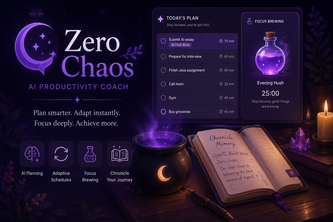
The company appears to be a solo-developer project named Zero Chaos, an AI-powered productivity coach that transforms brain dumps into daily plans using Gemini and Codex. The author states it aims to reduce cognitive load by offering adaptive planning, focus sessions, and habit management within a calming alchemy-inspired interface.
What changed: The project evolved from a basic task manager into an AI-driven coaching tool focused on real-time adaptation, user control, and emotional experience design.
Single most important open question: Is there evidence of any user adoption or feedback loops that would validate the core value proposition of adaptive AI planning in a real-world context?
This analysis is based entirely on self-reported information from the project description. No independent verification or historical data is available. All claims are stated by the author and not independently confirmed.
What The Product Actually Is
- The description states that Zero Chaos is an AI productivity coach.
- It converts "messy brain dumps" into realistic daily plans using AI.
- It includes features such as:
- AI Brain Dump
- Intelligent daily scheduling
- Adaptive replanning
- Daily habit management
- Focus Brewing sessions
- Night Reflection
- Chronicle Memories
- The system is described as acting like an AI coach, not a calendar or traditional task manager.
- It uses Google AI Studio (Gemini) and OpenAI Codex for AI functionality.
Not evidenced: What the actual product looks like, how it works in practice, or whether users interact with it beyond the author’s own use.
Positioning & Claim Evolution
- The author states that modern productivity apps are good at storing tasks but leave users with the problem of figuring out what to do next.
- Zero Chaos is positioned as an AI productivity coach, not a task manager.
- It aims to provide:
- Realistic plans
- Adaptive planning when days change
- Focus on meaningful actions instead of overwhelming lists
- The experience is described as cozy and alchemy-inspired, intended to make productivity feel less stressful.
Inferred: The positioning evolved from a simple task list tool to an AI-driven coaching system focused on emotional UX and adaptability. This evolution is claimed by the author but not substantiated with evidence of user feedback or usage patterns.
Target Customer & ICP
- The description does not explicitly name target customers.
- It implies users who:
- Have messy brain dumps
- Struggle with unrealistic plans
- Want to stay focused despite interruptions
- Prefer a calming, non-timer-based experience
- The product is described as being for people seeking reduced cognitive load and personalized productivity guidance.
Not evidenced: No explicit ICP defined. No customer segments, personas, or user types identified in the description.
Business Model & Pricing Evidence
- There is no mention of pricing, monetization strategy, or business model.
- The project is described as a hackathon submission, suggesting it may not yet be commercialized.
- The author mentions future plans including:
- Calendar integration
- Cross-device sync
- Team collaboration
- Wearable support
Not evidenced: No indication of how the product will generate revenue or whether any users are paying for it.
Technical & Delivery Signals
- Built with:
- Frontend: React, TypeScript, Vite
- Backend: Node.js, Express
- AI tools: Google AI Studio (Gemini), OpenAI Codex
- Development environment: GitHub
- The author used Codex for code review and development assistance.
- The system uses Gemini for understanding workload, planning, prioritization, scheduling, and adaptive coaching.
Inferred: The technical stack suggests a modern web application with AI integration. However, no evidence of deployment, scalability, or infrastructure details is provided.
Traction & Maturity Signals
- The project was submitted to the OpenAI 2026 hackathon, indicating it's in early development.
- It is described as a single-person effort (team size: 1).
- No evidence of:
- Users
- Revenue
- Customer feedback
- Product usage metrics
- Market traction
Not evidenced: No signs of product-market fit, user engagement, or business maturity beyond the author’s own development.
Competitive Context
- The description does not name competitors.
- It contrasts Zero Chaos with "traditional productivity apps" that store tasks but fail to help users figure out what to do next.
- The unique positioning is:
- AI-driven coaching
- Adaptive planning
- Calming UX design
- Focus on meaningful actions over task lists
Not evidenced: No competitive landscape, market analysis, or differentiation from existing tools.
Open Questions & Risks
- Solo developer project: The lack of team size raises questions about scalability and long-term maintenance.
- No traction or revenue: The product is not yet monetized or used by others.
- Unverified claims: All features and benefits are self-reported without external validation.
- Hackathon origin: Suggests early-stage development with limited real-world testing.
- AI integration complexity: The described AI functionality (adaptive planning, coaching) may be technically challenging to implement effectively at scale.
Inferred: Risk of overpromising on AI capabilities without proving their effectiveness or user adoption.
Questions the description leaves open
- What specific problems do users face that this tool solves?
- How does the AI determine what constitutes a "realistic" plan?
- Have you tested the adaptive planning feature with real users?
- What is your path to monetization and customer acquisition?
- Can you demonstrate how the system adapts when a user’s day changes unexpectedly?
- How do you plan to scale beyond a single developer?
Overall Assessment
- Not evidenced: No data on revenue, users, or traction.
- The project is described as a hackathon submission and a single-person effort, with no indication of commercial viability or market validation.
- It shows potential in concept but lacks evidence of execution, product-market fit, or business model.
Inferred: This is an early-stage idea with strong conceptual appeal. However, due to the lack of any user feedback, revenue, or traction data, it cannot be evaluated as a viable investment or partnership opportunity at this time.
User Stories BotA demo video on every pull request
Get a demo video on every new feature
GitHub App that watches your pull requests and records a narrated, captioned demo.
Save time on demo prep and make informed decisions faster with a video walkthrough of every new feature.
Source
Submitted to the OpenAI 2026 hackathon on Devpost. Project home on Devpost. Back to the full gallery on Devpost.
This competitive analysis was produced by top-founders.com (opens in a new tab)
Generated by a language model from this project's public Devpost page — its tagline, the author's own write-up and any built-with tags listed there — as captured in August 2026. Short quotations are the author's words. It is an opinion on the idea as a business, not on the people behind it, and it reflects the description as published then. If the project has moved on, request a correction below. The analysis is not independent research and contains no verified traction, revenue or customer data.
An independent guide by KFG International LLC — not affiliated with, endorsed by, or connected to Devpost or OpenAI.