

Archive position — measured, not model output
0 likes on Devpost
2,263 of the 7,850 archived projects have more likes, and 5,587 share exactly 0 — so this project's #3,874 place in the like-ranked listing is a tie-break inside that group, not a ranking.
Projects (log scale)
Likes on Devpost. ▲ marks this project's group.
Show the figures
| Likes | Projects | Share of archive |
|---|---|---|
| 0 | 5,587 | 71.2% |
| 1 | 1,758 | 22.4% |
| 2 | 284 | 3.6% |
| 3–4 | 132 | 1.7% |
| 5–9 | 75 | 1.0% |
| 10+ | 14 | 0.2% |
 User Stories BotA demo video on every pull request
Get a demo video on every new feature
GitHub App that watches your pull requests and records a narrated, captioned demo.
Save time on demo prep and make informed decisions faster with a video walkthrough of every new feature.
Executive Summary
What the company appears to be
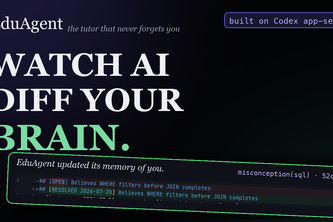
EduAgent is an AI-powered tutoring system built with Codex app-server that uses a git-based memory model for learners. The product is described as an AI agent for technical interview prep (SQL and Python DS&A in demo), designed to grow with users over time by remembering their learning history, misconceptions, and mastery levels.
What changed
The project was developed during a hackathon and is presented as a working prototype built end-to-end using Codex. It leverages git for versioning learner progress, sandboxed execution for code grading, and thread/forking capabilities to simulate personalized tutoring and mock exams.
Single most important open question
Is there evidence of traction or commercial viability beyond the hackathon demo? The description does not indicate any revenue, customers, or adoption data — only a self-reported prototype built in a short timeframe.
What The Product Actually Is
The description states that EduAgent is an AI tutor for technical interview prep (SQL and Python DS&A), extendable to other domains. It uses a git-based memory model where:
- Learner progress is stored as versioned files (e.g., roadmap.yaml).
- Sessions begin with recall of prior learning.
- Mastery scores are updated based on performance, committed with evidence.
- Misconceptions are tracked and resolved via diffs.
- Mock exams fork the learner’s memory to create personalized assessments.
- The entire system runs on Codex app-server as its runtime.
It also includes:
- A Next.js frontend
- SQLite for instant replay
- Per-learner git workspaces
- Sandboxed code execution
- MCP (stdio server) for UI tools
Inference The product is described as a full-stack application built using Codex, not just an API wrapper or chatbot.
Positioning & Claim Evolution
The author claims EduAgent addresses the problem of "amnesia" in AI tutors — where learners lose progress after each session. The solution is to use git for memory persistence and personalization.
Claims
- “A learner model is just files that change over time.”
- “Real tutors are valuable precisely because of what they remember.”
- “We already have a perfect, battle-tested tool for 'files changing over time' - git.”
Inference The positioning centers on the idea that memory should be legible and persistent — not opaque or ephemeral like embeddings.
Target Customer & ICP
The description states that EduAgent is designed for users preparing for technical interviews (SQL and Python DS&A), but is extendable to any teaching domain.
Claims
- “Technical interview prep (SQL and Python DS&A in the demo)”
- “Extendable to any teaching domain”
Inference The initial ICP appears to be job seekers or students preparing for technical interviews, with potential expansion into broader educational contexts.
Business Model & Pricing Evidence
Not evidenced. The description does not mention pricing models, monetization strategies, or business model details beyond the prototype nature of the product.
Technical & Delivery Signals
The system is built using:
- Codex app-server as its runtime
- Node.js/TypeScript backend
- Next.js frontend
- Docker + Caddy deployment
- Git-based learner memory
- Sandboxed code execution via bubblewrap
- MCP for UI tooling
- SQLite for session replay
- Hetzner VPS provisioned with Pulumi
Claims
- “The product runs on Codex in production.”
- “Every tutoring turn, grading run, and memory commit is a real Codex session.”
- “A learner model you can read. Anyone can open Alex's repo and understand exactly why the tutor believes what it believes.”
Inference The technical stack suggests a high degree of integration with Codex, indicating strong engineering focus on runtime primitives rather than traditional APIs.
Traction & Maturity Signals
Not evidenced. There is no mention of revenue, customers, usage metrics, or product adoption beyond the hackathon demo.
Competitive Context
Not evidenced. No competitor names, market positioning, or competitive landscape are provided in the description.
Open Questions & Risks
- Prototype-only: The entire product is described as a hackathon prototype with no evidence of traction or commercial viability.
- Limited scope: Initial focus on technical interview prep may limit scalability unless proven otherwise.
- High technical complexity: Requires deep integration with Linux sandboxing, seccomp profiles, and AppArmor — risks operational overhead.
- No monetization strategy: No indication of how the product would be monetized or whether it has a path to revenue.
Questions the description leaves open
- What is the current state of the product beyond the hackathon demo?
- Are there any early adopters or pilot users?
- How do you plan to scale the learner memory system beyond individual users?
- What are your plans for monetization and pricing?
- How does the product handle data privacy and user ownership of their learning history?
- What is the roadmap for expanding into other domains beyond technical interviews?
Overall Assessment
Not evidenced. The description provides no information about funding, valuation, or investment interest. It also lacks any indication of traction, revenue, or customer base.
Confidence Level Low This analysis is based entirely on self-reported content from a hackathon submission. No independent verification or commercial data exists to support further conclusions.
User Stories BotA demo video on every pull request
Get a demo video on every new feature
GitHub App that watches your pull requests and records a narrated, captioned demo.
Save time on demo prep and make informed decisions faster with a video walkthrough of every new feature.
Source
Submitted to the OpenAI 2026 hackathon on Devpost. Project home on Devpost. Back to the full gallery on Devpost.
This competitive analysis was produced by top-founders.com (opens in a new tab)
Generated by a language model from this project's public Devpost page — its tagline, the author's own write-up and any built-with tags listed there — as captured in August 2026. Short quotations are the author's words. It is an opinion on the idea as a business, not on the people behind it, and it reflects the description as published then. If the project has moved on, request a correction below. The analysis is not independent research and contains no verified traction, revenue or customer data.
An independent guide by KFG International LLC — not affiliated with, endorsed by, or connected to Devpost or OpenAI.