

Archive position — measured, not model output
0 likes on Devpost
2,263 of the 7,850 archived projects have more likes, and 5,587 share exactly 0 — so this project's #3,876 place in the like-ranked listing is a tie-break inside that group, not a ranking.
Projects (log scale)
Likes on Devpost. ▲ marks this project's group.
Show the figures
| Likes | Projects | Share of archive |
|---|---|---|
| 0 | 5,587 | 71.2% |
| 1 | 1,758 | 22.4% |
| 2 | 284 | 3.6% |
| 3–4 | 132 | 1.7% |
| 5–9 | 75 | 1.0% |
| 10+ | 14 | 0.2% |
 User Stories BotA demo video on every pull request
Get a demo video on every new feature
GitHub App that watches your pull requests and records a narrated, captioned demo.
Save time on demo prep and make informed decisions faster with a video walkthrough of every new feature.
Executive Summary
What the company appears to be
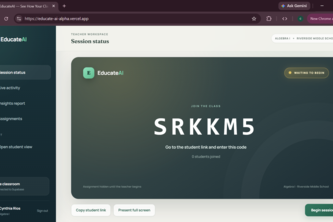
EducateAI is a self-reported educational platform designed to support student learning in real-time during classroom sessions, using AI to guide students without revealing answers, while helping teachers identify class-wide learning gaps and generate reteach plans.
What changed
The project was submitted as part of the OpenAI 2026 hackathon. It is a self-developed prototype built by two individuals over a short timeframe, likely representing an early-stage concept or proof-of-concept rather than a product in active use.
Single most important open question
Is there evidence that EducateAI has been tested with real educators and students, or whether it has achieved any traction beyond the hackathon submission?
What The Product Actually Is
The description states that EducateAI is an educational platform that allows students to ask questions in real-time during class. It uses a rule-based tutoring system (not relying on paid language-model APIs) to guide students through problems without giving away answers.
It also enables teachers to monitor student progress, identify learning patterns, and generate focused reteach plans based on classroom activity.
The platform supports full classroom workflows including assignment creation, waiting room setup, live session management, and insights generation.
Evidence The author's own write-up.
Inference The product appears to be a web-based application built using Next.js, TypeScript, Supabase, Vercel, and PostgreSQL.
Positioning & Claim Evolution
The author positions EducateAI as an AI-powered tool that supports student learning without replacing teachers. It is described as a resource that helps students think through problems while giving teachers visibility into class-wide struggles.
It claims to provide real-time insights and actionable reteach plans, aiming to enhance teacher control over classroom instruction.
Evidence The author’s own write-up.
Inference The positioning suggests a focus on supporting pedagogical goals rather than automating teaching, which aligns with current trends in AI-assisted education tools that emphasize human-in-the-loop systems.
Target Customer & ICP
The primary users identified are:
- Students who need help during class but may not get individual attention due to time constraints.
- Teachers who want to understand where their students are struggling and how to adjust instruction accordingly.
The platform is designed for use in classroom settings, particularly math classes, based on the author’s personal experience.
Evidence The inspiration section and what it does.
Inference The ICP likely includes K–12 educators and students in STEM subjects, though this is not explicitly stated.
Business Model & Pricing Evidence
There is no evidence provided about a business model or pricing structure. The description does not mention monetization strategies, subscription tiers, or any revenue streams.
Evidence Not evidenced.
Inference Since it was built as a hackathon project and lacks traction data, the business model remains unknown.
Technical & Delivery Signals
The platform is built using:
- Next.js and TypeScript
- Supabase for authentication, database, security policies, and live updates
- Vercel for deployment
- A rule-based system instead of relying on paid LLM APIs
It supports real-time classroom interactions and has been deployed in a demo-ready state.
Evidence The "How we built it" section.
Inference The use of Supabase suggests a backend-as-a-service approach, while the rule-based system indicates minimal reliance on external AI services. This may imply cost efficiency but also limits scalability or adaptability if the system needs to evolve beyond its current scope.
Traction & Maturity Signals
There is no evidence of any traction, customers, or adoption beyond the hackathon submission. The project was developed by two people and submitted as a competition entry.
Evidence Not evidenced.
Inference The lack of any mention of users, usage metrics, or feedback from real classrooms indicates that this is an early-stage prototype with no demonstrated market validation.
Competitive Context
No competitive landscape or comparison to existing tools was provided in the description. There is no indication of whether similar platforms exist or how EducateAI differentiates itself.
Evidence Not evidenced.
Inference Given the focus on real-time classroom support and AI-guided learning, it may overlap with tools like Khan Academy, Desmos, or other educational tech platforms, but this cannot be confirmed without further information.
Open Questions & Risks
- No traction or customer validation: The platform is only described as a hackathon submission.
- Limited technical depth: Reliance on rule-based systems may limit scalability and adaptability.
- Unproven market fit: No evidence of real-world testing with educators or students.
- Founder team size: Only two members, which may pose challenges in execution and growth.
Evidence Self-reported description only.
Questions the description leaves open
- Has EducateAI been tested with actual teachers and students? If so, what feedback did you receive?
- What specific classroom workflows or pedagogical goals does the platform aim to support?
- How do you plan to scale beyond a single rule-based system if needed?
- Are there any partnerships or pilot programs with schools or districts already underway?
- What is your long-term vision for monetization and product development?
Overall Assessment
At this stage, EducateAI appears to be an early-stage prototype developed as a hackathon project. There is no evidence of traction, revenue, customers, or validated market demand.
The idea has potential in the educational tech space, but without real-world testing, user feedback, or business model clarity, it cannot be considered a viable investment or partnership opportunity at this time.
Confidence level Low — based entirely on self-reported information with no external validation.
User Stories BotA demo video on every pull request
Get a demo video on every new feature
GitHub App that watches your pull requests and records a narrated, captioned demo.
Save time on demo prep and make informed decisions faster with a video walkthrough of every new feature.
Source
Submitted to the OpenAI 2026 hackathon on Devpost. Project home on Devpost. Back to the full gallery on Devpost.
This competitive analysis was produced by top-founders.com (opens in a new tab)
Generated by a language model from this project's public Devpost page — its tagline, the author's own write-up and any built-with tags listed there — as captured in August 2026. Short quotations are the author's words. It is an opinion on the idea as a business, not on the people behind it, and it reflects the description as published then. If the project has moved on, request a correction below. The analysis is not independent research and contains no verified traction, revenue or customer data.
An independent guide by KFG International LLC — not affiliated with, endorsed by, or connected to Devpost or OpenAI.