

Archive position — measured, not model output
0 likes on Devpost
2,263 of the 7,850 archived projects have more likes, and 5,587 share exactly 0 — so this project's #7,799 place in the like-ranked listing is a tie-break inside that group, not a ranking.
Projects (log scale)
Likes on Devpost. ▲ marks this project's group.
Show the figures
| Likes | Projects | Share of archive |
|---|---|---|
| 0 | 5,587 | 71.2% |
| 1 | 1,758 | 22.4% |
| 2 | 284 | 3.6% |
| 3–4 | 132 | 1.7% |
| 5–9 | 75 | 1.0% |
| 10+ | 14 | 0.2% |
 User Stories BotA demo video on every pull request
Get a demo video on every new feature
GitHub App that watches your pull requests and records a narrated, captioned demo.
Save time on demo prep and make informed decisions faster with a video walkthrough of every new feature.
Executive Summary
The company appears to be a two-person team building an autonomous software delivery system using multi-agent AI workflows. The system claims to enable end-to-end product development from idea to demo with no human handoffs, through teams of specialized AI agents that build trust and learn continuously.
What changed
The project description shows a self-reported attempt to build an AI-powered autonomous development pipeline using pre-trained agents in a multi-agent architecture, with emphasis on trust-building, continual learning, and artifact lineage.
Key open question
Is there evidence of any real product usage, customer feedback or revenue generation beyond the hackathon submission? The description states no traction data exists.
What The Product Actually Is
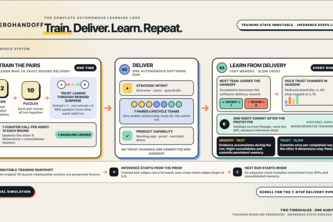
The description states that Zero Handoff is a system that takes a user idea for a product as input and returns a working application with a video demo as output. It coordinates 14 GPT-5.6 Sol pre-trained agents organized into 7 two-agent teams, each team performing one stage of the development process (SENSE → MODEL → COMPOSE → DECIDE → SIMULATE → EXECUTE → OBSERVE).
The system uses:
- Pre-training with split-clue puzzles to build trust relationships between agents
- Asymmetric trust values (floats) that update based on success or failure of handoffs
- Curators maintaining additional relationship dimensions and memory
- Typed artifact contracts, schema-constrained calls, deterministic quality gates, repair loops, artifact-lineage tracking, immutable training state, continual learning, JSON logs, browser verification, and checksummed delivery packages
The final experiment built an application called EchoLedger that converts customer-support calls into evidence-linked problems and assigned follow-up actions.
Evidence Self-reported by authors. No independent verification or demonstration of actual product functionality beyond the hackathon submission.
Positioning & Claim Evolution
The description states that Zero Handoff aims to turn one short product request into tested software with no human handoffs, using pairs of specialized AI agents that develop trust with each other in training and continual learning.
It positions itself as:
- An autonomous software delivery system
- A solution for enterprise product development
- A multi-agent system that learns from experience like humans do
The claim evolution appears to be:
- Start with idea brief → end with tested application + demo
- Use AI agents that learn trust relationships through experience
- Achieve no human handoffs in the process
- Enable scalable autonomous product development
Evidence Self-reported claims about positioning and intent. No evidence of market traction, customer feedback or competitive positioning beyond the project description.
Target Customer & ICP
The description states that Zero Handoff is designed for enterprise product development, with a vision of "one strategic intent enters, a trusted autonomous organization builds the product, and every decision remains inspectable."
It mentions building EchoLedger, which turns customer-support calls into evidence-linked problems and assigned follow-up actions — suggesting a potential use case in customer support automation or business process improvement.
However, no specific target customer segments, personas, or buyer profiles are detailed. The description focuses on the technical architecture rather than market targeting.
Evidence Self-reported positioning toward enterprise use cases. No evidence of specific customers, buyer personas, or market segmentation.
Business Model & Pricing Evidence
The description does not contain any information about pricing models, revenue streams, or business model assumptions.
It mentions a vision of autonomous organization building products but provides no details on how this would generate value for paying customers or how the team intends to monetize their work.
Evidence Not evidenced. No pricing, revenue, or monetization strategy described.
Technical & Delivery Signals
The description indicates that Zero Handoff uses:
- 14 pre-trained GPT-5.6 Sol agents
- 7 two-agent teams working in sequence (SENSE → MODEL → COMPOSE → DECIDE → SIMULATE → EXECUTE → OBSERVE)
- Pre-training with 10 split-clue puzzles per team, 70 episodes with 63 puzzles solved
- Asymmetric trust values updated based on handoff success/failure
- Curators maintaining nine additional relationship dimensions and memory
- Typed artifact contracts and schema-constrained GPT calls
- Deterministic quality gates, repair loops, artifact-lineage tracking
- Immutable training state, continual learning, JSON logs, browser verification
- Checksummed delivery packages
The final experiment built EchoLedger with:
- 81 agent calls
- 32 gates
- 18 repairs
- 147-file delivery bundle
- Interactive demo
Evidence Self-reported technical architecture and implementation details. No evidence of production deployment or operational performance.
Traction & Maturity Signals
The description states that this was submitted to the OpenAI 2026 hackathon on Devpost, and that it completed all seven stages with the EchoLedger experiment.
It mentions:
- Training completed 70 team episodes with 63 puzzles solved
- Final rewards of [1, 1, 1, 1, 0, 1] retained real rejection and repair
- The system preserved invalid history, restored verified state, implemented atomic persistence
However, there is no evidence of:
- Revenue generation
- Customer adoption or feedback
- Product usage beyond the hackathon
- Any measurable business impact or market traction
Evidence Limited to hackathon submission and internal testing. No external validation or commercial traction.
Competitive Context
The description does not provide any information about competitors, market landscape, or competitive positioning.
It does not mention existing solutions in autonomous software development, AI agent platforms, or low-code/no-code tools that might compete with or complement this approach.
Evidence Not evidenced. No competitive analysis or market context provided.
Open Questions & Risks
Key risks and open questions based on the description:
- Unproven commercial viability: The system is described only as a hackathon project with no evidence of revenue, customers or product-market fit
- Technical complexity without validation: The multi-agent architecture with trust-building, continual learning, and repair loops is highly complex but lacks demonstration of real-world performance or reliability
- No clear monetization path: No pricing model or business model described beyond the vision statement
- Limited team size: Only two founders working on a technically sophisticated system suggests potential resource constraints
- Self-reported claims only: All information is unverified and self-reported, with no independent corroboration
Evidence Inferences based on lack of evidence for key commercial metrics or operational performance.
Questions the description leaves open
- What specific enterprise use cases have you identified for this system?
- Have you conducted any pilot testing with actual customers or partners?
- How do you plan to validate the trust-building mechanisms in real-world scenarios?
- What are your assumptions about how this system would scale across different types of product development?
- Can you describe any measurable improvements or outcomes from using this system compared to traditional development methods?
- What is your roadmap for transitioning from a hackathon prototype to a viable commercial product?
- How do you intend to monetize this technology, and what pricing models are you considering?
Evidence These questions are prompted by the lack of evidence in the description regarding real-world application, customer feedback, or business model.
Overall Assessment
The description states that Zero Handoff is a two-person team working on an autonomous software delivery system using multi-agent AI workflows. It was submitted to the OpenAI 2026 hackathon and includes detailed technical architecture but lacks evidence of any commercial traction, revenue, or customer adoption.
Confidence level Low — based entirely on self-reported information with no external validation or demonstration of product-market fit.
Assessment Not evidenced as a viable investment or partnership opportunity at this stage. The project appears to be an experimental prototype with strong technical ambition but no demonstrated commercial viability or market traction. Any potential value would depend on future development and evidence of real-world application, which is not present in the current description.
Inference If the team can demonstrate early traction, pilot results, or a clear path to monetization, this could represent an interesting opportunity. However, as presented, it is a speculative technical experiment with no commercial validation.
User Stories BotA demo video on every pull request
Get a demo video on every new feature
GitHub App that watches your pull requests and records a narrated, captioned demo.
Save time on demo prep and make informed decisions faster with a video walkthrough of every new feature.
Source
Submitted to the OpenAI 2026 hackathon on Devpost. Project home on Devpost. Back to the full gallery on Devpost.
This competitive analysis was produced by top-founders.com (opens in a new tab)
Generated by a language model from this project's public Devpost page — its tagline, the author's own write-up and any built-with tags listed there — as captured in August 2026. Short quotations are the author's words. It is an opinion on the idea as a business, not on the people behind it, and it reflects the description as published then. If the project has moved on, request a correction below. The analysis is not independent research and contains no verified traction, revenue or customer data.
An independent guide by KFG International LLC — not affiliated with, endorsed by, or connected to Devpost or OpenAI.