

Archive position — measured, not model output
1 like on Devpost
505 of the 7,850 archived projects have more likes, and 1,758 share exactly 1 — so this project's #1,911 place in the like-ranked listing is a tie-break inside that group, not a ranking.
Projects (log scale)
Likes on Devpost. ▲ marks this project's group.
Show the figures
| Likes | Projects | Share of archive |
|---|---|---|
| 0 | 5,587 | 71.2% |
| 1 | 1,758 | 22.4% |
| 2 | 284 | 3.6% |
| 3–4 | 132 | 1.7% |
| 5–9 | 75 | 1.0% |
| 10+ | 14 | 0.2% |
 User Stories BotA demo video on every pull request
Get a demo video on every new feature
GitHub App that watches your pull requests and records a narrated, captioned demo.
Save time on demo prep and make informed decisions faster with a video walkthrough of every new feature.
Executive Summary
What the company appears to be
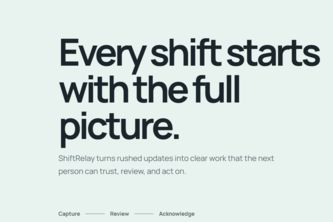
ShiftRelay is a self-reported SaaS product designed for frontline teams to manage shift handovers more effectively. It uses AI (specifically GPT-5.6 Sol) to process unstructured updates into structured handover documents, including actions, owners, deadlines, and missing-context prompts. The system supports voice input, structured output via JSON, and includes workflow steps for workers, supervisors, and incoming staff.
What changed
The project was submitted as part of the OpenAI 2026 hackathon. It is described as an MVP with a working end-to-end handover flow, including UI, AI processing, notifications, and role-based access. The author states that it was built using Codex to accelerate development across multiple components.
Single most important open question
Is there any evidence of real-world usage or traction beyond the hackathon demo? The description does not indicate whether ShiftRelay has been adopted by frontline teams or if it has moved past prototype stage.
What The Product Actually Is
The description states that ShiftRelay is a tool for managing shift handovers in frontline environments. It allows users to submit updates (via text or voice), which are then processed by GPT-5.6 Sol into structured formats including summaries, actions, priorities, owners, deadlines, evidence, and missing-context questions.
It includes:
- A UI for workers to record updates
- Supervisory review steps
- Acknowledgment workflows for incoming staff
- In-app notifications and audit trails
- Voice transcription via server-side API
- JSON-based output contract for AI processing
The system is described as supporting mobile use with minimal page reloads and background refreshes.
Not evidenced:
- Whether the product is live or in production
- If it has any customer base or real-world deployment
- Any revenue model or monetization strategy
Positioning & Claim Evolution
The author claims that ShiftRelay addresses a common problem in frontline work — the lack of structured, documented handovers. It positions itself as a way to reduce safety risks, missed commitments, and duplicated effort by ensuring continuity through AI-assisted documentation.
Key claims:
- Shift handovers are often rushed, verbal, and undocumented.
- The tool prevents critical context from disappearing between shifts.
- It supports industry-neutral workflows but starts with clinical use cases.
- AI is used to preserve evidence, surface uncertainty, and avoid inventing facts.
Inferences:
- The product is built around accountability and documentation.
- It emphasizes human-in-the-loop AI rather than automation.
Not evidenced:
- No stated target market beyond “frontline teams” or specific industries
- No mention of competitors or positioning against existing tools
- No indication of how the tool differentiates from generic chat or note-taking apps
Target Customer & ICP
The description states that ShiftRelay targets frontline teams in sectors such as clinical, retail, logistics, security, and field services. These are described as environments where shift handovers are critical but often poorly managed.
It also mentions:
- Workers who need to pass on context
- Supervisors who review updates
- Incoming staff who must acknowledge tasks
Not evidenced:
- No explicit customer personas or segmentation
- No indication of whether the tool targets small businesses, large enterprises, or government agencies
- No mention of decision-makers (e.g., HR, operations managers) or buying processes
Business Model & Pricing Evidence
The description does not provide any information about pricing models, monetization strategies, or business models. It only describes how the MVP was built and what features it includes.
Not evidenced:
- No pricing structure
- No indication of B2B vs. freemium vs. SaaS model
- No mention of enterprise licensing or usage-based billing
Technical & Delivery Signals
The author states that ShiftRelay is built with:
- Node.js, JavaScript, HTML5, CSS3, PostgreSQL
- GPT-5.6 Sol for AI processing
- Codex for rapid development
- Server-side transcription API
- JSON contract for structured output
- Render for deployment
- Terminal and web interfaces
Key technical decisions noted:
- AI output constrained to explicit JSON schema
- Voice input handled server-side
- Human review required before relay
- Credential-free demo mode available
- Mobile-first approach with background refreshes
Inferences:
- The tool is designed to be lightweight and fast, especially on mobile.
- It uses a hybrid human-AI workflow.
Not evidenced:
- No information about scalability or infrastructure
- No mention of data privacy or compliance features
- No indication of API integrations or extensibility
Traction & Maturity Signals
The description indicates that this is an MVP built for the OpenAI 2026 hackathon. It includes:
- Working end-to-end handover flow
- UI, AI processing, notifications, and role-based access
- Demo mode available for evaluators
- Plans to expand with push notifications, email verification, and mobile apps
Not evidenced:
- No real-world usage or adoption data
- No customer feedback or testimonials
- No revenue or user growth metrics
- No indication of product-market fit beyond the hackathon context
Competitive Context
The description does not mention any competitors or similar tools in the market. It only says that the workflow is intentionally industry-neutral and that it was inspired by clinical scenarios.
Inferences:
- The tool may compete with generic messaging platforms, shared notes, or internal communication tools.
- It could be positioned against tools used for shift management or workforce coordination.
Not evidenced:
- No list of direct or indirect competitors
- No competitive advantage claimed beyond AI-assisted structure
- No differentiation from existing tools like Slack, Notion, or Microsoft Teams
Open Questions & Risks
- Unproven traction: The product is described as an MVP built for a hackathon. There is no evidence of real-world usage or adoption.
- AI dependency without clarity on control: While AI is used to structure updates, the system still requires human review — but it's unclear how this is enforced or monitored.
- Limited scope and lack of commercialization plan: The tool appears to be in early development with no stated path to monetization or scaling.
- No data security or compliance features mentioned: Given its use in clinical and other regulated sectors, this could be a major concern if not addressed.
Not evidenced:
- No mention of regulatory compliance
- No indication of how user data is stored or protected
- No evidence of any commercial strategy beyond the hackathon
Questions the description leaves open
- Has ShiftRelay been tested with actual frontline teams? What feedback did you get?
- How do you plan to scale beyond the MVP and into production use?
- What is your go-to-market strategy for reaching frontline teams in different industries?
- Are there any partnerships or integrations planned with existing workforce management tools?
- How will you ensure data privacy and compliance, especially in regulated sectors like healthcare?
- What are the key assumptions behind the AI’s ability to structure unstructured input accurately?
Overall Assessment
The description indicates that ShiftRelay is an early-stage project built for a hackathon. It shows some technical capability and a clear problem-solution fit, but lacks any evidence of traction, revenue, or commercial viability.
Confidence level Low This is a self-reported, unverified account of a prototype. No independent verification exists regarding product-market fit, adoption, or scalability.
Assessment Not ready for investment or partnership consideration at this stage. The project needs to demonstrate real-world usage and a clear path to monetization before it can be evaluated as a viable business opportunity.
User Stories BotA demo video on every pull request
Get a demo video on every new feature
GitHub App that watches your pull requests and records a narrated, captioned demo.
Save time on demo prep and make informed decisions faster with a video walkthrough of every new feature.
Source
Submitted to the OpenAI 2026 hackathon on Devpost. Project home on Devpost. Back to the full gallery on Devpost.
This competitive analysis was produced by top-founders.com (opens in a new tab)
Generated by a language model from this project's public Devpost page — its tagline, the author's own write-up and any built-with tags listed there — as captured in August 2026. Short quotations are the author's words. It is an opinion on the idea as a business, not on the people behind it, and it reflects the description as published then. If the project has moved on, request a correction below. The analysis is not independent research and contains no verified traction, revenue or customer data.
An independent guide by KFG International LLC — not affiliated with, endorsed by, or connected to Devpost or OpenAI.