

Archive position — measured, not model output
1 like on Devpost
505 of the 7,850 archived projects have more likes, and 1,758 share exactly 1 — so this project's #1,913 place in the like-ranked listing is a tie-break inside that group, not a ranking.
Projects (log scale)
Likes on Devpost. ▲ marks this project's group.
Show the figures
| Likes | Projects | Share of archive |
|---|---|---|
| 0 | 5,587 | 71.2% |
| 1 | 1,758 | 22.4% |
| 2 | 284 | 3.6% |
| 3–4 | 132 | 1.7% |
| 5–9 | 75 | 1.0% |
| 10+ | 14 | 0.2% |
 User Stories BotA demo video on every pull request
Get a demo video on every new feature
GitHub App that watches your pull requests and records a narrated, captioned demo.
Save time on demo prep and make informed decisions faster with a video walkthrough of every new feature.
Executive Summary
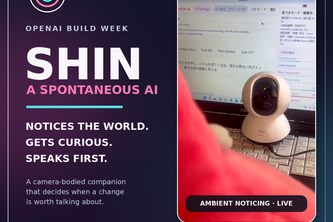
What the company appears to be: Shin: A Spontaneous AI is a self-reported project submitted to the OpenAI 2026 hackathon. The description states it is an AI that watches the world, decides what interests it, and starts the conversation. It was built by one person, Yu Matsuda.
What changed: No evidence of prior version or evolution is provided. This appears to be a single project submission with no history or prior development.
Single most important open question: Is this a proof-of-concept or prototype, or does it represent a functional product that has moved beyond the hackathon stage?
The analysis is based entirely on self-reported information from the author’s Devpost submission. There is no evidence of revenue, customers, traction, or commercial viability. The description contains no claims about business model, pricing, or technical delivery beyond the tools used (e.g., OpenAI API, Python, etc.). This is a very early-stage project with limited evidence.
What The Product Actually Is
The description states: “Shin: A Spontaneous AI” watches the world, decides what interests it, and starts the conversation. It was built using tools including codex, elevenlabs, go2rtc, gpt-5.6, openai-api, opencv, python, tapo-c220.
Inference: The product appears to be a system that uses AI to observe visual or audio inputs (possibly via camera or microphone), processes them using OpenAI APIs and computer vision tools like OpenCV, and then autonomously initiates interaction or communication based on what it detects. It may involve voice synthesis (via ElevenLabs) and real-time video capture (via go2rtc and Tapo C220).
Not evidenced: No functional demonstration, codebase, or output examples are provided. The author does not describe how the system works beyond its high-level behavior.
Positioning & Claim Evolution
The tagline states: “Not just autonomous—spontaneous: An AI that watches the world, decides what interests it, and starts the conversation.”
Claim: The product is positioned as an AI that goes beyond autonomy to spontaneity — implying a level of initiative or curiosity in its actions.
Inference: This suggests a shift from reactive systems (e.g., responding to commands) to proactive ones (e.g., initiating interaction based on observation). It may be attempting to position itself in the space of conversational AI or autonomous agents, but no further detail is given.
Not evidenced: No evidence of prior positioning, evolution of claims, or market differentiation. The description does not indicate whether this is a new idea or an extension of existing work.
Target Customer & ICP
The description does not state who the intended customer or ideal customer profile (ICP) is.
Not evidenced: No information about target users, use cases, or personas is provided. The author does not describe any specific market segment or application area.
Business Model & Pricing Evidence
The description does not include any information on how the product would be monetized or priced.
Not evidenced: No evidence of pricing strategy, revenue model, or commercialization plan. The project is presented as a hackathon submission with no indication of business intent.
Technical & Delivery Signals
The author states that the system was built using:
- codex
- elevenlabs
- go2rtc
- gpt-5.6
- openai-api
- opencv
- python
- tapo-c220
Inference: The project likely involves a combination of AI APIs (OpenAI), computer vision (OpenCV), real-time video capture (go2rtc, Tapo C220), and voice generation (ElevenLabs). It may be a prototype or proof-of-concept.
Not evidenced: No evidence of technical architecture, scalability, deployment strategy, or delivery mechanism. The author does not describe how the system is intended to be used in practice.
Traction & Maturity Signals
The project was submitted to the OpenAI 2026 hackathon on Devpost.
Claim: This is a hackathon submission, suggesting it is early-stage and experimental.
Not evidenced: No evidence of user adoption, customer feedback, or product maturity beyond the hackathon. There is no indication that the system has been tested in real-world conditions or scaled beyond prototype status.
Competitive Context
The description does not provide any information about competitors or market context.
Not evidenced: No mention of existing solutions, competitive landscape, or positioning relative to other AI systems or autonomous agents.
Open Questions & Risks
- Unverified claims: The description is self-reported and unverified. There is no evidence of actual functionality or results.
- No traction: The project is a hackathon submission with no evidence of adoption or user engagement.
- Single founder: The team size is listed as one, which may indicate limited development capacity or lack of commercial support.
- Unclear scope: The system’s behavior and purpose are described in high-level terms without technical detail or demonstration.
Questions the description leaves open
- What specific problem does this system solve, and how is it different from existing AI systems?
- How does the system decide what to “watch” and when to “start the conversation”?
- Has this been tested in real-world conditions or is it purely a prototype?
- Is there any plan for commercialization or further development beyond the hackathon?
- What are the technical limitations of the current implementation?
Overall Assessment
Not evidenced: No evidence of commercial viability, traction, or strategic fit to support an investment or partnership decision.
Inference: This is a very early-stage project submitted as part of a hackathon. It lacks any demonstrated product-market fit, revenue model, or customer engagement. The author does not describe how the system would be monetized or scaled.
Confidence level: Very low — based on self-reported information only, with no third-party validation or evidence of progress beyond prototype stage.
User Stories BotA demo video on every pull request
Get a demo video on every new feature
GitHub App that watches your pull requests and records a narrated, captioned demo.
Save time on demo prep and make informed decisions faster with a video walkthrough of every new feature.
Source
Submitted to the OpenAI 2026 hackathon on Devpost. Project home on Devpost. Back to the full gallery on Devpost.
This competitive analysis was produced by top-founders.com (opens in a new tab)
Generated by a language model from this project's public Devpost page — its tagline and any built-with tags listed there, since the author published no write-up — as captured in August 2026. Short quotations are the author's words. It is an opinion on the idea as a business, not on the people behind it, and it reflects the description as published then. If the project has moved on, request a correction below. The analysis is not independent research and contains no verified traction, revenue or customer data.
An independent guide by KFG International LLC — not affiliated with, endorsed by, or connected to Devpost or OpenAI.