

Archive position — measured, not model output
1 like on Devpost
505 of the 7,850 archived projects have more likes, and 1,758 share exactly 1 — so this project's #1,914 place in the like-ranked listing is a tie-break inside that group, not a ranking.
Projects (log scale)
Likes on Devpost. ▲ marks this project's group.
Show the figures
| Likes | Projects | Share of archive |
|---|---|---|
| 0 | 5,587 | 71.2% |
| 1 | 1,758 | 22.4% |
| 2 | 284 | 3.6% |
| 3–4 | 132 | 1.7% |
| 5–9 | 75 | 1.0% |
| 10+ | 14 | 0.2% |
 User Stories BotA demo video on every pull request
Get a demo video on every new feature
GitHub App that watches your pull requests and records a narrated, captioned demo.
Save time on demo prep and make informed decisions faster with a video walkthrough of every new feature.
Executive Summary
What the company appears to be
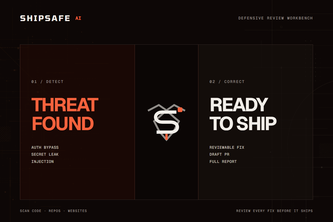
ShipSafe is a self-reported developer tool that uses AI (specifically GPT-5.6) to scan code, GitHub repositories, npm dependencies, and websites for security vulnerabilities. It generates prioritized reports with actionable fixes and integrates with GitHub via pull requests.
What changed
This is a self-reported project submitted to the OpenAI 2026 hackathon. The description indicates it was built over a short timeframe using Codex as a development partner. No evidence of prior traction, revenue, or customer adoption exists.
Single most important open question
Is there any evidence that ShipSafe’s AI output is reliable or accurate in real-world usage beyond its own controlled test fixtures?
What The Product Actually Is
The description states that ShipSafe:
- Scans four types of evidence: pasted source code, public GitHub repositories or pull requests, locked npm dependencies, and verified websites.
- Collects relevant security evidence and creates a prioritized report including:
- Severity-weighted security score
- Danger summary
- Risk findings (Critical, High, Medium, Low, Informational)
- Problem locations
- Risk explanations
- Recommended corrections
- Production-readiness notes
- Export formats: Markdown, PDF, SARIF
- Uses GPT-5.6 as the reasoning layer via OpenAI’s Responses API.
- Provides a “Fix Studio” where users can select findings and request AI-generated corrections.
- Does not execute or modify user files; all changes must be reviewed by the user.
- Can create new branches and draft pull requests in two demonstration repositories only, with human approval required.
Inference The product is described as an AI-powered security co-pilot for developers, intended to streamline vulnerability detection and correction before software deployment.
Positioning & Claim Evolution
The description states that ShipSafe aims to:
- Make security review easier for junior developers, vibe coders, and small teams.
- Help teams move from detection to correction in one workflow.
- Provide a short, actionable plan instead of long, unactionable reports.
- Offer a seamless experience by integrating AI reasoning with human oversight.
Inference ShipSafe positions itself as a DevSecOps tool that bridges the gap between automated scanning and manual review, targeting small teams lacking dedicated security specialists.
Target Customer & ICP
The description states:
- ShipSafe targets junior developers, vibe coders, and small teams.
- These users often ship software without a security specialist on board.
- It is designed for developers who want practical AI assistance before shipping code.
Inference The ideal customer profile (ICP) appears to be small development teams or individual developers working in environments where security is not formally integrated into their workflow.
Business Model & Pricing Evidence
Not evidenced. The description does not mention any pricing model, monetization strategy, or business model.
Technical & Delivery Signals
The description states:
- Built with React, TypeScript, Vite, Tailwind CSS (frontend), Node.js, Express (backend).
- Uses OpenAI Responses API with structured output schema.
- Implements safety measures like:
- Server-side API key handling
- Deterministic fallback scanner
- Repository allowlists
- File-by-file previews
- Human approval before GitHub writes
- Supports export formats: Markdown, PDF, SARIF.
- Uses OSV for npm dependency scanning.
- Deployed on Railway.
Inference The technical stack and delivery approach suggest a lightweight, developer-focused tool built with modern web technologies and integrated with AI services. The use of structured output and safety controls implies an attempt to manage risk in AI-generated content.
Traction & Maturity Signals
Not evidenced. There is no mention of:
- Revenue
- Customers
- User base
- Adoption metrics
- Product usage data
- Any form of traction beyond the demo and controlled test fixtures.
Competitive Context
Not evidenced. The description does not reference:
- Competitors
- Market positioning relative to existing tools
- Differentiation from other DevSecOps or AI security platforms
Open Questions & Risks
- Unverified AI accuracy: The only validation mentioned is a deterministic baseline test with fake problems — no real-world performance data.
- Limited scope of fixes: The tool does not execute code; it only provides suggestions, which may reduce utility for teams seeking automation.
- No commercial or user feedback: No evidence of customer interviews, beta users, or product-market fit beyond the hackathon submission.
- Single-founder team: The team size is listed as one member, raising questions about scalability and resource availability.
- Dependency on OpenAI API: Reliance on GPT-5.6 and OpenAI services introduces potential risks related to availability, cost, and control.
Questions the description leaves open
- What are the actual accuracy rates of the AI-generated fixes in real-world code?
- How does ShipSafe handle false positives or misleading outputs from GPT-5.6?
- Are there any plans for integrating with existing CI/CD pipelines or security platforms?
- What is the long-term strategy for scaling beyond the current MVP and demo repositories?
- Has the tool been tested on real open-source projects or enterprise codebases?
- How does ShipSafe plan to monetize this product, if at all?
Overall Assessment
Not evidenced. The description provides no information about:
- Valuation
- Funding status
- Strategic partnerships
- Commercial traction
- Go-to-market strategy
Confidence level Low. This is a self-reported hackathon project with no independent verification or evidence of commercial viability, revenue, or user adoption. It may be an early-stage idea or prototype, but there is no indication it has progressed beyond the experimental phase.
User Stories BotA demo video on every pull request
Get a demo video on every new feature
GitHub App that watches your pull requests and records a narrated, captioned demo.
Save time on demo prep and make informed decisions faster with a video walkthrough of every new feature.
Source
Submitted to the OpenAI 2026 hackathon on Devpost. Project home on Devpost. Back to the full gallery on Devpost.
This competitive analysis was produced by top-founders.com (opens in a new tab)
Generated by a language model from this project's public Devpost page — its tagline, the author's own write-up and any built-with tags listed there — as captured in August 2026. Short quotations are the author's words. It is an opinion on the idea as a business, not on the people behind it, and it reflects the description as published then. If the project has moved on, request a correction below. The analysis is not independent research and contains no verified traction, revenue or customer data.
An independent guide by KFG International LLC — not affiliated with, endorsed by, or connected to Devpost or OpenAI.