

Archive position — measured, not model output
0 likes on Devpost
2,263 of the 7,850 archived projects have more likes, and 5,587 share exactly 0 — so this project's #7,797 place in the like-ranked listing is a tie-break inside that group, not a ranking.
Projects (log scale)
Likes on Devpost. ▲ marks this project's group.
Show the figures
| Likes | Projects | Share of archive |
|---|---|---|
| 0 | 5,587 | 71.2% |
| 1 | 1,758 | 22.4% |
| 2 | 284 | 3.6% |
| 3–4 | 132 | 1.7% |
| 5–9 | 75 | 1.0% |
| 10+ | 14 | 0.2% |
 User Stories BotA demo video on every pull request
Get a demo video on every new feature
GitHub App that watches your pull requests and records a narrated, captioned demo.
Save time on demo prep and make informed decisions faster with a video walkthrough of every new feature.
Executive Summary
What the company appears to be
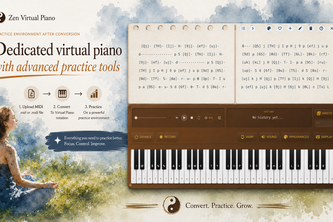
Zen Virtual Piano is a self-reported cross-platform virtual piano application built by a single developer (Nguyen Canh Toan). The product combines a virtual piano interface, digital music tools like MIDI conversion and analysis, and a library of playable piano sheets. It was submitted as a project for the OpenAI 2026 hackathon.
What changed
The author reports that the project evolved from a simple virtual piano tool into a broader musical ecosystem with additional features such as MIDI conversion and analysis, and a sheet music library. The developer left a full-time job to focus on the project after it gained early traction (4,000+ users, 200–300 daily active users).
The single most important open question
Is there evidence of sustainable product-market fit or scalable user engagement beyond the initial developer’s personal use case?
What The Product Actually Is
- The description states that Zen Virtual Piano is a cross-platform virtual piano, built with Electron, React, and TailwindCSS.
- It includes digital music tools such as MIDI conversion and analysis.
- It features a library of thousands of playable piano sheets.
- The author reports using technologies like Cloudflare, Supabase, Vercel, and AI tools including ChatGPT, Codex, Kimi, and OpenCode.
Inference: Based on the self-reported features, it appears to be a hybrid tool combining performance-based virtual piano with music creation and management capabilities. However, no evidence is provided about how these components are integrated or whether they form a cohesive product experience.
Positioning & Claim Evolution
- The author states that the project began as an attempt to relearn piano using a virtual instrument.
- It evolved from a personal solution into a broader musical ecosystem.
- The positioning is described as offering:
- A modern and intuitive design
- Fast, optimized performance
- A rich set of features
- An accessible experience for both beginners and experienced users
Inference: The product’s positioning appears to have shifted from a niche personal tool to a more general-purpose digital music platform. However, the claim of “broader musical ecosystem” is not substantiated with data or user feedback.
Target Customer & ICP
- The author identifies two types of users:
- Those who are interested in playing music but not ready for traditional training
- Users who want a lightweight, fast, and accessible way to play and explore piano
Inference: The target customer is likely a subset of amateur musicians or hobbyists. No specific segmentation or persona details are provided.
Business Model & Pricing Evidence
- The author states that the current business model is planned to be based on:
- Advertising
- Subscriptions
- They estimate that the app needs to grow 3–5 times its current user base before generating significant revenue.
- No pricing information, monetization strategy, or revenue data are provided.
Inference: The business model is speculative and not yet implemented. There is no evidence of any actual revenue streams or pricing tiers.
Technical & Delivery Signals
- Built with:
- Electron (for desktop app)
- React, TailwindCSS, Vercel, Supabase
- AI tools: ChatGPT, Codex, Kimi, OpenCode
- The author reports that the application is:
- Lightweight and responsive
- Fast, optimized performance
- No technical architecture or scalability details are provided.
Inference: The tech stack suggests a modern web-based or desktop app with some AI integration. However, no evidence of robustness, scalability, or infrastructure maturity is presented.
Traction & Maturity Signals
- The author reports:
- 4,000+ users
- 200–300 daily active users
- Average session time of ~8 minutes
- The app was launched eight months prior to the submission.
- The developer left a full-time job to focus on the project.
- No evidence of revenue, retention metrics, or user feedback is provided.
Inference: Early traction exists but no clear signs of sustainable growth or monetization. Engagement levels are modest and not quantified beyond average session time.
Competitive Context
- The author identifies two existing approaches in the market:
- A dated platform (VirtualPiano.net) with a large user base but poor UX and performance
- A lightweight Chrome extension with limited features and offline capability
- The goal was to combine strengths of both:
- Modern design
- Fast performance
- Rich feature set
Inference: The competitive landscape is described in general terms, without specific competitor names or market share data. No evidence of competitive positioning or differentiation strategy.
Open Questions & Risks
- Single-founder model: Only one developer is involved; no team structure or operational support.
- No revenue or monetization: Despite a user base, there is no indication of any income or monetization efforts.
- Unproven business model: The monetization strategy is speculative and not yet tested.
- Self-reported metrics only: All traction data is self-reported without external verification.
- Limited product scope: No clear roadmap or feature prioritization beyond the current version.
Inference: The project lacks commercial viability indicators, operational scalability, and financial sustainability. It remains in a pre-revenue, early-stage development phase.
Questions the description leaves open
- What specific user feedback has driven changes to the product?
- How do you plan to monetize the platform beyond advertising and subscriptions?
- Are there any plans for team expansion or operational support?
- What are your long-term goals for the platform’s growth and feature development?
- How do you intend to scale beyond the current user base?
- Have you validated pricing models with potential users?
Overall Assessment
- Not evidenced: No financials, revenue, or customer data are available.
- The project is described as a personal side initiative that has evolved into a broader musical tool, but it lacks commercial traction or clear monetization.
- It is not yet evident whether the product has achieved product-market fit or has a viable path to profitability.
Inference: At this stage, the project appears to be an early-stage idea with limited evidence of commercial viability. It may have potential for growth if further developed, but it does not currently meet criteria for investment or partnership consideration based on the self-reported description alone.
User Stories BotA demo video on every pull request
Get a demo video on every new feature
GitHub App that watches your pull requests and records a narrated, captioned demo.
Save time on demo prep and make informed decisions faster with a video walkthrough of every new feature.
Source
Submitted to the OpenAI 2026 hackathon on Devpost. Project home on Devpost. Back to the full gallery on Devpost.
This competitive analysis was produced by top-founders.com (opens in a new tab)
Generated by a language model from this project's public Devpost page — its tagline, the author's own write-up and any built-with tags listed there — as captured in August 2026. Short quotations are the author's words. It is an opinion on the idea as a business, not on the people behind it, and it reflects the description as published then. If the project has moved on, request a correction below. The analysis is not independent research and contains no verified traction, revenue or customer data.
An independent guide by KFG International LLC — not affiliated with, endorsed by, or connected to Devpost or OpenAI.