

Archive position — measured, not model output
0 likes on Devpost
2,263 of the 7,850 archived projects have more likes, and 5,587 share exactly 0 — so this project's #3,873 place in the like-ranked listing is a tie-break inside that group, not a ranking.
Projects (log scale)
Likes on Devpost. ▲ marks this project's group.
Show the figures
| Likes | Projects | Share of archive |
|---|---|---|
| 0 | 5,587 | 71.2% |
| 1 | 1,758 | 22.4% |
| 2 | 284 | 3.6% |
| 3–4 | 132 | 1.7% |
| 5–9 | 75 | 1.0% |
| 10+ | 14 | 0.2% |
 User Stories BotA demo video on every pull request
Get a demo video on every new feature
GitHub App that watches your pull requests and records a narrated, captioned demo.
Save time on demo prep and make informed decisions faster with a video walkthrough of every new feature.
Executive Summary
What the company appears to be
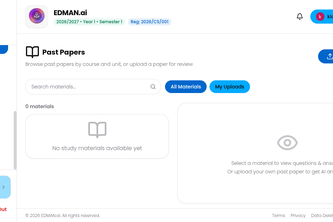
EDMAN.ai is a self-reported personal AI tutor for students, built by one developer (kioko muli), that uses real course materials as its training data. It is described as a multi-tenant platform with role-based dashboards and integrated M-Pesa payments, deployed in production at edmanaitutor.com.
What changed
The project was submitted to the OpenAI 2026 hackathon on Devpost. The author states it is live and in use, built end-to-end using Codex as an engineering partner.
Single most important open question
Is there evidence of actual student adoption or institutional usage beyond the author's claim?
Analysis basis
Self-reported only. No third-party verification, revenue, customer data, or traction metrics are available. All claims are from the project description and must be treated as unverified statements.
What The Product Actually Is
The description states that EDMAN.ai is:
- A 24/7 AI tutor accessible via web and mobile app.
- Trained on real course materials (lecturer notes, slides, past papers).
- Designed to teach, quiz, and track mastery per topic.
- A multi-tenant platform with five role-based portals: student, lecturer, admin, parent, superadmin.
- Integrated with M-Pesa for unit access payments.
- Built using Django REST Framework backend, Next.js + React frontend, vector store indexing (ChromaDB), OpenAI API, and deployment automation scripts.
Inference The product appears to be a learning platform that leverages AI to deliver personalized instruction based on specific course content. It includes features like voice lessons, auto-generated quizzes, gradebooks, and institutional management tools.
Evidence strength Self-reported. No independent confirmation of functionality or performance.
Positioning & Claim Evolution
The author positions EDMAN.ai as:
- A solution to the lack of one-on-one tutoring in resource-constrained environments (e.g., Kenya).
- An alternative to generic AI chatbots, emphasizing grounding in real course content.
- A tool that democratizes access to personal tutoring by making it available 24/7.
Claim evolution
The project evolved from a hackathon idea into a full production system. The author emphasizes:
- Using Codex for rapid development.
- Building a complete institution OS with multi-tenancy and payment integration.
- Focusing on real curriculum-based AI rather than generic AI tools.
Evidence strength Based entirely on self-description. No external validation or market positioning data provided.
Target Customer & ICP
The description states:
- The primary users are students in institutions where one lecturer teaches 300+ students.
- Institutions are the target customers, not individual learners.
- Role-based access includes student, lecturer, admin, parent, and superadmin.
- Payment is via M-Pesa, indicating a focus on Kenyan or East African markets.
Inference The ICP likely centers around educational institutions in low-resource settings that want to provide scalable tutoring support but lack the human resources for personalized instruction.
Evidence strength Self-reported. No data on actual customer segments or usage patterns.
Business Model & Pricing Evidence
The description states:
- Access is paid per unit via M-Pesa.
- The platform supports multi-tenant architecture with different roles and institutions.
- Payments are processed through the M-Pesa Daraja API.
Inference This suggests a freemium or pay-per-unit model, likely aimed at institutions rather than individuals. Pricing details are not specified.
Evidence strength Self-reported. No pricing tiers, revenue models, or customer acquisition costs mentioned.
Technical & Delivery Signals
The description states:
- Built with Django REST Framework (PostgreSQL), Next.js + React + TypeScript.
- Uses vector store indexing (ChromaDB) for retrieval-grounded AI.
- Integrated M-Pesa checkout flow.
- Deployment automation using Python + Paramiko scripts.
- Codex was used extensively for development, including UI fixes and deployment logic.
Inference The technical stack indicates a full-stack SaaS product with backend APIs, frontend dashboards, vector search capabilities, and payment processing. The use of Codex suggests rapid prototyping and iterative engineering.
Evidence strength Self-reported. No independent review or code audit available.
Traction & Maturity Signals
The description states:
- It is live in production at edmanaitutor.com.
- Used by real institutions.
- Built end-to-end by one person (kioko muli).
- Has been deployed and maintained in HTTPS mode with zero-downtime updates.
Inference There is evidence of a working product in production, but no data on user engagement, retention, or institutional adoption beyond the author’s claim.
Evidence strength Self-reported. No metrics, user counts, or usage analytics provided.
Competitive Context
The description does not mention any competitors directly. However, it implies:
- A niche in edtech focused on grounding AI in real curriculum.
- Competition with generic AI tutoring tools (e.g., ChatGPT, Copilot).
- Potential overlap with LMS platforms like Moodle or Canvas.
Inference The product positions itself as a specialized tool for curriculum-aligned AI tutoring, potentially filling a gap between general-purpose AI and traditional LMS systems.
Evidence strength Inferred from self-description. No competitive analysis or market positioning data provided.
Open Questions & Risks
- Single-founder model: The entire platform was built by one person (kioko muli), raising concerns about scalability, maintenance, and future development.
- Unverified traction: No evidence of real users or institutional adoption beyond the author’s claim.
- Limited commercial data: No pricing, revenue, or customer feedback available.
- Dependency on Codex: Heavy reliance on AI-assisted development may not be sustainable long-term without human oversight.
- Payment complexity: M-Pesa integration introduces risk related to asynchronous callbacks and payment failures.
Evidence strength Inferred from self-reported claims. No external validation of risks or mitigations.
Questions the description leaves open
- What is the actual number of institutions using the platform?
- How many students are currently enrolled or interacting with the system?
- What are the key challenges in scaling beyond one developer?
- Can you provide any anonymized usage data or feedback from users?
- How does the grounding mechanism prevent hallucinations when course materials are incomplete or ambiguous?
- What is the current payment processing success rate and failure handling strategy?
- Are there plans to expand beyond Kenya or M-Pesa?
Note
These questions aim to uncover gaps in the self-reported narrative.
Overall Assessment
The description states that EDMAN.ai is live and in production, built by one developer using Codex. It presents a compelling idea for addressing educational inequality through AI tutoring grounded in real curriculum content.
However:
- There is no evidence of revenue, customers, or traction.
- The single-founder model raises scalability concerns.
- No commercial metrics or financial data are available.
- The product’s maturity and long-term viability depend on further validation and expansion beyond the hackathon prototype.
Assessment This is a conceptually strong idea with early-stage execution. It requires deeper due diligence to assess whether it has moved beyond an experimental phase into a scalable, commercially viable model.
Confidence level Low — based solely on self-reported information, no independent verification or traction data.
User Stories BotA demo video on every pull request
Get a demo video on every new feature
GitHub App that watches your pull requests and records a narrated, captioned demo.
Save time on demo prep and make informed decisions faster with a video walkthrough of every new feature.
Source
Submitted to the OpenAI 2026 hackathon on Devpost. Project home on Devpost. Back to the full gallery on Devpost.
This competitive analysis was produced by top-founders.com (opens in a new tab)
Generated by a language model from this project's public Devpost page — its tagline, the author's own write-up and any built-with tags listed there — as captured in August 2026. Short quotations are the author's words. It is an opinion on the idea as a business, not on the people behind it, and it reflects the description as published then. If the project has moved on, request a correction below. The analysis is not independent research and contains no verified traction, revenue or customer data.
An independent guide by KFG International LLC — not affiliated with, endorsed by, or connected to Devpost or OpenAI.