

Archive position — measured, not model output
0 likes on Devpost
2,263 of the 7,850 archived projects have more likes, and 5,587 share exactly 0 — so this project's #5,836 place in the like-ranked listing is a tie-break inside that group, not a ranking.
Projects (log scale)
Likes on Devpost. ▲ marks this project's group.
Show the figures
| Likes | Projects | Share of archive |
|---|---|---|
| 0 | 5,587 | 71.2% |
| 1 | 1,758 | 22.4% |
| 2 | 284 | 3.6% |
| 3–4 | 132 | 1.7% |
| 5–9 | 75 | 1.0% |
| 10+ | 14 | 0.2% |
 User Stories BotA demo video on every pull request
Get a demo video on every new feature
GitHub App that watches your pull requests and records a narrated, captioned demo.
Save time on demo prep and make informed decisions faster with a video walkthrough of every new feature.
Executive Summary
Project: PatchQuest
Self-reported basis: Author's own description, submitted to the OpenAI 2026 hackathon on Devpost
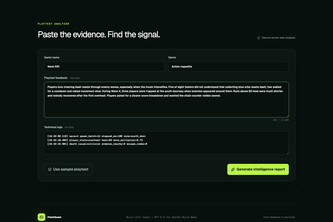
Commercial due-diligence read: PatchQuest appears to be a developer tool for indie game teams that processes qualitative playtest feedback and technical logs into structured reports with evidence-linked findings, prioritized action plans, and regression tests. It is built as a web application using AI (GPT-5.6) and modern frontend stack (Next.js, React, TypeScript). The description states it was built in a hackathon context and does not evidence revenue, customers or traction beyond the sample data and demonstration mode.
Key open question: Is there sufficient evidence of a real market need for this tool among indie game teams, or is this an experimental prototype with no commercial viability?
What The Product Actually Is
The description states that PatchQuest is a web application that turns playtest feedback and technical logs into structured reports. It uses AI (GPT-5.6) to process qualitative data and telemetry, producing:
- Structured findings
- Evidence-linked diagnoses
- Recommended fixes
- Effort estimates
- Prioritized action plans
- Acceptance criteria
- Regression tests
- Markdown export
It is built with Next.js 16, React 19, TypeScript, Tailwind CSS, Vercel AI SDK 6, OpenAI provider, and Zod. The system includes server-side validation and rate limiting.
Inference: It is a tool for indie game developers to synthesize playtest data into actionable output. It is not a chatbot but a structured workflow tool.
Positioning & Claim Evolution
The description states that PatchQuest was inspired by the difficulty of turning messy playtest feedback into actionable decisions, especially when teams rely on Discord threads or spreadsheets.
It claims to avoid generic summarization and instead produce structured, evidence-linked reports. It positions itself as a tool that:
- Identifies bugs, UX friction, performance risks, engagement signals, and moments of delight
- Preserves positive signals while ranking issues by impact
- Produces actionable fixes with clear acceptance criteria
It also claims to be built for indie teams who often lack structured workflows.
Inference: The positioning is that PatchQuest is a developer tool for indie game teams, aiming to improve the playtest synthesis process through AI and structured output.
Target Customer & ICP
The description states that PatchQuest is aimed at indie game teams who often finish playtests with Discord threads, spreadsheets, observations, survey answers, and technical logs.
It does not name specific roles or personas beyond "indie teams" and "developers". It implies a need for structured workflows in the playtest process.
Inference: The ICP is likely indie game developers or small development teams, with a focus on playtest data synthesis and prioritization.
Business Model & Pricing Evidence
The description does not state anything about pricing, monetization, or business model. It only describes the tool’s functionality and technical stack.
Not evidenced
Technical & Delivery Signals
The project is built using:
- Next.js 16
- React 19
- TypeScript
- Tailwind CSS
- Vercel AI SDK 6
- OpenAI provider
- Zod
It uses GPT-5.6 as its reasoning engine and includes:
- Server-side input validation
- Rate limiting
- Safe error handling
- Sample data for immediate testing
- A demonstration mode
The system is described as schema-validated, with GPT-5.6 output validated by Zod before rendering.
Inference: The tool is built with modern, scalable web stack and includes security and validation features typical of a production-ready prototype.
Traction & Maturity Signals
The description states that PatchQuest was built for a hackathon, and it includes:
- Sample data
- A demonstration mode
- A public deployment
It does not mention any revenue, customers, or usage metrics. It also does not state whether the tool has been used in real indie teams.
Not evidenced
Competitive Context
The description does not mention any competitors or similar tools. It only describes its own functionality and how it differs from generic summarization or chatbots.
Not evidenced
Open Questions & Risks
- No traction evidence: The tool is described as a hackathon project with no real-world usage.
- Unproven market need: No data on whether indie teams actually struggle with playtest synthesis or would pay for such a tool.
- AI dependency: Reliance on GPT-5.6 and Codex implies potential cost, availability, and control risks.
- Limited scope: The tool is described as a prototype with no mention of integration with existing tools (e.g., GitHub, Linear).
- Self-reported only: No third-party validation or user feedback.
Inference: The project may be an experimental idea rather than a commercial product. It lacks evidence of real-world adoption or demand.
Questions the description leaves open
- What is the actual problem you're solving, and how do you know indie teams struggle with it?
- Have you tested this tool with any real indie teams or playtest sessions?
- How would you monetize this tool if you were to build a product around it?
- What are the technical limitations of using GPT-5.6 for structured output at scale?
- Are there any existing tools that solve this problem, and how does PatchQuest differ?
Overall Assessment
The description states that PatchQuest is a hackathon project, built with a single developer (Ramadan Durguti). It is not evidenced to have traction, revenue, or customers.
Assessment: Not ready for investment or partnership. The tool is an experimental prototype with no commercial viability evidence. It may be a starting point for a product, but it lacks the maturity and market validation required for due-diligence consideration.
Confidence level: Low — based on self-reported description only, with no external corroboration.
User Stories BotA demo video on every pull request
Get a demo video on every new feature
GitHub App that watches your pull requests and records a narrated, captioned demo.
Save time on demo prep and make informed decisions faster with a video walkthrough of every new feature.
Source
Submitted to the OpenAI 2026 hackathon on Devpost. Project home on Devpost. Back to the full gallery on Devpost.
This competitive analysis was produced by top-founders.com (opens in a new tab)
Generated by a language model from this project's public Devpost page — its tagline, the author's own write-up and any built-with tags listed there — as captured in August 2026. Short quotations are the author's words. It is an opinion on the idea as a business, not on the people behind it, and it reflects the description as published then. If the project has moved on, request a correction below. The analysis is not independent research and contains no verified traction, revenue or customer data.
An independent guide by KFG International LLC — not affiliated with, endorsed by, or connected to Devpost or OpenAI.