

Archive position — measured, not model output
0 likes on Devpost
2,263 of the 7,850 archived projects have more likes, and 5,587 share exactly 0 — so this project's #7,757 place in the like-ranked listing is a tie-break inside that group, not a ranking.
Projects (log scale)
Likes on Devpost. ▲ marks this project's group.
Show the figures
| Likes | Projects | Share of archive |
|---|---|---|
| 0 | 5,587 | 71.2% |
| 1 | 1,758 | 22.4% |
| 2 | 284 | 3.6% |
| 3–4 | 132 | 1.7% |
| 5–9 | 75 | 1.0% |
| 10+ | 14 | 0.2% |
 User Stories BotA demo video on every pull request
Get a demo video on every new feature
GitHub App that watches your pull requests and records a narrated, captioned demo.
Save time on demo prep and make informed decisions faster with a video walkthrough of every new feature.
Executive Summary
What the company appears to be
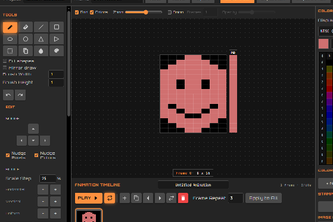
The author describes YAJA 2600 Animator as a sprite animator app for Atari 2600 game development. It is part of a suite of tools (including YAJA 2600 Painter and YAJA 2600 Composer) aimed at homebrew developers working on Atari 2600 games.
What changed
The project was submitted to the OpenAI 2026 hackathon. It is described as a one-person effort built using OpenAI Codex, with iterative development and testing in browser and real hardware environments.
Single most important open question
Is there any evidence of adoption or usage by the Atari homebrew community beyond the author’s own development and testing?
What The Product Actually Is
The description states that YAJA 2600 Animator is a tool for drawing, coloring, and animating Atari 2600 sprites. It supports features such as animation timing, positioning, onion skinning, reusable artwork, image references, and two-sprite designs. It can export projects as images or code (specifically batari Basic code) for use in Atari games.
It is built as both a browser and desktop application using technologies like HTML5, CSS3, JavaScript, Node.js, and Electron.
Evidence
- The author states it "lets people draw, color, and animate Atari 2600 sprites"
- It includes animation timing, positioning, onion skinning, reusable artwork, image references, and support for two-sprite designs
- Projects can be exported as images or code for Atari games
- Built using HTML5, CSS3, JavaScript, Node.js, Electron
Inference The tool is designed to integrate with the broader YAJA suite of tools.
Positioning & Claim Evolution
The author positions YAJA 2600 Animator as part of a creative development suite for Atari 2600 homebrew. It aims to make sprite animation more visual and approachable while preserving the hardware’s limitations and charm.
Evidence
- The tool is described as "the third tool in my creative suite for Atari 2600 homebrew development"
- The goal was to "make sprite animation more visual and approachable while preserving the charm and limitations of the original hardware"
Inference The positioning reflects a niche focus on retro game development, particularly within the Atari 2600 community.
Target Customer & ICP
The description implies that YAJA 2600 Animator targets homebrew developers working on Atari 2600 games. It is part of a suite of tools for this specific audience.
Evidence
- The tool is described as part of a "creative suite for Atari 2600 homebrew development"
- It supports exporting code for use in Atari games
Inference The target customer is likely a small, niche group of retro game developers or enthusiasts.
Business Model & Pricing Evidence
There is no evidence of any business model or pricing structure. The project is described as a personal tool built for the homebrew community.
Evidence
- No mention of monetization, pricing, or revenue streams
- The author states it was built by one person and is intended for the Atari homebrew community
Inference It appears to be a hobbyist or open-source project without a commercial model.
Technical & Delivery Signals
The tool is built using modern web technologies (HTML5, CSS3, JavaScript) and desktop app frameworks (Electron). It integrates with OpenAI Codex for development assistance. The author mentions iterative development and testing in browser and real Atari hardware.
Evidence
- Built with HTML5, CSS3, JavaScript, Node.js, Electron
- Used OpenAI Codex throughout development
- Developed through many small versions, tested in browser and real Atari 2600 programs
Inference The tool is technically feasible and designed for both desktop and web use.
Traction & Maturity Signals
There is no evidence of traction or adoption beyond the author’s own development. The project is described as "production ready" but not yet released to the public.
Evidence
- The author states it is a "working, production ready tool"
- It was submitted to a hackathon
- No mention of users, downloads, or community engagement
Inference The tool has reached a functional state but lacks external validation or adoption.
Competitive Context
No competitive landscape is described. The project appears to be unique within the Atari 2600 homebrew development space, as it is part of a suite of tools and not directly compared to others in the market.
Evidence
- No mention of competitors
- Described as part of a "creative suite" with other tools (YAJA 2600 Painter and YAJA 2600 Composer)
Inference The tool operates within a niche, possibly underserved, segment of Atari development.
Open Questions & Risks
- The project is self-reported and unverified.
- No evidence of revenue, customers, or adoption.
- It is a one-person project with no indication of scalability or team support.
- The tool is not yet released to the public, so its real-world utility is unknown.
Evidence
- No traction, revenue, or customer data
- One-person team
- Not yet publicly released
Inference The lack of external validation and commercial traction raises questions about viability and impact.
Questions the description leaves open
- What specific feedback has the author received from the Atari homebrew community?
- Has the tool been tested or used by others beyond the author’s own development?
- Are there any plans to monetize or commercialize the tool?
- How does the tool integrate with existing Atari development workflows?
- What is the long-term roadmap for the YAJA suite of tools?
Overall Assessment
Not evidenced.
Evidence
- No financials, revenue, or customer data
- No indication of commercial traction or scalability
- The project is described as a personal tool and not yet publicly released
Inference There is insufficient evidence to assess the potential for investment or partnership. The project appears to be in an early stage with no clear commercial path or market validation.
User Stories BotA demo video on every pull request
Get a demo video on every new feature
GitHub App that watches your pull requests and records a narrated, captioned demo.
Save time on demo prep and make informed decisions faster with a video walkthrough of every new feature.
Source
Submitted to the OpenAI 2026 hackathon on Devpost. Project home on Devpost. Back to the full gallery on Devpost.
This competitive analysis was produced by top-founders.com (opens in a new tab)
Generated by a language model from this project's public Devpost page — its tagline, the author's own write-up and any built-with tags listed there — as captured in August 2026. Short quotations are the author's words. It is an opinion on the idea as a business, not on the people behind it, and it reflects the description as published then. If the project has moved on, request a correction below. The analysis is not independent research and contains no verified traction, revenue or customer data.
An independent guide by KFG International LLC — not affiliated with, endorsed by, or connected to Devpost or OpenAI.